Exotic Shorthair Cat: The ‘Lazy Man’s Persian’ Explained
Your cat isn’t a Persian that got a haircut — though it’s fair to say the Exotic Shorthair is essentially a Persian in every way that matters, minus the coat that needs daily brushing. Breeders sometimes call it “the lazy man’s Persian,” a nickname that’s more about grooming effort than personality.
That same round, smooshed face has made this breed instantly recognizable, even showing up as the real-world inspiration behind a certain lasagna-loving cartoon cat. Spoiler: despite the reputation for laziness, the actual breed is a lot more playful than its famous fictional lookalike.
Quick Facts: Compact, cobby build. 10-12 inches at the shoulder, 10-12 lbs. Short, dense, plush coat in any color or pattern. Lifespan 8-15 years.
History: A Shorthaired Answer to the Persian
Breeders developed the Exotic Shorthair in the 1950s by crossing American Shorthairs (and in some lines, Burmese) with Persians, aiming to bring new coat colors and patterns into the Persian gene pool. What actually happened surprised everyone: the short-hair trait kept showing up, and breeders realized they’d created something genuinely new — all of the Persian’s signature look, in a coat that took a fraction of the maintenance.
The breed caught on quickly with people who loved the Persian’s face and temperament but couldn’t commit to daily brushing, and it’s remained a popular, recognizable breed ever since.
That accidental discovery is a fairly common story in the cat fancy — breeders setting out to solve one problem and stumbling onto an entirely new, marketable trait that ends up defining the whole project.
Exotic Shorthair vs. Persian: What’s Actually Different
Genetically and temperamentally, these two are close relatives — same round face, same cobby body, same gentle nature. The real difference comes down to the coat: Persian fur is long and silky, requiring daily brushing to prevent mats, while the Exotic Shorthair carries a short, dense, plush coat that resists matting and needs only weekly attention.
Personality-wise, the Exotic Shorthair tends to run slightly more playful and lively than its Persian ancestor, without quite reaching the acrobatics of more athletic breeds. If you love the Persian look but not the grooming commitment, this breed is built for exactly that trade-off.
Both breeds share the same known health considerations too, since the Exotic Shorthair’s Persian ancestry carries those genetic risks forward regardless of coat length — shorter fur doesn’t reduce the underlying facial-structure or kidney concerns either breed can pass on.
Physical Characteristics
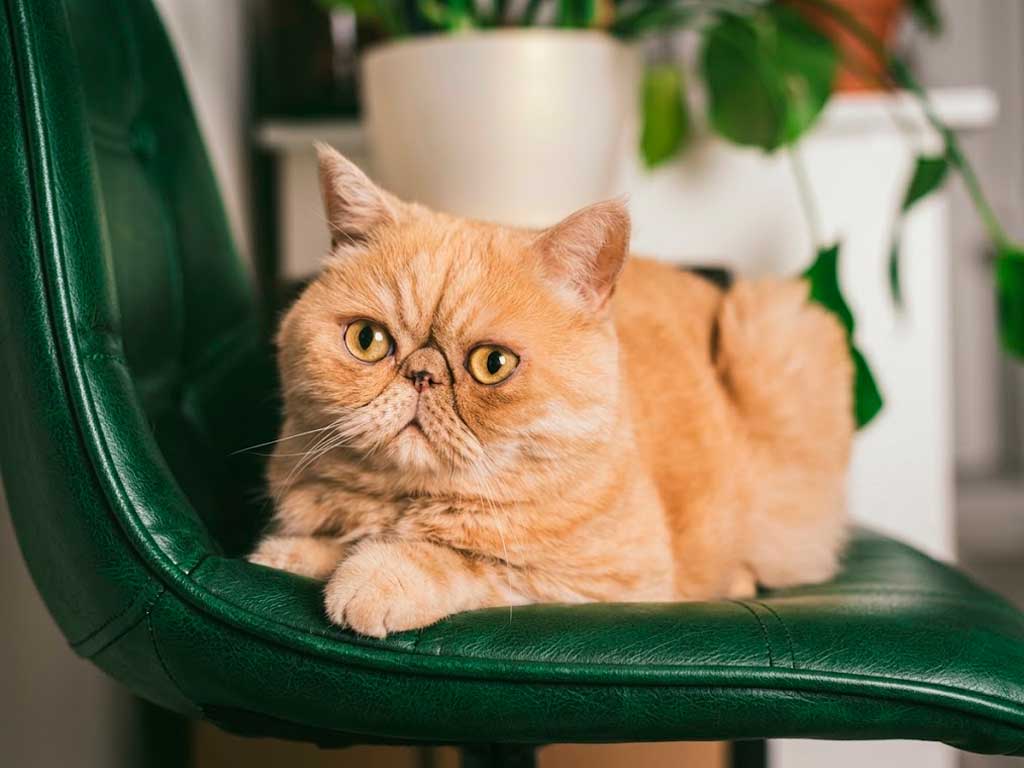
Everything about the Exotic Shorthair reads round: a round head, round eyes, a round, flat face, and a compact, cobby body carried low on short, sturdy legs. The coat comes in every color and pattern recognized in cats, from solid to tabby to bicolor to pointed.
Eyes run large and expressive, in green, yellow, or blue depending on coat color. That same flat-faced structure responsible for the breed’s charm is also the source of most of its health considerations, covered in more detail below.
The nose sits notably short and set high between the eyes, which is precisely the feature responsible for both the breed’s famously endearing expression and its breathing considerations covered later in this guide.
Personality and Temperament
Your cat isn’t lazy — it just prefers your company over acrobatics. Despite the nickname, Exotic Shorthairs are genuinely playful and curious, enjoying batting around toys and chirping at birds through the window, while generally skipping the shelf-to-shelf jumping more athletic breeds go in for.
They’re deeply affectionate with their own household and don’t do well left alone for long stretches. Patient with kids and generally compatible with well-mannered dogs and other cats, this breed thrives on companionship. With strangers, expect a warm-up period — Exotic Shorthairs can be a little reserved at first before settling into their famously loyal, friendly nature.
Positive-reinforcement training works well here, and many respond happily to praise, petting, and treats. One important note: leash and harness training isn’t recommended for this breed, since breathing difficulty and heat regulation issues linked to their flat face make exertion riskier than for a typical cat.
Vocally, Exotic Shorthairs stay on the quiet side, communicating more through presence and gentle chirps than persistent meowing — fitting for a breed that would rather be near you than demanding attention loudly.
Caring for an Exotic Shorthair
Grooming is the whole point of this breed’s existence, and it delivers: a weekly brushing session keeps the dense coat looking its best, with a bit more frequency during spring shedding. Baths generally aren’t necessary for coat health.
Eye care deserves real attention. Watery eyes and tear staining are common given the facial structure, so gently wiping the eye area with a warm, damp cloth helps prevent buildup. Ears need regular checking too, since the same compact facial structure makes this breed more prone to ear infections than average — clean gently and watch for odor or discharge.
Nail trims and dental care follow standard schedules — nothing breed-specific there beyond the usual consistency every cat benefits from.
Feed kittens three to four small meals daily as they grow rapidly, transitioning to two set meals a day in adulthood — free-feeding tends to encourage weight gain once cats mature, which matters more for this breed than most given the health risks tied to excess weight.
Health Conditions to Know
The Exotic Shorthair’s flat face is central to its charm and also the source of its main health considerations. Brachycephalic airway syndrome can restrict breathing and heat tolerance, especially in overweight, senior, or allergy-prone cats — open-mouth breathing is a medical emergency requiring immediate vet attention.
Congenital hydrocephalus, a rare but serious buildup of fluid in the brain, shows up more often in extremely flat-faced kittens; signs include a dome-shaped head, poor growth, circling, and loss of balance, usually appearing within the first year. Polycystic kidney disease (PKD), inherited from Persian ancestry, causes progressive kidney damage — genetic testing can identify carriers, and reputable breeders test before pairing cats.
Obesity carries extra risk in this breed specifically, since even modest weight gain worsens breathing difficulty in a cat already working harder to breathe due to face shape.
Health Disclaimer: This guide is for educational purposes only and doesn’t replace professional veterinary advice. Ask breeders for PKD DNA test results on both parents, and contact your vet immediately if your cat ever breathes with an open mouth.
Exotic Shorthair Price and Where to Find One
Kittens typically run $750 to $1,000 from a registered breeder, with retired adult breeding cats sometimes available for less. Given the shared health considerations with Persians, rescue groups specializing in either breed are worth checking for adoption options.
When comparing breeders, ask directly about hydrocephalus and PKD history in the line, and consider the degree of facial flattening on the parents — more moderate faces generally carry lower breathing risk than the most extreme, ultra-flat show-standard look.
Is an Exotic Shorthair Right for You?
This breed suits people who love the Persian look and gentle temperament but want a genuinely lower-maintenance coat. If a round-faced, affectionate lap cat that’s playful without being hyperactive sounds appealing, an Exotic Shorthair is a strong match.
It’s a tougher fit for anyone in a hot climate without reliable air conditioning, given this breed’s heat sensitivity, or for households wanting a leash-trainable, highly active cat. Your cat isn’t going anywhere fast. It’s going to be right there on your lap, exactly where it wants to be.
Apartment living works well too, since this breed has no real need for outdoor space or high-energy exercise — a comfortable window perch for bird-watching and a bit of daily play covers most of what it needs to feel content.
One last practical note: because breathing tolerance varies so much by individual face shape, spend time with a kitten’s parents in person if possible — it’s the clearest indicator of what your own cat’s health profile is likely to look like.
Frequently Asked Questions
Is an Exotic Shorthair just a short-haired Persian?
Essentially, yes — it shares the Persian’s face, body type, and temperament, with a short, dense coat instead of long fur, developed through deliberate crossbreeding in the 1950s.
Are Exotic Shorthairs actually lazy?
No, despite the nickname. They’re playful and curious, just less acrobatic than more athletic breeds, and genuinely enjoy interactive play with their people.
What health problems are Exotic Shorthairs prone to?
The main concerns tied to their flat-faced structure include brachycephalic airway syndrome and, rarely, congenital hydrocephalus. Polycystic kidney disease, inherited from Persian lines, is also a concern that reputable breeders screen for.
How much does an Exotic Shorthair cost?
Kittens typically range from $750 to $1,000 from a registered breeder.
Can Exotic Shorthairs be leash trained?
It’s not recommended. Breathing and heat regulation difficulties linked to their facial structure make leash walking and strenuous exercise riskier for this breed than for most cats.
An Exotic Shorthair delivers everything people love about the Persian — the round face, the gentle nature, the endless cuddliness — in a coat built for people who’d rather spend their time playing with their cat than brushing it.
Browse more breed profiles in the full Cat Breeds guide.