Birman Cat: Breed Guide, Personality & Price
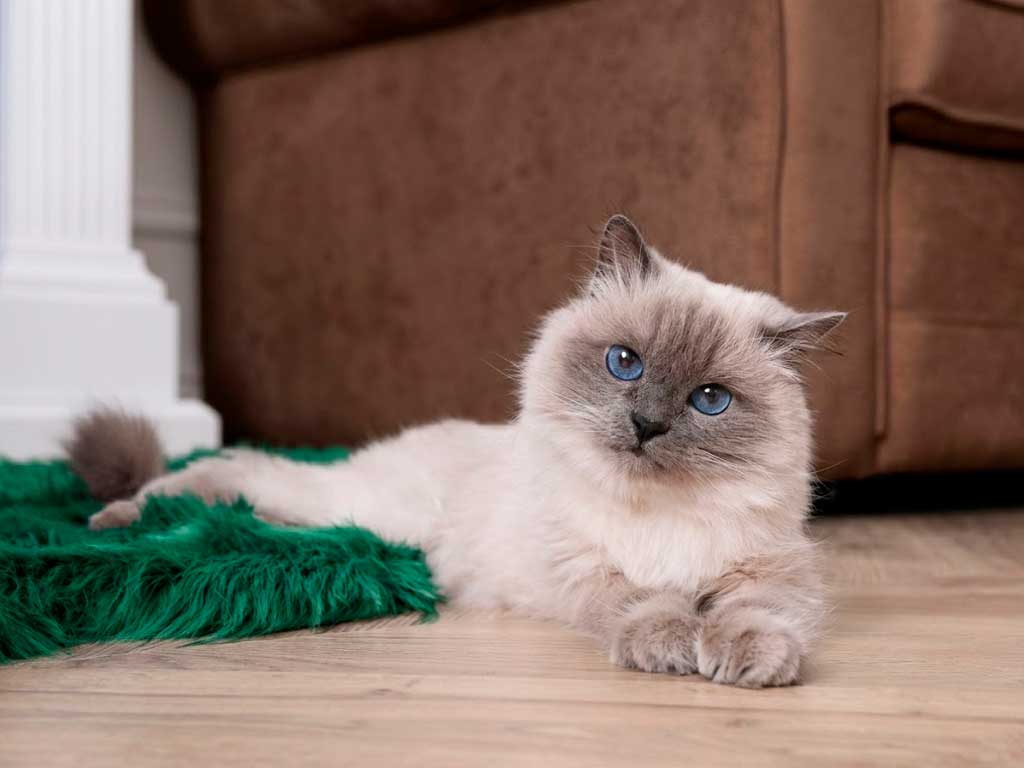
Your cat isn’t wearing socks by accident — legend says a goddess put them there. If you own a Birman cat, you own a breed wrapped in one of the most beautiful origin stories in the cat world, whether or not you believe a word of it.
The tale goes like this: a temple priest in ancient Burma was dying, and his loyal white cat pressed its paws to him at the moment of death. A goddess transformed the cat, turning its eyes sapphire blue and its paws pure white, wherever they touched the priest’s white beard. Did it sound too good to be a real breed history? It is. Here’s what actually happened, and everything else worth knowing before bringing one home.
Quick Facts: Medium to large, well-muscled, semi-long silky coat with no undercoat. Males 10-15 lbs, females 7-12 lbs. Lifespan 12-16 years, some reaching 18+. Sapphire-blue eyes and white “gloved” paws on every purebred Birman.
History: Sacred Legend Meets Documented Reality
The romantic version credits the goddess Tsun-Kyan-Kse with creating the breed at a Burmese temple. The documented version is quieter but still remarkable: a breeding pair was shipped from Burma to France around 1919, and the pregnant female became the true foundation of the breed. The first officially recorded Birman, a kitten named Poupée de Madalpour, was born in Nice in 1920.
The name itself comes from “Birmanie,” the French word for Burma. The breed reached the United States in 1959 and earned CFA registration in 1967.
World War II nearly ended the Birman entirely. By the war’s end, only two cats were known to survive in Europe — a pair named Orloff and Xenia de Kaabaa. French breeders spent the following years rebuilding the breed almost from scratch, outcrossing with Persians and Siamese to restore a healthy, viable population. By the early 1950s, pure Birman litters were being produced again.
Whichever version you prefer, both point to the same conclusion: this is a breed that arrived in the West already carrying an air of mystery, and it never really lost it.
Physical Characteristics
Birman kittens are born completely white — no points, no gloves, nothing. Color develops gradually over the first several months, which means a kitten’s final look often isn’t fully apparent for a while, one of the more dramatic transformations in the cat world.
The signature trait is the white “gloves”: symmetrical white markings on all four paws, extending up the back of the hind legs in a pattern breeders call “laces.” Getting that symmetry right is one of the hardest standards to breed for consistently, and it’s the single most scrutinized feature in the show ring.
Beyond the gloves, Birmans carry deep sapphire-blue eyes, a broad rounded head, and a body that’s more substantial than it looks under that silky coat. Point colors include the classic seal, blue, chocolate, and lilac, plus red, cream, tabby, and tortie variations that have been added to the standard over time. A faint golden warmth on the back and sides, called “golden mist,” is considered a desirable extra touch.
Fun fact for anyone tracking Birman lineage: many breeders still follow a French tradition of naming every kitten born in a given year with the same starting letter, cycling through the alphabet year after year — a small but charming holdover from the breed’s earliest French roots.
Personality and Temperament
Your cat isn’t just following you around — it’s genuinely helping, or at least it thinks it is. Birmans are famous for showing up wherever there’s activity, offering quiet supervision on everything from folding laundry to answering email.
They’re patient and even-tempered almost to a fault, which makes them a strong match for households with kids, seniors, or other pets. Vocally, Birmans lean soft and chirpy rather than demanding, though many become chattier the more their owners respond to them.
This is a genuinely social breed that doesn’t handle long stretches of isolation well. If your household is empty most of the day, a second cat tends to make a real difference in how content a Birman feels.
They tend to take about three years to reach full physical maturity, so that patient, easygoing temperament often shows up well before the body has finished filling out.
Caring for a Birman
Diet needs are standard for the breed’s size — a quality food matched to life stage, with portion control mattering more as cats age. Birmans run on the lower-energy side, which makes weight gain a gradual, easy-to-miss issue worth watching for at every vet visit.
Grooming is more manageable than most long-haired breeds. With no dense undercoat, the coat resists matting far better than a Persian or Maine Coon’s does. Two to three brushing sessions a week with a soft slicker brush or wide-tooth comb, paying extra attention to the ears, armpits, and collar area, covers most of it. Many Birmans actually tolerate bathing better than average, since the coat handles water without turning into a tangled mess.
A companion that provides both mental and physical enrichment matters too, even for a lower-energy breed. Wand toys, puzzle feeders, and a window perch for bird-watching go a long way toward keeping a Birman engaged without demanding constant active play.
Keep those famous white gloves clean too — pale fur shows litter and stains more easily than a solid dark coat, so a quick paw check now and then goes a long way.
Health Conditions to Know
Birmans are a generally healthy breed, but two hereditary conditions are worth understanding before you buy or adopt.
Hypertrophic cardiomyopathy (HCM) is the most significant concern — a thickening of the heart muscle that can progress toward heart failure if undetected. Responsible breeders screen breeding cats via echocardiogram performed by a cardiologist. Polycystic kidney disease (PKD) causes fluid-filled cysts to develop in the kidneys over time; a straightforward DNA test identifies carriers before breeding.
Dental disease and gradual weight gain round out the more routine concerns, neither of which is breed-specific but both worth staying ahead of with regular checkups.
Health Disclaimer: This guide is for educational purposes only and doesn’t replace professional veterinary advice. Ask any breeder for cardiac clearance and PKD DNA test results on both parents, and keep up with annual wellness exams as your Birman ages.
Birman Cat Price and Where to Find One
Kittens from a registered breeder commonly start around $1,000 to $2,000, with price shifting based on color, lineage, and breeder reputation. Given the breed’s popularity, most CFA shows include at least a few Birmans, making shows a genuinely useful way to meet breeders face to face.
If you’re flexible on color or sex, finding a kitten usually isn’t difficult. A specific blue point or a particular lace pattern, though, may mean a longer wait.
Pet insurance is worth setting up from day one rather than waiting — cardiac conditions and routine dental work can add up over a 12 to 16 year lifespan, and coverage is cheaper and easier to obtain before any issue shows up on record.
Is a Birman Cat Right for You?
This breed suits nearly every kind of household — families with kids, first-time cat owners, retirees, multi-pet homes. Few pedigreed breeds adapt as broadly or ask for as little in return for genuine devotion.
It’s a less natural fit for anyone who’s away from home constantly without another pet in the house, or who wants a completely hands-off coat. Your cat isn’t asking for much. It’s just asking to be near you, consistently, for the next 15 years or so.
Apartment living suits this breed well too — Birmans are calm indoors, don’t need a yard to feel satisfied, and generally settle into a stable routine without much fuss over space.
Frequently Asked Questions
Why do Birman cats have white paws?
The white “gloves” are a genetic trait bred into the breed standard, extending up the back legs in a lace pattern. Legend attributes them to a goddess; genetics attributes them to a specific inherited gene.
Are Birman kittens born white?
Yes. Birman kittens are born completely white, with their point coloring and gloves developing gradually over the first several months of life.
How much does a Birman cat cost?
Kittens from registered breeders typically start around $1,000 to $2,000, depending on color, lineage, and breeder.
Do Birman cats need a companion?
Not strictly required, but strongly recommended for households where the cat is regularly home alone, since Birmans are social and dislike extended isolation.
What health tests should I ask a Birman breeder for?
Cardiac clearance via echocardiogram and a PKD DNA test on both parents are the two most important screenings to confirm before buying.
A Birman cat carries a legend in its paws and a genuinely gentle nature in everything else. Whether you believe the temple story or stick with the documented one, what you end up living with is one of the most consistently affectionate breeds in the cat world.
Browse more breed profiles in the full Cat Breeds guide.