Copadichromis Borleyi: Care Guide for the Red Fin Kadango
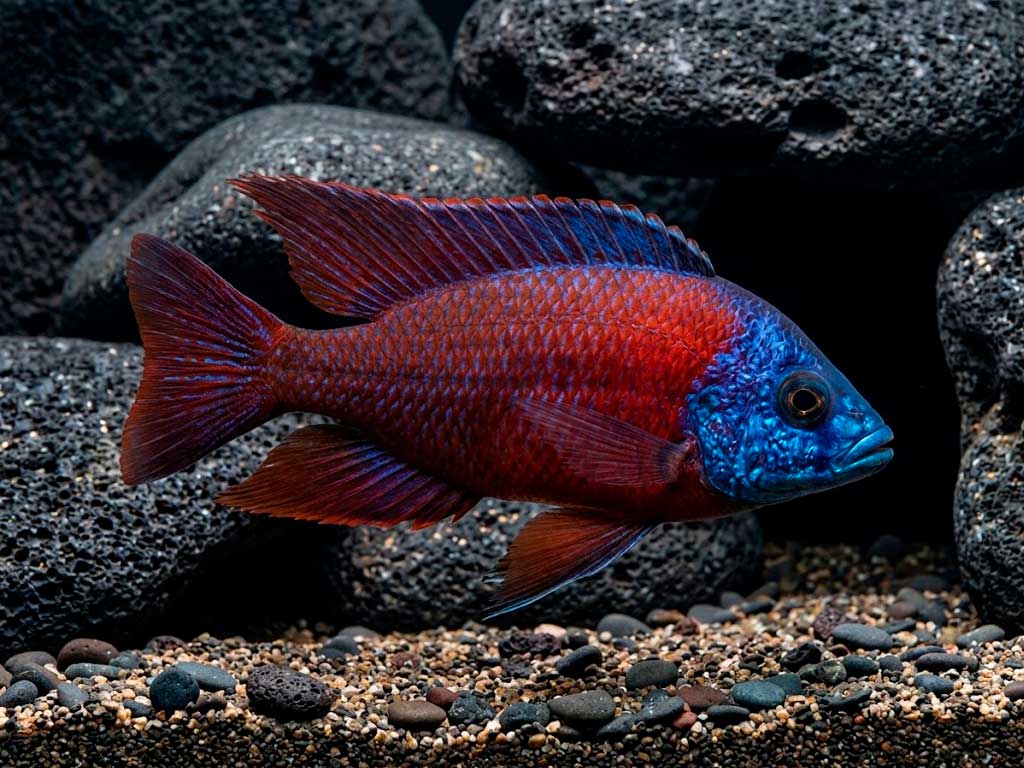
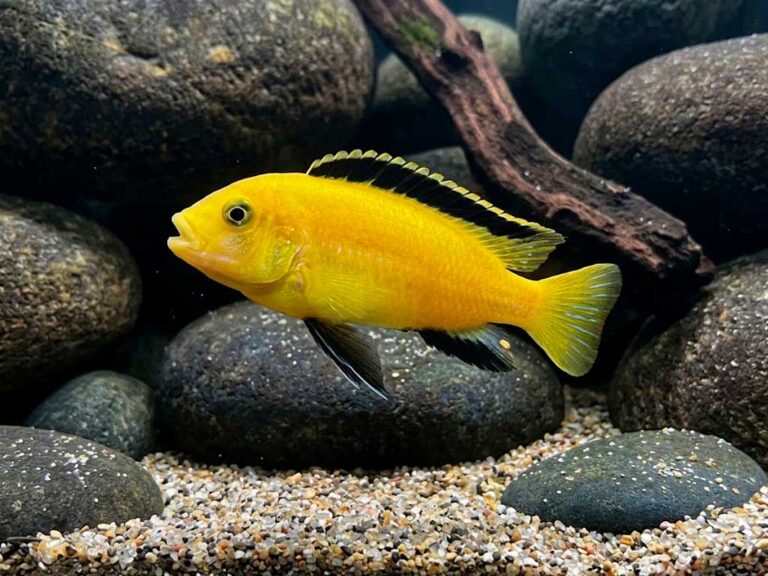
Copadichromis borleyi is named for the fins of its plainest fish: the red fins in the common name belong to females and juveniles, while adult males turn yellow or orange with a blue head. In practice, that color split and the strong local variation across Lake Malawi explain why one species shows up in shops as red fin kadango, yellow fin borleyi, goldfin hap, and more.
This guide covers the open-water lifestyle behind its shoaling behavior, the local forms, what the tank needs, and why fights between males matter more than the fish’s peaceful reputation suggests.
Quick Identity Card
| Trait | Detail |
| Scientific name | Copadichromis borleyi (Iles, 1960), originally Haplochromis borleyi |
| Common names | Red Fin Kadango, Kadango, Red Fin Borleyi, Yellow Fin Borleyi, Redfin Hap, Goldfin Hap |
| Family | Cichlidae (utaka, Lake Malawi) |
| Origin | Lake-wide in Lake Malawi, at rocky outcrops and boulders |
| Adult size | Males 15 to 20 cm (6 to 8 in), females about 15 cm; some sources list less |
| Diet | Planktivore, zooplankton and phytoplankton in open water |
| Temperament | Peaceful in a community; males fight each other |
| Water temperature | 24 to 26°C (75 to 79°F); 23 to 28°C reported |
| pH | 7.5 to 8.5 |
| GH (hardness) | Roughly 8 to 20 dGH |
| Minimum tank | At least 150 cm long, about 300 to 500 L |
| Lifespan | Reported at 7 to 8 years |
| Breeding | Maternal mouthbrooder, easy |
| IUCN status | Least Concern |
A Utaka in Your Aquarium
Copadichromis borleyi belongs to the utaka, a group of Malawi cichlids specialized for open-water life. SeriouslyFish explains that Copadichromis and the genus Mchenga together form this group, which lives in huge numbers across much of the lake.
The utaka feed on plankton drifting in the water column, which explains the shoaling behavior and the active swimming that set these fish apart from rock-dwelling mbuna.
Borleyi keeps closer to the rocks than most utaka. Malawi.si describes it in open water close to the shoreline and in intermediate habitat, usually near rocky areas and large boulders at an average depth of around 10 meters.
Two details help with identification: a protrusible mouth and three small lateral spots, which are often reduced or absent in some populations, plus elongated pelvic fins in mature males.
Names, Local Forms, and a Tangled Genus
Thomas Iles described the species in 1960 as Haplochromis borleyi, in a paper about zooplankton-feeding Haplochromis in Lake Nyasa. Older sources also list Cyrtocara borleyi as a synonym, which connects it to the genus story in the blue dolphin cichlid guide, where Cyrtocara served for years as a temporary home for many Malawi haplochromines.
Malawi.si gives Nkhata Bay as the type locality. According to Frank Schäfer, the name Kadango refers to a place in the southeast of the lake, and Fishipedia even carries a separate page for a Kadango form. Animal-World adds names such as Chakhuta, Liuli, and Sambia Reef for local populations.
Male color and female fin color both vary by locality, and malawi.si documents forms such as the Lupingu population from Tanzania. A captive OB (orange blotch) strain adds to the naming pile. Because of that variation, Fishipedia advises against mixing several varieties of the same species, to avoid hybrids.
Where the Red in Red Fin Comes From
Females and juveniles are pewter grey to beige, sometimes yellowish, with yellow, orange, or red fins depending on locality, and those fins earned the common name. Adult males develop a blue head, often elongated pelvic fins, and a yellow to orange body with blue fins, in a pattern that varies by population.
Frank Schäfer notes that males change color drastically when they become sexually active. At first they look a bit like Placidochromis electra, and then they turn into some of the most colorful fish in Lake Malawi.
Size varies with the source. Malawi.si gives 18 cm for males and 15 cm for females, and SeriouslyFish says a male can top 20 cm. Fishipedia and AquaRank list only 14 cm, so plan for the larger figure.
Origin and Natural Habitat
Malawi.si reports a lake-wide distribution, present at virtually all known rocky outcrops, while Animal-World says it is missing from Likoma and Chizumulu Islands.
SeriouslyFish places it in water 5 to 20 meters deep, associated with rocky areas or isolated boulders, where it shoals in the open in large numbers, often alongside other species. Recorded localities include Kadango, Nkhata Bay, Mpanga Rocks, Mbenji Island, and Nkhungu Reef.
Behavior and Temperament: The Male Problem
Toward other species this is a calm fish. Malawi.si calls it generally peaceful and well suited to community tanks with similarly calm cichlids, and Animal-World says it turns territorial mainly at spawning time.
Toward its own kind, males are another matter. Fishipedia says dominant males cannot stand each other and that fights between two individuals can be intense and violent, ending in submission and sometimes death, so it strongly advises against keeping several males in one tank. Malawi.si suggests one male with two or three females, and allows larger groups with several males only if each male has access to several females.
This is a gregarious fish, and Fishipedia recommends at least five individuals with about three females per male. SeriouslyFish adds an odd social detail: a female removed from the colony for too long may lose her place in the pecking order.
Diet and Feeding
In the wild it feeds mainly on phytoplankton and zooplankton in open water, and it takes invertebrates and other microorganisms when plankton is scarce. In the aquarium, Frank Schäfer says it accepts any usual fish food, and retailers list spirulina flake, brine shrimp, mysis, and pellets. Sources call the diet carnivorous or omnivorous, and small portions of varied foods work either way.
AquaRank says the species is very sensitive to nitrites, so strong filtration and regular water changes matter, and one UK retailer links regular water changes to avoiding bloating. The feeding guide for ornamental fish covers building a balanced rotation.
Tank Requirements and Water Parameters
Length matters more than any other number. SeriouslyFish says the tank shouldn’t be smaller than 150 x 45 x 45 cm (about 300 L), malawi.si asks for 400 L, and Fishipedia asks for 500 L for a group of five. Animal-World and retailers list 55 to 90 US gallons as minimums, which sits below the specialist figures.
Build with large open sandy areas and a few larger rocks or boulders, leaving open water for swimming. AquaRank says plants are not harmed, and one retailer advises against wood, which tends to lower pH. The African cichlid tank setup guide covers the general Malawi build.
Water needs to stay hard and alkaline: temperature between 24 and 26°C (75 to 79°F), with 23 to 28°C reported, pH from about 7.5 to 8.5, and general hardness of roughly 8 to 20 dGH depending on the source. Fishipedia suggests 20 to 30 percent water changes monthly, though the nitrite sensitivity noted above argues for more frequent ones.
Tankmates and Compatibility
Similarly calm cichlids make the best partners. Two gentle fish covered in this series are the blue dolphin cichlid and the flavescent peacock, though the tank has to be large enough for all of them. One retailer lists the species as community safe with African cichlids only, and a calm shoaling fish is a poor match for aggressive mbuna.
Breeding
Breeding is rated easy. Fishipedia gives ideal conditions around 25°C and pH 8, and one retailer says males are ready to breed at about one year. In the wild, males defend spawning sites next to large boulders, often spawning against vertical rock faces or under overhangs, and some populations build shallow sand platforms on rocks as spawning arenas, according to malawi.si. The female incubates the eggs in her mouth.
SeriouslyFish notes that the fry are large enough for Artemia nauplii and crushed dried foods as soon as the mother releases them. Some breeders strip the fry from the female’s mouth at about two weeks, an approach it labels strictly for experts.
Conservation Status: Rocks as Refuge
The IUCN rates Copadichromis borleyi Least Concern, a rating recorded in 2006 and repeated by Fishipedia and Animal-World. Ad Konings explains why: it belongs to the few utaka only marginally affected by the massive over-fishing in Lake Malawi. Utaka are the group hit hardest by local fishermen, but borleyi stays close to rocky habitat and large boulders, and the chirmila nets used for utaka fisheries can’t be used near rocky substrates.
That makes a useful contrast with the sand-dwelling blue dolphin cichlid, whose decline is tied to net fishing. For buyers, captive-bred fish are the norm, and wholesale listings supply captive-bred juveniles at 4 to 8 cm.