The Hungarian Vizsla: Gold in Motion, Heart in Hand
The Hungarian Vizsla is the breed that ruins you for all others.
Ask any Vizsla owner — they’ll tell you the same thing. There’s something about this dog’s combination of golden warmth, athletic elegance, and absolute emotional devotion that gets under your skin in a way few breeds can match. It’s no coincidence that Vizsla ownership tends to be a lifestyle, not just a pet decision.
But the Vizsla comes with a reputation that’s worth understanding before you commit: this is the velcro dog of the gundog world. It bonds with an intensity that is genuinely touching — and genuinely demanding. A Vizsla that doesn’t get enough time, exercise, and human connection will tell you about it, loudly and destructively, until it does.
In this guide, you’ll get the complete picture: a 1,000-year history carved in Carpathian stone, a near-extinction story that reads like a thriller, and everything you need to know about temperament, care, training, and health — so you can make the best possible decision for you and for the dog.
History and Origin of the Hungarian Vizsla
The Hungarian Vizsla may be the most historically documented hunting breed in existence.
Stone carvings discovered in the Carpathian Mountains, dating back approximately 1,000 years, depict a Magyar nomad hunting with a falcon — and a dog unmistakably similar to the modern Vizsla standing at his side. That image places this breed firmly in the medieval world of the Hungarian plains, working alongside the Magyar tribes who swept into Central Europe around the 10th century.
For centuries, the Vizsla was the hunting companion of choice for the Hungarian nobility and aristocracy. These dogs were treasured possessions — bred with extraordinary care for their scenting ability, pointing instinct, retrieving skill, and exceptional temperament. Historical records mention the breed repeatedly across medieval Hungarian manuscripts. This wasn’t a working dog kept in kennels; it was a companion to kings and lords, living in the castle alongside its owners.
Here’s where the story turns dramatic.
The two World Wars very nearly erased the Vizsla from existence entirely. Hungary was devastated by both conflicts, and with the country, its dog breeds suffered catastrophically. By the end of World War II, the Vizsla population had collapsed to near-extinction levels. The breed’s survival is directly credited to the extraordinary efforts of a small group of dedicated Hungarian breeders — who, facing the threat of the advancing Soviet occupation, smuggled breeding stock out of Hungary in secret, preserving enough genetic diversity to rebuild the breed.
That act of devotion under impossible conditions is the reason the Vizsla exists today.
The breed was subsequently re-established in Austria, Western Europe, and eventually the United Kingdom and United States, where it has grown steadily in popularity. One fascinating footnote that survived the centuries: the Vizsla is said to retain a natural affinity with birds of prey, a legacy of its centuries-long partnership with falconers. Some enthusiasts still work Vizslas alongside hawks and falcons today.
Physical Characteristics
The Hungarian Vizsla is a medium-sized, robustly built dog with a noble bearing that immediately signals its aristocratic heritage.
Size:
- Males: 57–64 cm tall
- Females: 53–60 cm tall
- Weight: 20–30 kg for both sexes
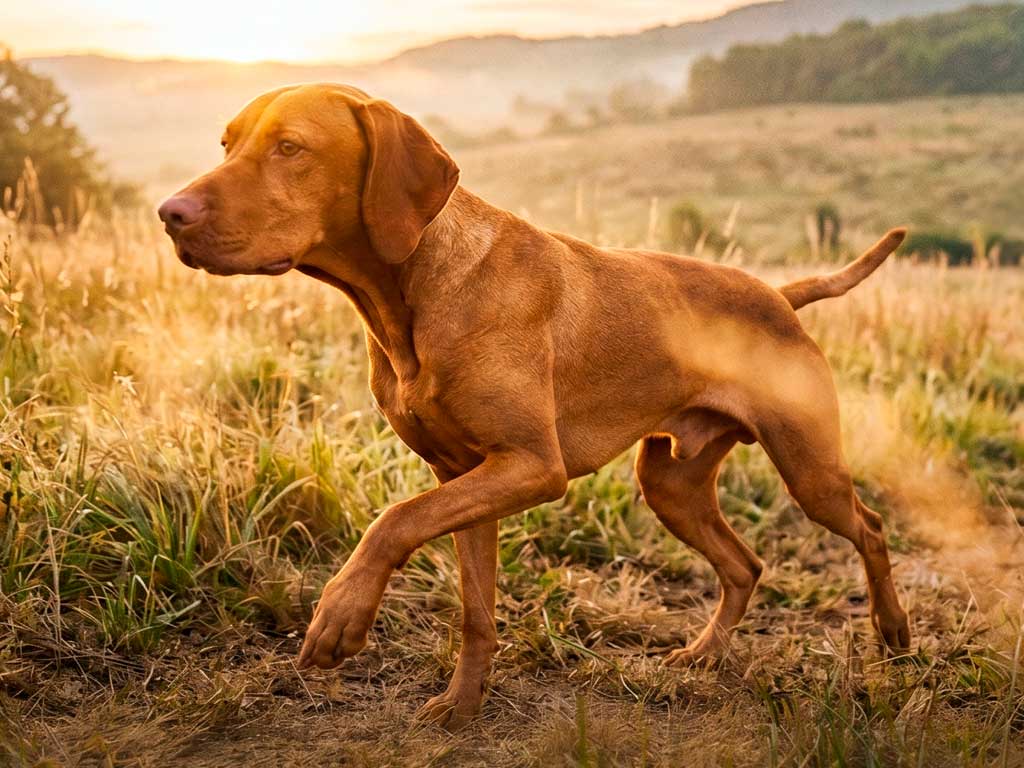
The coat is the breed’s most immediately striking feature — short, dense, flat, and possessed of a distinctive rich golden-rust color that is unlike any other breed. The shade ranges from a warm sandy gold to a deeper, burnished copper. Notably, the Vizsla’s nose, eye rims, lips, and nails all carry the same golden-rust pigmentation, creating a remarkable visual harmony across the entire dog. There are no markings, patches, or ticking — just that single, luminous color from nose to tail.
The coat has a slightly oily, close-lying texture that makes it naturally water-resistant and easy to keep clean. This quality — combined with the breed’s characteristic tendency to groom itself almost cat-like — makes the Vizsla one of the most effortlessly presentable large breeds in any setting.
The body is lean and muscular, built for speed and endurance in equal measure. The head is noble and well-proportioned, with a broad skull, a strong muzzle, and warm, expressive brown eyes that closely match the coat color. The ears hang close to the cheeks, framing a face that many owners describe as almost human in its expressiveness.
A wirehaired variety of the Vizsla also exists — the Wirehaired Vizsla — which has a rougher, denser coat and a slightly heavier build. However, the smooth-coated Hungarian Vizsla is significantly more common worldwide and is the focus of this guide.
Temperament and Personality
Here is where the Hungarian Vizsla truly distinguishes itself — even within the competitive company of the HPR breeds covered in this series.
The Vizsla is described as possessing a character unlike any other — joyful, affectionate, playful, and emotionally tuned to its family in a way that borders on the uncanny. It is a sensitive dog. Deeply sensitive. This isn’t the kind of breed that shrugs off a harsh word or bounces back instantly from a difficult training session. The Vizsla feels things acutely, and its emotional weather will reflect yours.
Several defining personality traits set this breed apart:
- The Velcro Effect. The Vizsla earned its famous nickname honestly. This dog wants to be physically close to its people — not in the same house, not in the same room, but right next to you, ideally touching. On the sofa, on the bed, across your feet under the desk. If velcro-intensity bonding doesn’t appeal to you, this is genuinely not your breed.
- Cheerful and playful. The Vizsla approaches life with a lightness and joy that is genuinely infectious. It loves to play, loves to learn, and brings enthusiasm to almost everything it does. Owners frequently describe the breed as eternally puppyish in its energy and delight.
- Naturally protective. Without being a guard dog by profession, the Vizsla is attentive and watchful over its family. It will notice strangers and alert you — though its friendly temperament means it’s unlikely to be aggressive without genuine cause.
- Sensitive to training approach. This point cannot be overstated. A Vizsla trained with patience, positivity, and consistency blossoms into an extraordinary partner. One trained with harsh corrections or inconsistency shuts down, becomes anxious, and loses confidence rapidly. The sensitivity that makes this breed so emotionally rewarding is the same quality that makes gentle handling non-negotiable.
- Needs human company. The flip side of that velcro bond is a breed that struggles profoundly when left alone for extended periods. An under-stimulated, isolated Vizsla will express its distress through barking, chewing, and general household disruption. This is not a breed that can be parked in a garden while you work a full day.
The Vizsla is also notably good with children — though its energy and size mean all interactions with young kids benefit from supervision. With other dogs, it is generally sociable and friendly, particularly when well-socialized from puppyhood.
Care Guide
Diet and Nutrition
The Hungarian Vizsla is a medium-to-large, highly active breed with a healthy appetite and specific nutritional requirements. Feed a high-quality diet formulated for active dogs of this size, with a strong emphasis on animal protein to support lean muscle mass.
Key feeding principles for the Vizsla:
- Feed twice daily. Two measured meals per day is the standard recommendation. Avoid leaving food down all day (free-feeding), which makes portion control difficult and can encourage overeating.
- Follow the guidelines for your specific food. Different formulas have different caloric densities. Use the feeding guide for your chosen food as a starting point, then adjust based on your dog’s body condition — you should be able to feel the ribs with gentle pressure but not see them prominently.
- Always provide fresh water. Particularly important for an active breed that may lose significant fluid through exercise.
- Adjust for activity level. A Vizsla working or running intensively needs significantly more calories than one resting through a quiet week. Feed to what the dog is actually doing, not to a fixed number.
- Watch for bloat risk. Like other medium-to-large deep-chested breeds, the Vizsla carries some elevated risk for gastric dilatation-volvulus. Avoid vigorous exercise for at least an hour after meals, and consider splitting the daily ration into two or three portions rather than one large feeding.
Consult your vet to tailor a feeding plan to your individual dog’s age, weight, reproductive status, and activity level. Nutritional needs change significantly across the dog’s life stages.
Exercise Requirements
Two hours of vigorous exercise every day is the minimum baseline for an adult Hungarian Vizsla — and the emphasis on vigorous is deliberate.
This is a dog built for the Hungarian plains — open, fast terrain where it could run at full stretch for hours. In a suburban or urban context, that instinct needs an outlet. Off-lead runs in open countryside, retrieving sessions on land and in water, agility training, and structured field work are all ideal. Swimming is particularly highlighted as a favourite activity, delivering full-body exercise that’s easier on joints than hard-surface running.
The Vizsla also adapts well to a wide range of dog sports — from HPR field trials and tracking to agility circuits and canicross. Any activity that engages both the body and the brain simultaneously suits this breed well.
One important distinction from some of the other HPR breeds covered in this series: the Vizsla’s exercise needs, while significant, are paired with a genuine adaptability to different lifestyles — provided the daily exercise minimum is met. An active urban owner who commits to two serious exercise sessions per day and keeps the dog engaged can make it work. What the Vizsla cannot adapt to is neglect of that minimum.
As always, puppies are the exception. Avoid sustained high-impact exercise until growth plates close around 18 months. Supervised play, short walks, and mental stimulation are appropriate at that stage.
Grooming Needs
The Hungarian Vizsla is, almost without exception, the easiest of all the HPR breeds to keep groomed.
The short, flat, slightly oily coat requires almost no maintenance. A light brush-through with a soft bristle brush or rubber grooming mitt once a week removes dead hair, distributes natural oils, and keeps the coat gleaming. The breed’s natural tendency toward self-grooming means it rarely develops that distinctive “dog smell” that plagues owners of other breeds — many Vizsla owners report bathing their dogs only a handful of times per year.
Beyond the coat, standard routine care applies:
- Ears: Check and clean weekly. As with all drop-eared breeds, moisture can accumulate after swimming, increasing infection risk. Dry the ears thoroughly after water activities.
- Nails: Trim monthly, or check regularly if the dog is exercising on hard surfaces that wear nails naturally.
- Teeth: Brush several times per week. Dental hygiene is the most commonly neglected aspect of dog care and one of the most impactful for long-term health.
- Eyes: Wipe gently with a clean damp cloth as needed to remove any discharge at the inner corner.
For owners who spend a great deal of time on exercise, training, and engagement — which Vizsla ownership requires — the minimal grooming burden is a genuine quality-of-life advantage.
Training and Education
Training a Hungarian Vizsla is one of the great pleasures of working with dogs — when it’s done right.
The Vizsla is enthusiastic, intelligent, and deeply motivated by positive interaction with its handler. It picks up new skills quickly, generalizes well to different environments, and responds with evident joy to reward-based training. This is not a breed that needs convincing to engage. It wants to work with you. The challenge is channeling that enthusiasm effectively and protecting the sensitive temperament from approaches that would undermine it.
The cardinal rule: keep it positive. Harsh corrections, punishment-based methods, or even a sharp tone of voice can set a Vizsla back significantly. A dog that has lost confidence in its handler becomes hesitant, anxious, and difficult to progress. Conversely, a Vizsla trained with patience, clarity, and generosity of spirit develops into a partner that is genuinely exceptional — responsive, creative, and joyful in its work.
Practical training guidance for the Vizsla:
- Start socialization immediately. From the first week home, expose your puppy to a wide variety of people, environments, animals, sounds, and situations. The Vizsla’s adult temperament — how it responds to novelty, strangers, and unexpected situations — is shaped overwhelmingly by these early weeks.
- Enroll in puppy classes early. Structured group training develops both obedience and social skills simultaneously. The Vizsla thrives in class environments where there’s interaction, variety, and positive reinforcement flowing steadily.
- Make training fun. Incorporate play, vary the exercises, use food rewards generously, and celebrate effort as much as achievement. The Vizsla’s joy in learning is one of its greatest qualities — protect it by making every session something the dog looks forward to.
- Be consistent with rules. The Vizsla’s intelligence means it will probe for inconsistencies in household rules and exploit them with cheerful efficiency. Clear, consistent boundaries established from day one make ongoing management significantly easier.
- Consider dog sports or field work. For owners interested in going beyond basic obedience, the Vizsla excels in HPR field trials, tracking, agility, and even flyball. These structured outlets honor the breed’s working instincts and deepen the human-dog bond profoundly.
The Vizsla is classified as suitable for owners with some experience — not because it is especially difficult, but because its sensitivity and exercise demands require someone who understands what they’re committing to.
Health and Longevity
The Hungarian Vizsla enjoys one of the best life expectancy ranges among HPR breeds: 12 to 15 years. This is a genuinely long-lived large dog, and with good care, many Vizslas remain active and healthy well into their early teens.
Overall, the breed is considered healthy. However, two conditions appear with greater frequency than in the general dog population and warrant specific awareness:
Swallowing disorders — specifically, conditions affecting the mechanics of eating and swallowing — are noted as a breed-specific concern. In practice, this can range from mild inefficiency to more significant dysphagia (difficulty swallowing). If you notice your Vizsla coughing, regurgitating food, or appearing to struggle during meals, consult your vet promptly.
Epilepsy occurs at a higher rate in Vizslas than in many other breeds. It is manageable with veterinary support and appropriate medication, but it does require ongoing monitoring and care. Ask breeders about the epilepsy history in their lines before purchasing a puppy — responsible breeders will be transparent about this.
Beyond these breed-specific concerns, standard large-breed health considerations apply: annual veterinary check-ups, dental care, weight management, appropriate exercise during puppyhood, and parasite control throughout life.
The Vizsla’s relative longevity — 12 to 15 years is genuinely excellent for a breed of this size — means that the commitment you make when you bring a puppy home is a long one. That’s worth both celebrating and taking seriously.
Is This the Right Dog for You?
Let’s be direct — because the Vizsla deserves an owner who truly understands what they’re taking on.
The Hungarian Vizsla is not a difficult breed. But it is a demanding one, in the most specific of ways: it demands your time, your presence, and your emotional engagement. Give it those things, and you will be rewarded with one of the most joyful, loving, and athletically brilliant companions in the dog world. Withhold them, and the dog suffers — and makes sure you know about it.
The Vizsla is a perfect fit if you:
- Lead an active lifestyle and can commit to a genuine two hours of vigorous daily exercise
- Work from home, have flexible hours, or have dog care arrangements that prevent long periods of isolation
- Want a dog that is deeply bonded, emotionally present, and physically affectionate — a true velcro companion
- Have some prior experience with medium or large breeds, or with working/sporting dogs
- Are interested in training, dog sports, field work, or any activity that engages body and mind
- Have older children who can engage respectfully with an energetic, sensitive dog
- Are willing to invest in training from puppyhood and maintain consistent engagement throughout the dog’s life
Think carefully before committing if you:
- Work long, inflexible hours with no dog care provision in place
- Want a dog that is content with modest exercise and low levels of attention
- Are a first-time dog owner who hasn’t yet experienced the demands of a high-drive working breed
- Have very young children and no experience managing the combination of toddler energy and large-dog exuberance
- Have small pets — the Vizsla’s prey drive, while manageable with training, is present and real
One final thought worth sharing: of all the HPR breeds covered in this series — the German Shorthaired Pointer, the German Wirehaired Pointer, the Weimaraner, the Bracco Italiano — the Hungarian Vizsla is consistently described by owners as the most emotionally rewarding. The velcro intensity that can be overwhelming in the wrong context becomes something genuinely extraordinary in the right one.
If that’s the relationship you’re looking for, there are very few dogs that can offer it the way a Vizsla can.
Frequently Asked Questions About the Hungarian Vizsla
1. Why is the Hungarian Vizsla called the “velcro dog”?
The nickname comes from the breed’s extraordinary tendency to stay physically close to its owner at all times — pressed against your leg, draped across your feet, following you from room to room without exception. This intense attachment is a defining breed characteristic rooted in centuries of close partnership with human hunters. It’s endearing to owners who welcome that level of closeness, and genuinely challenging for those who prefer more independence from their dog.
2. Is the Hungarian Vizsla good for first-time dog owners?
It’s suitable for owners with some prior experience, but not ideal for complete beginners. The Vizsla’s exercise demands, separation sensitivity, and need for consistent positive training require an owner who understands working breeds. That said, a highly committed first-time owner who researches thoroughly, invests in training from day one, and can genuinely meet the exercise requirements can absolutely succeed with this breed.
3. How much exercise does a Vizsla need per day?
A minimum of two hours of vigorous exercise daily for adults. This should include meaningful physical activity — off-lead running, retrieving on land and water, agility training, or structured field work — not just lead walking. Mental stimulation through training and scent work is equally important. An under-exercised Vizsla becomes destructive, vocal, and distressed.
4. Are Vizslas good with children?
Generally yes — they are affectionate, playful, and patient. However, their size and energy level mean that all interactions with young children should be supervised, and their sensitivity means they don’t respond well to rough handling or chaotic environments. They tend to do best with older children who can engage calmly and respectfully.
5. What health problems are most common in Hungarian Vizslas?
The two primary breed-specific concerns are swallowing disorders (ranging from mild to more significant dysphagia) and epilepsy, which occurs at a higher rate in this breed than average. Standard large-breed concerns — joint health, weight management, and dental disease — also apply. Always source from breeders who are transparent about health history in their lines, and schedule annual veterinary check-ups throughout the dog’s exceptionally long 12–15 year lifespan.
The Hungarian Vizsla was carved in stone a thousand years ago — a dog beside its hunter, inseparable and devoted. A millennium later, nothing has changed. Find the right owner, and that bond is just as extraordinary today.