Standard Poodle Dog Breed: Temperament, Care, and What Owners Really Experience
The Standard Poodle is officially ranked as the second most intelligent dog breed in the world.
Not second among large breeds. Not second in its group. Second overall — across every breed on the planet.
Yet somehow, this extraordinary dog still gets dismissed as a glamorous show piece. In this article, you’ll discover what the Standard Poodle is actually like to live with: its working origins, its real personality, its serious athletic needs, and the specific health conditions every potential owner must understand before committing.
This breed deserves better than the stereotypes.
History and Origin
The Standard Poodle is the oldest and original size of the Poodle family. The Miniature and Toy varieties came later, bred down from the Standard by owners who wanted a smaller companion dog. Everything about the Standard Poodle — its coat, its build, its instincts — traces back to a single purpose: water retrieval.
The exact country of origin is genuinely disputed. Some historians claim France, others Germany. The most widely accepted theory is that the breed developed in Germany as a working water dog — the name Pudelhund translates directly as “puddle dog” — and was subsequently refined in France into the elegant form we recognize today. Regardless of its precise birthplace, the Standard Poodle’s role was clear: to dive into cold lakes and rivers and retrieve downed waterfowl for hunters.
The famous Poodle clips? Pure working function. A fully coated dog swimming in cold water becomes waterlogged and exhausted. Hunters shaved most of the coat away for freedom of movement and buoyancy, while leaving strategic tufts over the chest, hips, and joints for warmth and protection. The ornate show clips of today evolved from that entirely practical starting point.
Throughout the 18th and 19th centuries, the Standard Poodle became a firm favorite among European royalty and the wealthy elite — from Louis XVI of France to Zsa Zsa Gabor — cementing an association with elegance and luxury that persists to this day. The breed is classified by The Kennel Club in the Utility Group, reflecting its versatile capabilities across many roles beyond the show ring.
Physical Characteristics
The Standard Poodle is a study in proportion and athletic elegance.
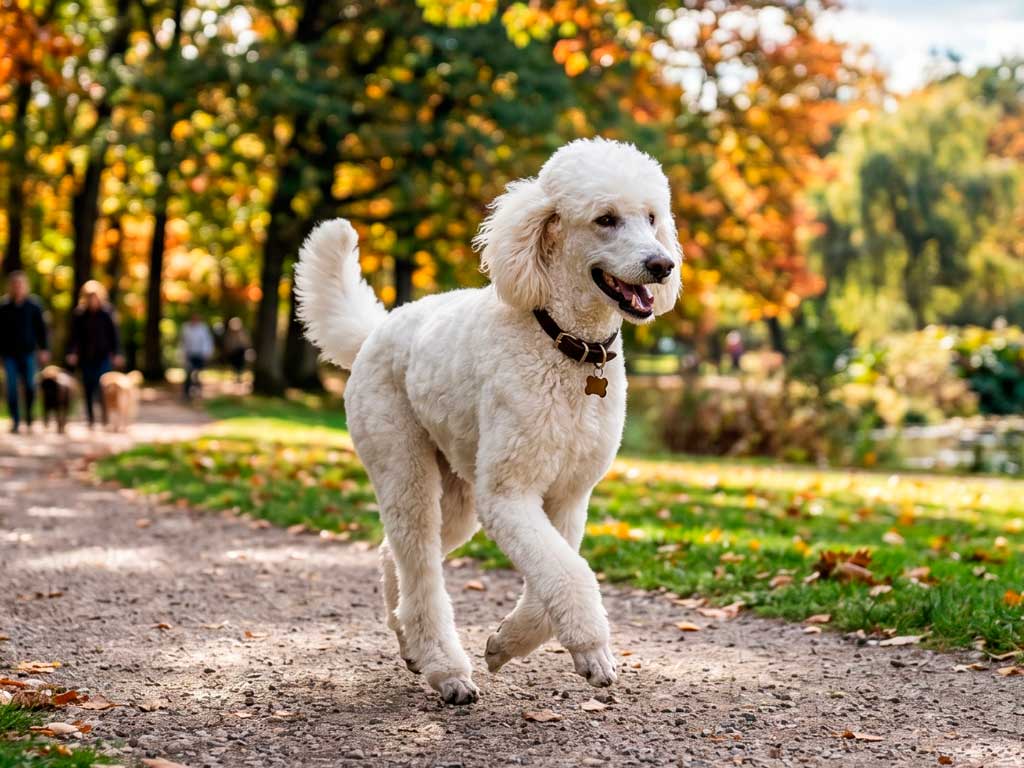
This is a large, squarely built dog with a long, fine muzzle, dark oval eyes, and a proud, upright carriage. Every physical feature communicates alertness, intelligence, and readiness for action. There is nothing soft or fragile about this dog beneath that distinctive coat — Standard Poodles are muscular, athletic working animals built for endurance.
Key physical stats:
- Height: Minimum 38 cm at the shoulder — most adults stand considerably taller, typically 45–70 cm
- Weight: 20–32 kg
- Coat: Dense, curly, and continuously growing — never sheds seasonally
- Colors: Black, white, blue, grey, silver, brown, apricot, cream — always a solid, uniform color
- Drooling: Minimal for a dog of this size
- Shedding: Extremely low — one of the most allergy-friendly large breeds available
The continuously growing coat is both the breed’s most distinctive feature and its most demanding care requirement. Unlike most dogs, the Standard Poodle’s coat does not shed naturally — it keeps growing indefinitely. This is what makes them so compatible with allergy sufferers, but it also means grooming is non-negotiable and never-ending.
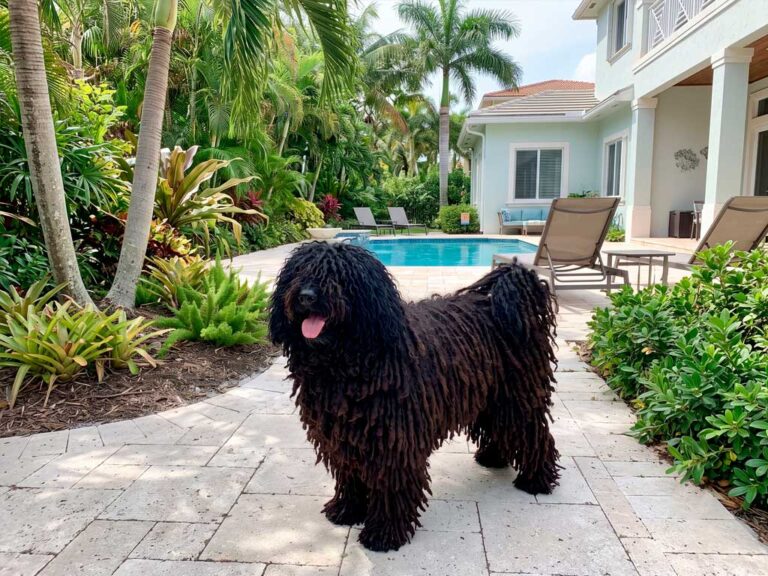
One fascinating coat option: the Standard Poodle’s fur can also be grown out and allowed to form into long, thin rope-like cords — a look entirely different from the familiar curled clip. Whether corded or clipped, the coat grows continuously and requires consistent attention.
Temperament and Personality
Here is what living with a Standard Poodle is genuinely like: engaging, warm, and never dull.
These are dogs that notice everything. They read the room, adapt to the household’s mood, and respond to their owners with a sensitivity that regularly surprises people who expect athleticism without emotional depth. Standard Poodles are simultaneously one of the most capable working breeds and one of the most affectionate family companions.
Key personality traits to understand:
- Joyful and full of life — they genuinely love being active and involved in everything the family does
- Deeply social — they get along exceptionally well with children, other dogs, and other pets
- Alert watchdogs — they’ll announce visitors promptly and confidently, but they are not guard dogs and are never aggressive
- Highly trainable — they respond to commands fast, retain training reliably, and actively enjoy the learning process
- People-oriented — they want to be with their family; prolonged isolation causes real distress
- Water-obsessed — many Standard Poodles retain the retrieval instinct strongly; near open water, keep safety in mind
One important nuance: Standard Poodles are recommended for owners with some prior dog experience. Not because they’re difficult — they’re actually among the most trainable breeds — but because their intelligence, energy, and need for engagement mean they thrive best with owners who understand how to channel those qualities productively.
Care
Diet and Nutrition
At 20–32 kg, the Standard Poodle sits firmly in the large breed category — and that matters significantly for feeding.
Large breeds have different nutritional requirements than smaller dogs, particularly regarding the balance of calcium, phosphorus, and joint-supporting minerals. Choose a high-quality large breed adult formula that supports lean muscle maintenance, healthy joints, and appropriate energy levels.
The most critical feeding consideration for this breed is bloat risk. The Standard Poodle is specifically noted as prone to gastric dilatation-volvulus (GDV) — a life-threatening condition where the stomach distends and twists. To minimize risk:
- Feed 2–3 smaller meals per day instead of one large daily meal
- Never allow vigorous exercise immediately before or after eating — wait at least an hour each way
- Use a slow-feeder bowl to discourage rapid gulping
- Avoid elevated food bowls unless specifically advised otherwise by your veterinarian
Puppies need large breed puppy formula specifically — standard puppy food can deliver excessive calcium that disrupts bone development in large breeds. Ask your vet for guidance on when to transition to adult food, typically around 12–18 months.
Exercise Requirements
This is where many prospective owners get the Standard Poodle wrong.
They see the elegant clips and assume a moderate, genteel dog. They are mistaken. The Standard Poodle needs one to two hours of genuine, purposeful exercise per day — and it means it.
This is an athletic working breed with real stamina. A slow daily walk is not sufficient. Standard Poodles need to run, retrieve, swim, and think. The good news is they’re exceptionally versatile athletes who excel at a wide range of activities:
- Agility trials — Poodles consistently place at the highest levels of competitive agility
- Obedience competitions — their precision and trainability make them natural champions
- Swimming and water retrieval — tapping directly into the breed’s working heritage; most Standard Poodles love water
- Fetch and retrieving games — excellent for burning physical and mental energy simultaneously
- Scent work and tracking — challenges the brain as much as the body
Mental stimulation is equally important. A Standard Poodle that exercises its body but not its mind will still be restless. Incorporate training sessions, puzzle feeders, and new skills into the weekly routine alongside physical activity.
Grooming Needs
The Standard Poodle has the same grooming demands as the Miniature — simply on a larger scale.
The coat never stops growing and mats quickly if neglected. This is a welfare commitment, not just an aesthetic one. Matted coats trap moisture against the skin, harbour parasites, and cause genuine physical discomfort.
The realistic grooming commitment for a Standard Poodle:
- Daily brushing at home — essential between professional appointments; use a slicker brush and work systematically through sections to prevent mat formation
- Professional grooming every 6 weeks — bath, blow-dry, clip, and style; budget for this recurring cost from day one
- Ear maintenance weekly — the ear canal traps moisture and loose hair, creating ideal conditions for infection; check and clean regularly, and have the inner ear hair removed periodically
- Nail trimming: Every 3–4 weeks
- Teeth brushing: 2–3 times per week — large breed or not, dental disease is one of the most common health issues across all dogs
- Eye area: Wipe daily around the eyes to prevent staining, particularly in lighter-colored dogs
Clip style is entirely your choice. Most pet owners opt for a practical, uniform-length “lamb clip” that’s easy to maintain between appointments. Show clips are beautiful but high-maintenance; they make sense in a competitive context but are unnecessary for a family companion.
Training and Education
Training a Standard Poodle is one of the great pleasures of dog ownership.
This breed learns at a remarkable pace. New commands are understood in just a few repetitions. Sequences of behaviors are retained and recalled reliably. They actively seek engagement with their handlers and genuinely seem to enjoy the challenge of learning something new.
Positive reinforcement is the method of choice — not because the Standard Poodle needs special handling, but because it works so effectively with this breed that there’s simply no reason to use anything else. Food rewards and enthusiastic praise produce outstanding results with minimal repetition.
Key training priorities for Standard Poodle owners:
Start socialization early and keep it broad. Expose puppies to a wide range of people, environments, sounds, dogs, and situations during the critical 8–16 week window. A well-socialized Standard Poodle becomes the confident, adaptable adult this breed is capable of being. Gaps in early socialization can manifest as anxiety or reactivity in an otherwise highly intelligent dog.
Address alone-time proactively. Like all Poodle varieties, Standard Poodles bond intensely with their families and do not cope well with extended isolation. Teach gradual alone-time from puppyhood — short absences first, building slowly. A well-established routine and a positive confinement space help significantly.
Progress to advanced activities. Basic obedience is a starting point, not a destination. Standard Poodles thrive when given progressively more complex challenges — agility courses, competitive obedience, scent tracking, or even therapy dog work. The more you invest in their training, the more exceptional the relationship becomes.
Never underestimate them. Standard Poodles notice inconsistency immediately. If a rule exists on Monday, it must exist on Friday. They test boundaries not out of defiance but out of intelligence — they’re checking whether the framework is reliable. Consistent expectations produce confident, well-adjusted dogs.
Health and Longevity
The Standard Poodle has a life expectancy of 12 to 15 years — impressive for a dog of this size, and a testament to the breed’s generally robust constitution.
That said, several hereditary and breed-specific health conditions require attention:
Eye conditions:
- Progressive Retinal Atrophy (PRA) — a hereditary degenerative eye condition that can lead to progressive vision loss and blindness; DNA testing of breeding dogs is available, essential, and must be verified before purchasing a puppy
Joint and orthopaedic conditions:
- Hip dysplasia — abnormal development of the hip joint causing pain and reduced mobility; hip scoring of both parents is mandatory from responsible breeders
Hormonal conditions:
- Addison’s disease (hypoadrenocorticism) — a hormonal disorder where the adrenal glands produce insufficient cortisol; notably more prevalent in Standard Poodles than in most other breeds; symptoms include lethargy, vomiting, and weight loss, and can mimic many other conditions, making diagnosis challenging
- This condition is manageable with lifelong medication once diagnosed, but awareness is important
Gastrointestinal conditions:
- Gastric dilatation-volvulus (bloat/GDV) — a life-threatening emergency requiring immediate veterinary intervention; Standard Poodles are among the higher-risk large breeds; know the warning signs: distended abdomen, unproductive retching, restlessness, drooling, and rapid deterioration
Structural conditions:
- Sebaceous adenitis — an inflammatory skin condition affecting the sebaceous glands; more common in Standard Poodles than in other breeds; causes patchy hair loss, scaling, and secondary skin infections
Before purchasing a Standard Poodle puppy, always verify:
- DNA-clear test results for PRA for both parents
- Hip scores for both parents
- Eye examination certificates (current)
A responsible breeder conducts all of these tests as standard practice and will provide documentation without hesitation. Any reluctance to share health documentation is a clear warning signal.
Is This the Right Dog for You?
The Standard Poodle is a magnificent breed. But magnificence comes with real commitments.
This dog is a genuinely excellent fit if:
- You want the intelligence, trainability, and responsiveness of a top-tier working breed
- You have some prior experience with dogs and understand how to provide structure
- You’re active and can commit to one to two hours of real exercise daily
- You or a family member has allergies and needs a large, low-shedding breed
- You want a family dog that integrates beautifully with children, other dogs, and other pets
- You’re ready to invest in professional grooming every six weeks — and daily brushing at home
- You want a long-lived companion: 12–15 years is both the commitment and the reward
Think carefully before committing if:
- You’re away from home for long periods regularly without a care plan for the dog
- You want a lower-energy, lower-demand large breed
- You’re not prepared for the grooming costs and time commitment this breed requires
- You live in a small space without reliable daily access to outdoor exercise
- You’re unwilling to provide consistent training and ongoing mental enrichment
The Standard Poodle rewards the right owner like few other breeds can. It’s athletic, affectionate, brilliant, and deeply devoted. For an active family or individual who appreciates a dog that is genuinely a thinking partner — not just a pet — this breed is one of the best choices available in any size category.
Frequently Asked Questions
1. Is the Standard Poodle the right size for families with children? Yes — Standard Poodles are exceptional family dogs. Their size makes them more robust around energetic children than the Miniature or Toy varieties, and their gentle, playful temperament means they integrate naturally into busy family life. As with any dog, interactions between young children and large dogs should always be supervised.
2. How does the Standard Poodle compare to the Miniature Poodle? The temperament and intelligence are essentially identical — both are among the most trainable and affectionate dogs available. The key differences are size (Standard Poodles weigh 20–32 kg versus 12–14 kg for the Miniature), exercise needs (Standards require more), specific health conditions (Addison’s disease and GDV are more prevalent in Standards), and the scale of grooming effort. The Standard is better suited to active households with more outdoor space.
3. Are Standard Poodles truly hypoallergenic? No dog is technically 100% hypoallergenic, because allergic reactions are triggered by proteins in saliva and skin dander rather than just shed fur. However, Standard Poodles shed so minimally that most allergy sufferers tolerate them well — making them one of the most popular choices for allergy-conscious households seeking a large breed.
4. What is Addison’s disease, and how common is it in Standard Poodles? Addison’s disease is a hormonal condition where the adrenal glands fail to produce adequate levels of cortisol. It is significantly more prevalent in Standard Poodles than in the general dog population. Symptoms — lethargy, vomiting, weakness, and weight loss — can be vague and easily confused with other conditions. Once diagnosed, it is manageable with daily or monthly medication, but awareness is important so owners seek testing if these signs appear.
5. How much does Standard Poodle grooming actually cost? Professional grooming every six weeks is the baseline, and costs vary by location, but budgeting between $60–$120 per session is a reasonable estimate in most US and UK markets. Additionally, daily home brushing requires a quality slicker brush, a pin brush, and a detangling spray. Many Standard Poodle owners learn to do basic maintenance trims themselves — which the breed’s non-shedding coat actually makes feasible between professional visits.
Considering all three Poodle sizes? Read our detailed article on the Miniature Poodle for a direct size-by-size comparison — and explore the Golden Retriever for another brilliant, family-oriented large breed alternative.