The Bracco Italiano: Legacy of Europe’s Premier Ancient Pointer
The Bracco Italiano is one of the most ancient hunting breeds in existence — and one of the most overlooked by English-speaking dog lovers.
In this guide, you’ll get the full picture: where this remarkable Italian pointer came from, what it’s really like to live with one, how to care for it properly, and whether it belongs in your home.
Here’s the thing — the Bracco is widely considered the oldest pointer-type breed in all of Europe. That alone tells you something. Thousands of years of selective breeding have produced a dog that is simultaneously a world-class working hunter and a warm, devoted family companion.
History and Origin
The Bracco Italiano’s story begins long before gunpowder existed.
Written and artistic references to this breed date back as far as the 4th and 5th centuries BC. Scholars believe it descended from a cross between a Mastiff-type dog and an ancient Egyptian hunting hound — a combination that produced something uniquely powerful and athletic.
By the 18th century, Italian hunters had refined the breed specifically for tracking, pointing, and flushing game. Before firearms became standard hunting tools, Bracchi (the plural) were used to drive prey directly into the nets of waiting hunters. When guns became widespread, the breed adapted seamlessly into the role of a classic pointing dog.
Here’s an interesting wrinkle in the breed’s history.
Originally, two distinct regional types existed in Italy. The Piedmontese type (bianco-arancio — white and orange) was lighter in frame, built for agility in mountain terrain. The Lombard type (roano-marrone — roan and brown) was heavier and more powerful, purpose-built for hunting in flat, marshy lowlands. These weren’t just color differences — they reflected genuinely different athletic builds shaped by the landscapes they worked.
In 1949, a unified breed standard was established, formally merging both types into the single Bracco Italiano we recognize today, incorporating traits from each regional variety.
The breed arrived in the United Kingdom for the first time in the late 1980s, and its population there — as well as in the US — remains relatively small. That rarity, for the right owner, makes finding one all the more rewarding.
Physical Characteristics
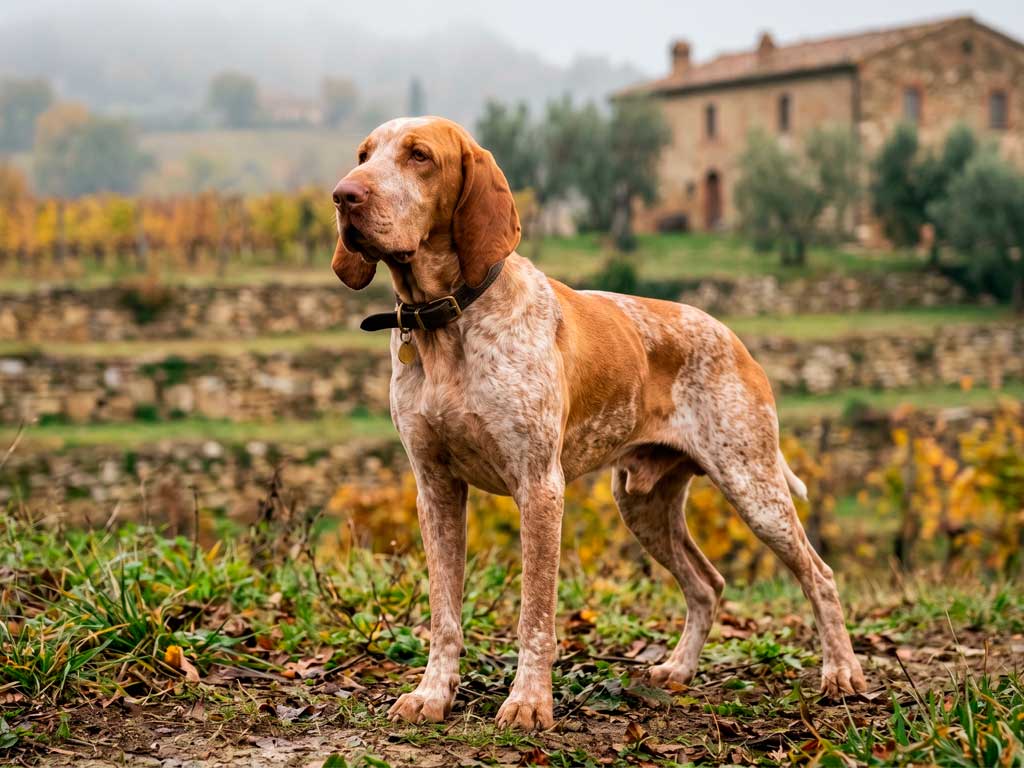
The Bracco Italiano is a large, muscular, and athletic dog with an unmistakable silhouette.
Size:
- Males: 58–67 cm tall, weighing up to 40 kg
- Females: 55–62 cm tall, weighing from 25 kg
The head is perhaps the breed’s most striking feature. Long, pendulous ears frame a well-developed jaw and a slightly domed skull, giving the Bracco a noble, almost aristocratic expression. The eyes are typically warm amber or ochre in color and convey a calm, intelligent presence.
The coat is short, dense, and fine — smooth to the touch and low-maintenance by design. It comes in four accepted color patterns:
- Orange and white
- Orange roan
- Chestnut and white
- Chestnut roan
The body is powerfully built but never heavy. Long, straight legs give the Bracco a fluid, ground-covering trot that makes it remarkably efficient in the field. The tail is typically carried horizontally or slightly below the topline when working.
Overall, this is a dog that radiates elegance and substance in equal measure.
Temperament and Personality
Don’t let the serious hunting heritage fool you — the Bracco Italiano is an absolute sweetheart at home.
These dogs are intelligent, loyal, and genuinely affectionate. They bond deeply with their families and tend to get along beautifully with children and other dogs. This is not a breed that tolerates isolation well — they want to be involved in family life, not left in the garden.
A few defining personality traits:
- Eager to please. Bracchi genuinely want to make you happy. This makes them a joy to work with in training — but it also means they feel it deeply when they’ve disappointed you.
- Sensitive souls. This is a critical point. Unlike some working breeds that respond well to firm corrections, the Bracco needs a gentle, patient approach. Harsh training methods don’t just fail with this breed — they can cause lasting damage to the dog’s confidence.
- Calm indoors. Once their exercise needs are met, Bracchi settle beautifully in the home. They’re not restless or hyperactive around the house.
- Alert and watchful. They’ll bark to alert you to visitors or unusual sounds, making them capable watchdogs — though they’re far too friendly to be guard dogs in any serious sense.
- Active outdoors. Put them in a field or forest, and a switch flips. They become tireless, focused, and extraordinarily driven.
This dual nature — composed family dog and passionate working athlete — is exactly what makes the Bracco so special. However, it also means they’re not ideally suited to first-time dog owners who may underestimate their exercise requirements.
Care Guide
Diet and Nutrition
The Bracco Italiano is a large, active breed with a healthy appetite. Their diet should be formulated for large working dogs, delivering the right balance of high-quality protein, healthy fats, and essential micronutrients.
Like many deep-chested breeds, the Bracco has a notable susceptibility to bloat (gastric dilatation-volvulus, or GDV) — a life-threatening emergency where the stomach fills with gas and can twist on itself. To reduce the risk:
- Feed two or three smaller meals per day rather than one large one
- Avoid vigorous exercise for at least an hour before and after eating
- Use raised feeders with caution — the evidence on their effectiveness for bloat prevention is mixed; consult your vet
High-quality dry kibble designed for large, active breeds is a solid foundation. Always adjust portions based on your dog’s individual activity level, age, and body condition score. Your vet is the best resource for personalized guidance.
Exercise Requirements
This is where many prospective owners underestimate the Bracco.
Adult Bracchi need a minimum of two hours of vigorous exercise every day. Not a gentle stroll around the block — meaningful, physical activity that gets them moving at pace. They love long countryside hikes, open-field running, and, notably, swimming. Many Bracchi are enthusiastic water dogs and will seize any opportunity to get wet.
They also excel at retrieving — an activity that doubles as both physical and mental exercise.
An under-exercised Bracco becomes a destructive, vocal, and generally disruptive housemate. Give them the outlet they need, and they transform into an ideal companion. This is a breed that thrives with active families or individuals who spend meaningful time outdoors.
Grooming Needs
Here’s some genuinely good news: the Bracco Italiano is one of the lowest-maintenance coats in the large-breed category.
The short, fine coat requires nothing more than a weekly once-over with a grooming mitt or soft bristle brush to remove dead hair and distribute natural oils. This keeps the coat gleaming and your furniture relatively hair-free.
Beyond coat care, maintain a routine that includes:
- Ear cleaning — those long, pendulous ears are prone to moisture retention and can develop infections if neglected. Check and clean weekly.
- Nail trimming — active dogs wear down nails naturally, but check monthly.
- Dental hygiene — brush teeth several times per week to prevent tartar build-up.
That’s genuinely it. No trips to the groomer, no elaborate coat maintenance. For a large breed, the Bracco’s grooming demands are refreshingly straightforward.
Training and Education
Training a Bracco Italiano is both a pleasure and a responsibility.
The pleasure: these dogs are intelligent and deeply motivated to please. They pick up new commands quickly and respond enthusiastically to positive reinforcement. Food rewards, verbal praise, and play work exceptionally well as motivators.
The responsibility: their sensitivity means training must always be calm, consistent, and reward-based. Frustration, raised voices, or physical corrections can shut a Bracco down entirely. A dog that’s lost confidence in its handler becomes reluctant and anxious — the opposite of what you want.
Key training principles for the Bracco:
- Start early. Socialization during puppyhood is critical. Expose your Bracco to a wide variety of people, environments, sounds, and other animals from as young as possible.
- Keep sessions short and positive. Ten to fifteen minutes of focused, enjoyable training is far more effective than an hour of repetitive drilling.
- Be consistent. Set clear rules from day one. Bracchi are smart enough to exploit inconsistency.
- Enroll in group classes. Structured training classes help with both basic obedience and the socialization this breed genuinely needs.
For those interested in working with their Bracco in the field, the breed excels at HPR (Hunt, Point, Retrieve) disciplines. Their natural instincts are strong, and with proper guidance, they develop into exceptional hunting partners.
This is not an ideal breed for a completely inexperienced owner — but with some prior knowledge and a willingness to invest time in training, the Bracco is enormously rewarding to work with.
Health and Longevity
The Bracco Italiano enjoys a solid life expectancy of 12 to 13 years — notably good for a large breed.
Overall, they’re a reasonably healthy dog. However, like most purebreds, certain conditions appear with greater frequency in the breed:
- Hip and elbow dysplasia. Malformation of the hip or elbow joints that can cause pain and reduced mobility. Always ask breeders for documented OFA or BVA screening results before purchasing a puppy.
- Hereditary eye disorders. Various genetic eye conditions have been identified in the breed. Pre-breeding eye examinations are essential.
- Bloat (GDV). As covered under nutrition, this is a serious risk for deep-chested breeds. Know the symptoms — restlessness, unproductive retching, a distended abdomen — and treat it as an emergency if they appear.
- Kidney disease (renal amyloidosis). This condition, in which abnormal protein deposits damage the kidneys, has been reported in the breed and warrants monitoring as the dog ages.
An important note on breeding: the Purina source specifically cautions against supporting breeders who promote extreme physical traits. The Bracco’s characteristic loose, pendulous facial skin and prominent dewlap should remain within healthy functional limits. When in doubt, choose breeders who prioritize health screening over exaggerated appearance.
Is This the Right Dog for You?
Let’s be direct about this.
The Bracco Italiano is a spectacular dog — but it’s absolutely not for everyone. Getting honest with yourself before you commit is the kindest thing you can do for both yourself and the breed.
The Bracco is a great fit if you:
- Have some prior experience with medium or large breeds
- Can genuinely commit to two-plus hours of daily vigorous exercise
- Live in or near the countryside, or have reliable access to open outdoor space
- Want a dual-purpose dog — a working athlete and a loving family companion
- Are willing to invest time in gentle, consistent training
- Can handle a dog that forms deep emotional bonds and dislikes being left alone
Think twice if you:
- Are a first-time dog owner with no prior large-breed experience
- Live in a small city apartment with no garden access
- Have a sedentary or largely indoor lifestyle
- Are looking for an independent, lower-maintenance breed
- Travel frequently or work long hours that leave the dog alone for extended periods
For active families — especially those with outdoor interests like hiking, hunting, or countryside life — the Bracco Italiano offers something very few breeds can match: a genuinely ancient working drive wrapped in an affectionate, family-friendly temperament.
If that sounds like your life, this breed might be exactly what you’ve been looking for.
Frequently Asked Questions About the Bracco Italiano
1. Is the Bracco Italiano a good family dog?
Yes — for the right family. Bracchi are affectionate, gentle, and patient with children, and they generally get along well with other dogs. However, their high exercise requirements and sensitive temperament mean they’re best suited to active households with some dog experience. As with any large breed, adult supervision is always advisable during interactions with young children.
2. How much exercise does a Bracco Italiano need?
A lot. Adult Bracchi require a minimum of two hours of vigorous exercise per day. This breed was built for long days in the field, and anything less will leave them frustrated and potentially destructive. Long countryside walks, swimming sessions, and retrieving games are all excellent outlets.
3. Is the Bracco Italiano rare in the UK and US?
Yes — the breed is relatively uncommon outside Italy. The first Bracco arrived in the UK in the late 1980s, and the population there remains small. In the US, numbers are also limited, though interest has grown steadily. Expect a waiting list with reputable breeders and be prepared to do your research carefully.
4. Are Bracco Italianos easy to train?
They are highly trainable but require a specific approach. Their intelligence and desire to please make them quick learners, while their sensitivity means they respond poorly to firm corrections or harsh methods. Patient, positive reinforcement-based training yields excellent results. They’re not ideal for completely novice owners, but with commitment, they’re a genuine pleasure to train.
5. What health problems are common in Bracco Italiano dogs?
The main concerns are hip and elbow dysplasia, hereditary eye disorders, bloat (GDV), and — less commonly — renal amyloidosis (kidney disease). Always source puppies from breeders who conduct full health screening for hips and eyes, and familiarize yourself with the warning signs of bloat, which is a veterinary emergency requiring immediate treatment.
Another versatile Italian hunting breed worth knowing is the Italian Spinone, easily recognized by its wiry coat and a name that literally means it hunts through thorns.