English Bulldog: Everything You Need to Know About This Iconic Breed
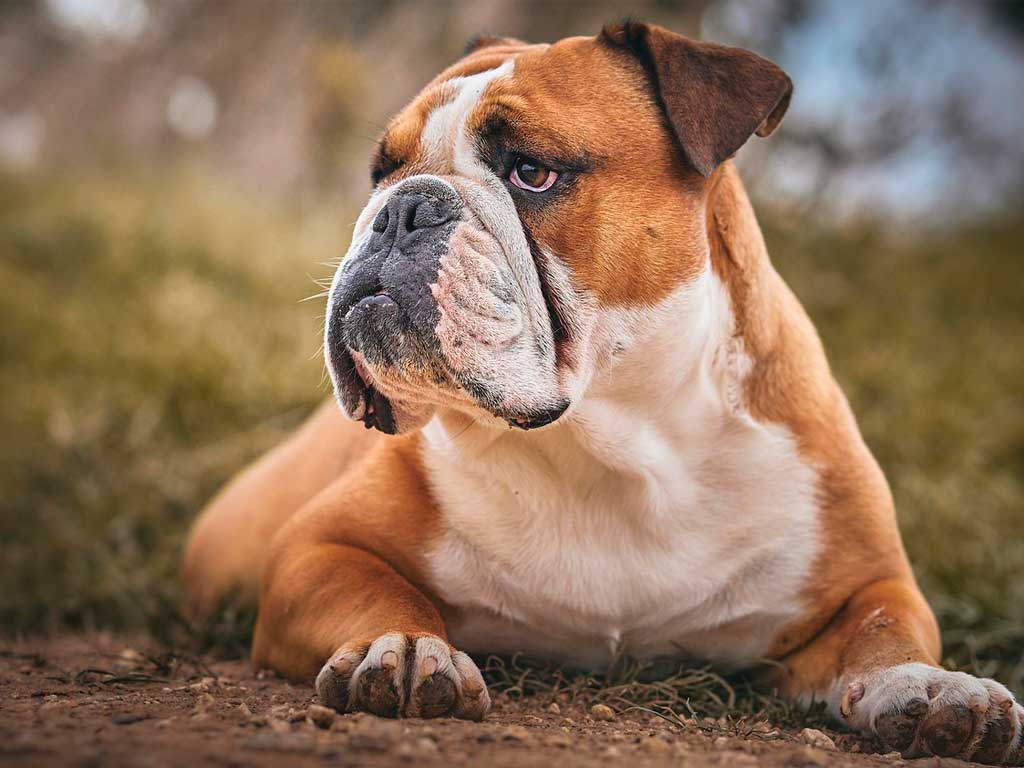
English Bulldog is a medium-sized British breed with a heavy, low-slung body, a broad head, and a short, flat muzzle. The FCI classes it in Group 2 among the Molossoid breeds as a dissuasion and companion dog.
Males weigh about 25 kg and females about 23 kg under the current FCI standard, and the Kennel Club registers the breed in the Utility group.
This is a calm, affectionate dog that bonds closely with its family and asks for less exercise than its size suggests. It is also a flat-faced breed, so breathing, heat, and skin folds shape daily life more than they do in most other breeds. Expect 30 to 60 minutes of gentle activity a day, daily wrinkle care, and a cool room in summer.
These are the headline figures, with the source noted because the registries publish different numbers.
| Official name | Bulldog, also called the English Bulldog |
| FCI standard | No. 149, Group 2, Section 2.1 Molossoid breeds |
| FCI utility | Dissuasion and companion dog |
| Working trial | Without a working trial |
| Origin | Great Britain |
| Kennel Club (UK) group | Utility |
| AKC recognition | 1886 |
| Weight | About 25 kg for males and 23 kg for females under the FCI standard |
| Height | No height figure in the standards, because the breed is judged on weight |
| Coat | Short, smooth, fine texture, close lying |
| Colours | Whole colours, brindle, and pied patterns with white markings |
| Lifespan | Under 10 years, and commonly given as 7 years and up |
| Exercise | About 30 to 60 minutes a day in short, gentle sessions |
| Suits | Owners who want a calm companion and can manage a flat-faced breed |
What Is an English Bulldog?
The FCI standard describes the English Bulldog as smooth-coated, fairly thick-set, rather low in stature, broad, powerful, and compact. The face is short, the muzzle broad and blunt, and the jaw slightly undershot. The current standard was published in September 2026, and it contains a line that matters to anyone buying a puppy: dogs showing respiratory distress or making excessive respiratory noise are unacceptable.
The English Bulldog is judged on weight rather than height, which is why no registry publishes a height range. It is a compact dog of roughly 23 to 25 kg, built low and wide with short, muscular legs.
| Source | What it publishes |
|---|---|
| FCI standard (No. 149) | Males about 25 kg, females about 23 kg; no height given; respiratory distress listed as unacceptable |
| American Kennel Club | Weight up to about 50 lb; no height in the breed standard; recognised in 1886 |
| Kennel Club (UK) | Medium size, Utility group, exercise up to one hour a day, lifespan under 10 years |
| Petplan breed profile | Medium size, 30 minutes of exercise a day, lifespan 7 years and up, flat-faced flag |
Where Does the English Bulldog Come From?
Bull baiting reached Britain with the Normans in the 12th century, and by the 16th century it was popular entertainment across every social class. The leggier mastiff types that started it gave way to smaller, thicker dogs with strong heads and powerful jaws, and those dogs became the ancestors of the modern Bulldog.
The FCI records that the breed was first classified as a Bulldog in the 1630s, that bull baiting was made illegal in 1835, and that the dog entered the show ring in 1860. The Kennel Club recognised the breed in 1873, and the American Kennel Club followed in 1886. With its original work gone, the breed survived through fanciers who kept it as a companion and then rebuilt it as a show dog.
That history left a mark. Victorian breeders selected hard for a short face, a heavy body, and a wide front, and the exaggeration they produced is why the English Bulldog now carries a documented breathing problem. The 2026 FCI text pushes back, penalising pinched nostrils and a heavy nose roll and calling respiratory noise a fault.
What Does an English Bulldog Look Like?
The English Bulldog’s head is large in proportion to the body, square from the front, with a furrowed brow and a defined stop. The ears are small and thin, set high and wide, and the correct shape is the rose ear, which folds inward and back to show part of the inside. The eyes sit low and wide apart, are round and dark, and show no white when the dog looks straight ahead.
Behind the head the body is short and well ribbed, with a wide deep chest and a topline that dips behind the shoulders and rises over the loin. The tail is set low and carried downward, the forelegs are short and set wide, and the gait is a short, quick step that looks as if the dog is skimming the ground.
Four details in the current standard separate a healthy Bulldog from an exaggerated one.
- The nostrils must be large, wide, and open, and pinched nostrils are explicitly unacceptable in the 2026 text.
- The nose wrinkle must never obscure the eyes or the nose, and a heavy roll over the nose is heavily penalised.
- The eyes must be free from obvious problems, with skin on the head slightly loose and finely wrinkled without excess.
- Dogs that show respiratory distress or make excessive breathing noise are unacceptable, which places breathing inside the breed standard itself.
Colour is narrower than many buyers expect. The FCI accepts whole colours of red, fawn, and white, whole colour with a black mask, brindle in red or fawn, and pied patterns of white with patches of any accepted colour.
The American Kennel Club registers a longer list that includes fallow, while UK breeders also produce black, blue, and chocolate puppies that the Kennel Club records as non-breed-standard colours.
Merle is a separate case. The Kennel Club does not accept the registration of any merle Bulldog, imported or bred at home, because the gene is linked to impaired hearing and sight and is not a naturally occurring pattern in this breed.
What Is the English Bulldog’s Temperament Like?
The FCI standard calls the breed alert, bold, loyal, dependable, and courageous, fierce in appearance but affectionate in nature. At home that means a dog that wants to be in the same room as its people and settles quickly once it is there.
The Kennel Club describes a calm, affectionate breed that thrives on human company and forms close bonds with its family, including children when introductions are supervised.
Bulldogs do carry a watchful streak and will usually announce a visitor, yet this rarely turns into aggression. Two temperament points catch new owners out. The first is stubbornness: the English Bulldog pauses before it complies and is not among the quickest to learn. The second is company, because the Kennel Club advises against leaving the breed alone for long periods.
Shop for Your Breed

Just Food For Dogs – Fresh Frozen
Fresh meals. Gently cooked, then frozen to lock in nutrients. 100% Human Grade Ingredients. Gently Cooked in the USA. #1 Vet-Recommended Fresh Food.
Shop on JustFoodForDogs
Raw Paws Pet Food – Frozen Raw Pet Food
Feeding your pet a frozen raw pet food diet is a simple way to deliver real, whole-food nutrition in its most natural form.
Shop on RawPawsPetFood
Bravecto Chews for Dogs
Bravecto is a long-lasting flea and tick protection option for your dog. 1 dose of Bravecto chew provides up to 12 weeks of powerful protection, which is nearly 3 times longer than a monthly treatment.
Shop on BestVetCare.com
Deworming Treatments for Dogs
BestVetCare offers you a wide range of worm treatments which come in a variety of forms such as oral paste, tablets, granules, and liquid solutions.
Shop on BestVetCare.comHappyPetZone participates in various affiliate programs with brands and retailers. We may receive a commission on purchases made through our links, at no extra cost to you.
How Much Exercise Does an English Bulldog Need?
An English Bulldog needs about 30 to 60 minutes of gentle activity a day, split into short sessions. The Kennel Club lists exercise needs at up to one hour per day, while Petplan suggests around 30 minutes, ideally as two 15-minute walks. Both agree on the principle: frequent, moderate movement beats one long outing.
The reason is the airway. A flat-faced dog moves air through a narrower passage than a long-nosed breed, so a brisk half hour in warm weather costs it far more than it costs a Labrador. A workable routine looks like this.
- A 10 to 15 minute walk in the cool of the morning, before the pavement warms up.
- A second short walk in the evening, with sniffing time built in, because mental work tires this breed faster than distance does.
- Indoor play with a tug toy or a food puzzle during the hot part of the day, which uses strength without raising the breathing rate.
- Rest in a cool room afterward, because a Bulldog needs longer to recover than a dog with an open airway.
Bulldogs are not natural swimmers, so water should stay shallow enough for the dog to stand, and stairs need care.
How Do You Keep an English Bulldog Cool in Hot Weather?
Heat is the single biggest daily risk for an English Bulldog. The American Kennel Club warns that a Bulldog’s short snout can cause labored breathing in hot and humid weather, and it recommends air conditioning on summer afternoons. Panting is the main cooling route for a dog, and a flat face makes it inefficient.
Know the warning signs before you need them. An overheating Bulldog may hang its tongue unusually far out, and that tongue can take on a bluish cast instead of the normal pink. Noisy breathing that gets louder, wobbling, vomiting, or collapse all point to the same emergency.
If a Bulldog overheats, act in this order.
- Move the dog into shade or a cool room at once, and stop all activity.
- Soak the body with cool water, starting at the belly and the paws, and keep the head above water.
- Offer small amounts of water and a few ice cubes to lick, without forcing the dog to drink.
- Call a vet while you cool the dog, because a Bulldog that cannot settle its breathing needs help beyond a bowl of water.
Prevention is simpler than treatment. Walk early or late, test the pavement with the back of your hand, and let the dog choose the shady side of the street. A Bulldog that stops on a walk and refuses to move is telling you the air is too warm.
A dog that collapses, cannot breathe, turns blue, or does not recover within minutes needs emergency veterinary care. This guide is educational and does not replace veterinary advice for the dog in front of you.
How Do You Groom an English Bulldog?
The coat is easy and the face is not. A short, smooth coat needs a soft brush for ten minutes two or three times a week, and a rubber curry brush helps during heavier shedding, according to the American Kennel Club. The Kennel Club lists grooming at once a week and notes that the breed sheds.
The daily work sits in the skin folds, where moisture and food collect and a warm, damp fold becomes a place for bacteria and yeast to grow. Two minutes a day prevents most of the itching and redness that sends Bulldogs to the vet. A routine that covers the breed looks like this.
- Wipe each facial fold daily with a soft cloth or pet-safe wipe, then dry the skin completely, because a fold that stays damp becomes a fold that smells.
- Wipe the tail pocket under the tail on the same schedule, since the tail sits close to the body and traps moisture in a groove.
- Check the ears weekly for redness, wax, or odour, because the breed’s flat ears sit close to the head and trap warmth.
- Trim the nails roughly every two weeks, since a low-slung dog that clicks across the floor is carrying nails that are too long.
- Look at the eyes during every session, because a Bulldog’s eyes sit shallow in the socket and a small injury can become an ulcer quickly.
Bathing is occasional rather than routine. Use grooming time to run your hands over the whole body, and treat a fold that stays red or weepy after a week of cleaning as a vet question.
What Health Problems Do English Bulldogs Have?
The headline problem for the English Bulldog is breathing. Bulldogs are brachycephalic, which means a short, wide skull, and in some dogs the soft tissue inside the nose and throat is excessive for the airway while the nostrils are narrow.
The result is brachycephalic obstructive airway syndrome, usually shortened to BOAS, which shows up as noisy breathing, heavy panting, snoring, and poor tolerance of exercise or heat. The Kennel Club runs a Respiratory Function Grading scheme that grades a dog’s breathing from 0 to 3, and lists the scheme as good practice for breeders.
Skin and eyes come next. Facial folds trap moisture and lead to fold dermatitis, and the shallow eye socket leaves the eye exposed to trauma, ulcers, entropion, cherry eye, and dry eye.
Ear infections are common because of the ear shape. Behind the skin sit the orthopaedic problems: cruciate ligament rupture, hip dysplasia, and elbow dysplasia, all of which a heavy body makes worse.
The two kennel clubs ask for different tests.
| Test or scheme | What it checks |
|---|---|
| Respiratory Function Grading | Grades BOAS severity in the clinic; good practice for breeding in the UK |
| BVA/KC/ISDS eye scheme | Screens for inherited eye disease; also listed as good practice |
| HUU DNA test | Hyperuricosuria, a urinary stone disorder carried by some lines |
| Hip and elbow scoring | Joint dysplasia, which matters more in a heavy, low-slung breed |
| Patella, cardiac, and tracheal checks | The three tests the AKC national breed club recommends |
Weight belongs in this section. A Bulldog carrying extra kilos breathes harder, loads its joints more, and tires sooner, and Petplan notes that the thickset shape and loose-fitting skin can mask obesity. A vet weigh-in beats a look in the mirror.
Lifespan figures are shorter than most buyers expect. The Kennel Club lists the breed at under 10 years, and Petplan gives 7 years and up. UK life-table research published in Scientific Reports in 2022 found flat-faced breeds among the shortest-lived groups of dogs.
A Bulldog in respiratory distress needs a vet immediately, and that includes a dog that cannot settle its breathing, turns blue, collapses, or cannot stand. This guide is educational and does not replace veterinary advice.
How Do You Feed an English Bulldog?
Feed a complete adult diet to a measured portion, and treat the portion as a ceiling. Petplan notes that the English Bulldog can be a greedy eater and that it matures slowly, often not reaching adulthood until 18 to 24 months, so the switch from puppy food to adult food is worth discussing with a vet.
Three feeding habits keep the weight stable.
- Weigh the food instead of scooping it, because a generous scoop three times a day adds up faster than most owners realise.
- Count treats into the daily total, since training rewards are calories like any other.
- Split meals into two smaller servings, which suits a deep-chested dog and keeps the dog from bolting its food.

Lemonade Pet Insurance
Explore customizable pet insurance coverage and learn whether Lemonade is the right fit for your dog or cat.
- Customizable coverage options
- Online policy management
How Do You Train an English Bulldog?
Train in short sessions and pay well. The Kennel Club describes the English Bulldog as strong willed and not among the quickest to train, and recommends short, positive sessions because the breed loses interest quickly. Five minutes twice a day teaches more than a twenty-minute class.
The skills worth teaching early are practical ones. A release cue makes tug games safe, and the AKC recommends teaching a young Bulldog to let people take food from its bowl so that guarding never develops.
Socialisation carries more weight than commands: puppy classes, gentle visitors, and calm trips to busy places in the first months produce an adult that handles novelty without stress.
Is an English Bulldog Right for You?
An English Bulldog fits a household that wants a calm companion, spends most of the day at home, and can keep the dog cool. It does not fit a household that wants a running partner or a breed with low veterinary costs. The Kennel Club notes that low energy and adaptability make the breed well suited to smaller homes, including flats, provided the dog is not alone for long periods.
The breed works when these points are true.
- Someone is home for most of the day, or the dog has company for the hours it would otherwise spend alone.
- The home stays cool in summer, with air conditioning or a reliably shaded room.
- You can commit to two minutes of fold care every day and a weekly check of ears, eyes, and nails.
- You are comfortable with short, gentle walks rather than long hikes and sports.
- You can budget for a breed with a high rate of veterinary visits, which is why breed-specific dog insurance is worth pricing before you buy.
Look at other breeds if any of these apply.
- You want a dog for running, hiking, or long summer days outdoors.
- Your home gets hot and has no way to cool one room properly.
- You travel often and the dog would spend long days alone.
- You want a breed that trains quickly and works for food without a pause.
Buying well matters more with this breed than with most. Ask to see both parents, ask for the breathing grade under the Kennel Club scheme, and ask for eye and joint results in writing.
Walk away from a breeder who shows you a puppy that pants heavily at rest, wheezes in a cool room, or has nostrils you can barely see. The 2026 FCI standard now calls those features unacceptable, so a breeder working to the standard should welcome the question.
If you are still deciding between flat-faced breeds, the French Bulldog guide covers a smaller, livelier cousin with its own airway risks. New owners should also read the puppy care guide before the dog comes home. For a wider comparison, browse the Dog Breeds hub or the medium breeds section.