Common Goldfish vs. Comet vs. Shubunkin: Single-Tail Types Explained
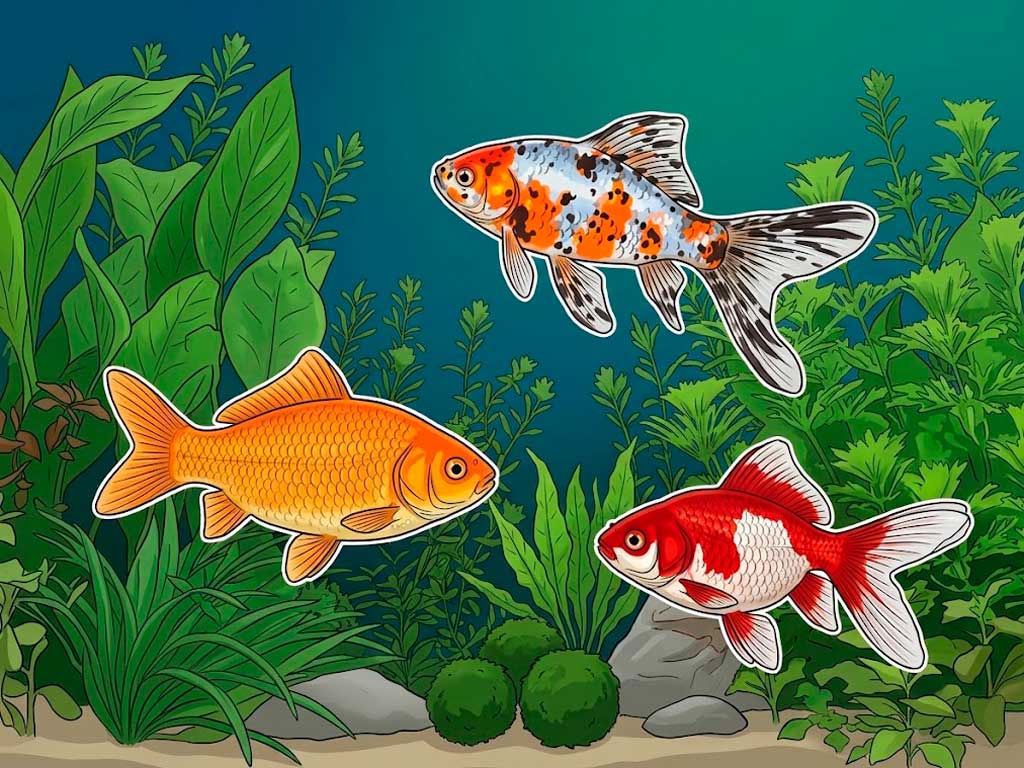
Comet goldfish get sold under the wrong name constantly, and the reason is simple: a bright orange common goldfish looks close enough to a comet at a glance that shops and buyers mix them up all the time. In practice, the three single-tail goldfish types covered here share a basic body plan but differ in real, checkable ways.
This guide covers what actually separates common, comet, and shubunkin goldfish, and why the mix-up between the first two happens so often.
Quick Comparison
| Type | Origin | Tail | Scales | Typical color |
| Common | China (original type) | Short, single | Metallic | Solid orange, red, or other solids |
| Comet | United States (1880s) | Long, deeply forked | Metallic | Bright orange or red, sometimes black or white |
| Shubunkin | Japan (c. 1900) | Long, flowing | Nacreous (pearly, semi-transparent) | Calico: blue, red, black, orange, white mottled |
Common Goldfish
The common goldfish stays closest to the original domesticated form, before centuries of selective breeding split off into the fancy varieties covered elsewhere on this site. The body runs deep and robust, with a short, single tail fin rather than the long, flowing fins seen in comets and shubunkins.
Metallic scales give common goldfish their characteristic shiny, opaque look, usually in a solid orange or red, though other solid colors turn up too. Given proper space, this variety can grow surprisingly large, well over a foot in a large enough pond, making it one of the hardiest and least demanding goldfish types available.
Comet Goldfish
The comet developed in the United States, generally dated to the 1880s, and its defining trait is the tail: long, deeply forked, and genuinely flowing compared to the common goldfish’s short, stubby fin. The body itself runs slimmer and more streamlined too, built for speed rather than bulk.
Comets typically show the same bright orange or red metallic coloring as common goldfish, though white, black, and red-and-black variants exist as well. That color overlap is exactly why the two get confused so often. Comets rank among the fastest, most active swimmers in the entire goldfish world, and that same activity level makes them a genuinely good match for koi ponds.
Shubunkin
The shubunkin came out of Japan around 1900, developed by Akiyama Yoshigoro through a specific cross: a calico telescope eye goldfish (demekin) bred with both a comet and a common goldfish. That heritage explains the body shape directly, since shubunkins share the comet’s slender, streamlined build and long flowing tail.
What sets them apart is the scale type and color pattern. Shubunkins carry nacreous scales, a semi-transparent, pearly finish rather than the solid metallic shine of commons and comets, arranged in a mottled calico pattern of blue, red, black, orange, and white. Breed standards actually call for less than half the body to show red, with blue considered the more prized color, and black speckling expected across the tail. Two recognized forms exist: the American shubunkin, closer to a comet’s slim build, and the Bristol shubunkin, with a broader body and a large, rounded tail.
Common vs. Comet: Solving the Confusion
Here’s what actually matters for telling these two apart at a glance: check the tail first, not the color. A common goldfish’s tail stays short and single-lobed, sitting close to the body. A comet’s tail runs long, deeply forked, and visibly flowing well past the body, often close to the fish’s own body length.
Color alone won’t settle it, since both varieties commonly show the same bright orange. Body shape helps as a secondary check too: commons run deeper and more robust, while comets stay slimmer and more built for speed. If a “comet” at a shop has a short, stubby tail, it’s almost certainly a common goldfish sold under the wrong name.
Care and Tankmates
All three types covered here count among the hardiest goldfish varieties, well-suited to outdoor ponds and large aquariums covered in the main goldfish care guide. Their streamlined bodies and functional fins make them noticeably better swimmers than the fancy goldfish types covered elsewhere on this site, which is exactly why mixing single-tail types with fancy varieties like ranchus or bubble eyes tends to go poorly: the faster single-tail fish simply outcompete the slower fancy ones at feeding time.
Comets and shubunkins in particular pair well with koi, given their comparable speed and activity level, while common goldfish do fine in either a dedicated pond or a mixed single-tail community.