Fancy Goldfish Types: Oranda, Ranchu, Ryukin & More Explained
Fancy goldfish types can look so different from each other that new keepers often assume they’re looking at entirely unrelated fish. In practice, every one of these varieties traces back to the same species, Carassius auratus, shaped over centuries of selective breeding in China and Japan.
This guide breaks down the major types actually worth knowing, what distinguishes genuinely similar-looking varieties from each other, and one health issue tied to several of them that rarely gets mentioned upfront.
Quick Reference: Major Fancy Goldfish Types
| Type | Key feature | Dorsal fin |
| Oranda | Raspberry-like wen covering the head | Yes |
| Ranchu | Arched back, no dorsal fin, 45° downturned tail | No |
| Lionhead | Flatter back than ranchu, fuller wen coverage | No |
| Ryukin | Pronounced hump directly behind the head | Yes |
| Telescope eye / Black Moor | Protruding, stalked eyes | Yes |
| Bubble eye | Large fluid-filled sacs beneath the eyes | No |
| Pearlscale | Domed, pearl-like individual scales | Yes |
| Veiltail | Long, flowing, drooping tail fin | Yes |
Oranda
The oranda is one of the two most searched fancy goldfish types, and its defining feature is the wen, a raspberry-textured growth that covers the top and sides of the head. Unlike several other hooded varieties, orandas keep a normal dorsal fin, giving them better balance and swimming ability than their hoodless relatives.
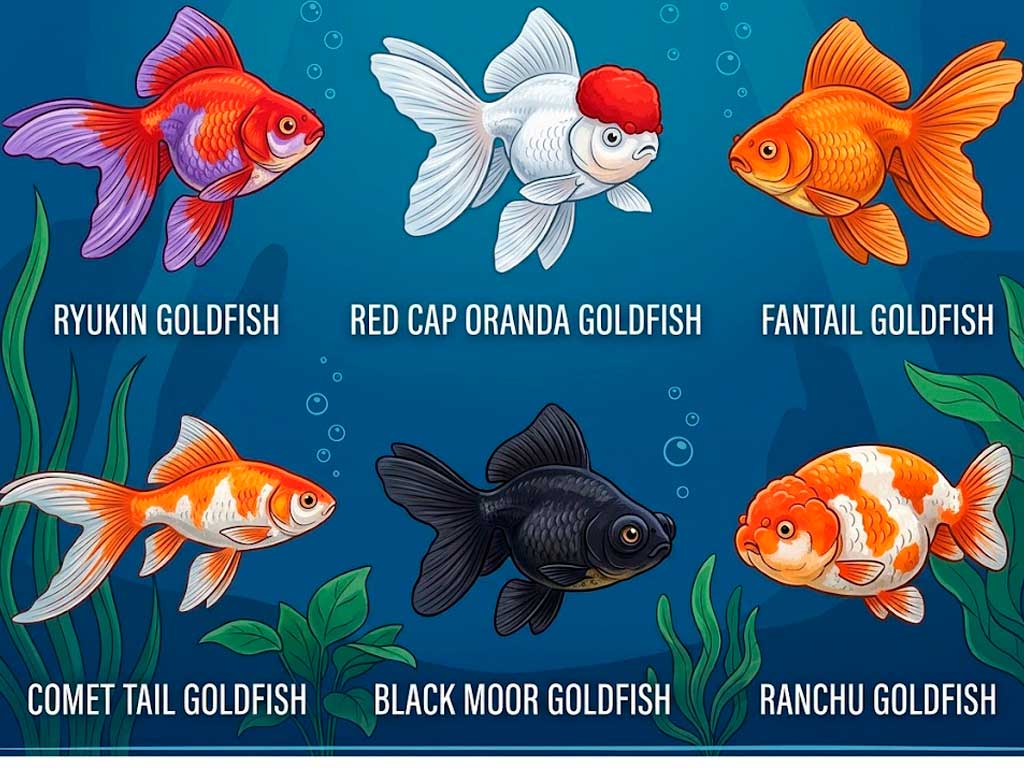
Color patterns vary enormously. Red cap orandas carry a solid white body with a red wen, giving an ornament-like look that’s genuinely one of the most recognizable fancy goldfish patterns in the hobby.
Panda orandas combine black and white, calico orandas mix red, black, and white in a mottled pattern, and chocolate or blue variants shift the base color entirely. Whatever the pattern, the egg-shaped body and flowing double tail stay consistent across the variety.
Ranchu
Ranchus carry the nickname “king of goldfish” in Japan, and the breed standard behind that reputation is exacting. The body runs egg-shaped with a deep belly, five-eighths to three-quarters of the total body length, and the back should be smoothly arched rather than flat.
Ranchus have no dorsal fin at all, a defining trait breeding standards enforce strictly. The tail meets the caudal peduncle at roughly a 45-degree angle, curving sharply downward, and the tail fins spread almost horizontally, giving ranchus a distinctive, slightly labored swimming style. Combined with a rounded, sumo-wrestler body shape, the overall look is unmistakable once you know what to look for.
Lionhead: The Fish People Confuse With Ranchu
Here’s what actually matters for anyone shopping for either variety: lionheads and ranchus get mixed up constantly, even in published references, but they’re genuinely distinct breeds with different origins. The ranchu is Japanese; the lionhead is Chinese, and it traces back to the Maruko or Egg Fish, itself linked to the twin-tailed Wakin.
The clearest difference sits in the back and tail. A lionhead’s back runs flatter and less curved than a ranchu’s arched profile, and its caudal peduncle meets the body at something closer to a square angle rather than the ranchu’s steep downward turn.
Lionhead tail fins also stay less spread, reading more like a standard twin-tail variety instead of the ranchu’s nearly horizontal spread. Wen coverage differs too: a well-bred lionhead’s wen should cover the cap, gill plates, and cheeks evenly, generally with fuller, more complete coverage than a typical ranchu.
Ryukin
Ryukins carry a short, deep body and one very specific structural trait: a pronounced hump rising directly behind the head, right where it meets the back. That hump, combined with long, flowing fins, gives the ryukin a distinctly different silhouette from the egg-shaped orandas and ranchus.
Unlike ranchus and lionheads, ryukins keep their dorsal fin and don’t develop a wen, making them noticeably more agile swimmers despite their rounded body shape. Calico and other multi-color patterns show up frequently in this variety.
Telescope Eye and Black Moor
Telescope eye goldfish, sometimes called demekin, carry eyes mounted on protruding stalks rather than sitting flush with the head. That striking look comes with a real practical downside: telescope eyes have notably poor eyesight and limited depth perception compared to standard goldfish varieties.
The black moor is simply the most famous color variant of the telescope eye, carrying a deep, velvety black coloration across the entire body. Because of their compromised vision, telescope-eyed varieties do best with soft, blunt decor and calmer tankmates that won’t out-compete them at feeding time.
Bubble Eye
Bubble eyes carry large, fluid-filled sacs beneath each eye, one of the most visually unusual traits in the entire fancy goldfish world. Like ranchus and lionheads, bubble eyes have no dorsal fin, which combined with the weight and drag of those sacs makes them genuinely poor, slow swimmers.
This is arguably the most fragile variety covered here. The eye sacs can tear or rupture against sharp decor, aggressive tankmates, or even a rough net, and a torn sac won’t grow back the same way. A bubble eye tank needs bare or heavily padded decor, gentle water flow, and tankmates chosen specifically for their gentleness, not just their size.
Pearlscale
Pearlscale goldfish carry individually domed scales that genuinely resemble a string of pearls set into the skin, an effect unlike any other fancy variety on this list. The body itself runs distinctly round, often compared to a golf ball or small soccer ball in shape.
Pearlscales keep their dorsal fin, and crown pearlscale variants add a small wen on top of the head, similar in spirit to an oranda’s hood but considerably smaller in scale.
Veiltail
Veiltails are defined almost entirely by their tail: long, flowing, and drooping well past the body, unlike the more structured, spread fins of a ryukin or the compact tail of a ranchu. The body itself runs egg-shaped, similar to an oranda, but without a wen.
That dramatic tail comes with a tradeoff familiar across several varieties on this list: reduced swimming agility compared to single-tail types like comets and common goldfish.
A Health Note on Wen Growth
Given how many of these varieties (oranda, ranchu, lionhead, and their lionchu hybrid) carry a wen, it’s worth addressing directly rather than treating it as a purely cosmetic feature.
Wen development can, in some individuals, grow enough to partially obstruct vision or even interfere with feeding, particularly in fish with an especially heavy hood.
Regular observation matters more with wen-carrying varieties than with sleeker types. Watching for a fish that seems to struggle finding food, or that bumps into decor more than expected, catches a genuine welfare issue before it becomes serious.
Choosing the Right Fancy Goldfish for Your Tank
The varieties covered here split naturally into two groups by swimming ability. Orandas, ryukins, and pearlscales keep a functional dorsal fin and swim reasonably well despite their rounded bodies. Ranchus, lionheads, and bubble eyes lack a dorsal fin entirely and swim noticeably less efficiently, especially the bubble eye.
That split matters directly for stocking decisions. Mixing a fast, hardy single-tail goldfish, covered in the main goldfish care guide, with a bubble eye or ranchu risks the more agile fish outcompeting the slower one at every feeding.
Grouping fancy varieties with roughly similar swimming ability, and giving slower swimmers like bubble eyes their own dedicated tank, avoids that problem entirely. Water parameters stay consistent across every variety covered here, so the water chemistry guide applies regardless of which type ends up in the tank.