Caique Parrot Care Guide: What to Know Before You Get One
Caique parrot care means preparing for a bird that never really sits still. These are the self-appointed clowns of the parrot world, small, powerfully built, and seemingly incapable of walking across a perch when hopping, bouncing, or rolling would do instead.
Owners who want a calm, cuddly lap bird should look elsewhere; owners who want a live wire of a companion have found the right species.
This guide covers the two caique species, what housing and diet actually require, the boundless energy that defines this bird, and whether one caique or two makes more sense for your home. Compare caiques against other small parrots in our types of pet parrots guide if you’re still deciding.
Types of Caiques: Black-Headed vs. White-Bellied
Two species make up nearly all the pet caiques in the world, and telling them apart is straightforward.
Black-headed caiques (Pionites melanocephalus) have a solid black cap, a white belly, and orange thighs, and they’ve earned a reputation as the more mischievous of the two, prone to testing limits and pushing boundaries.
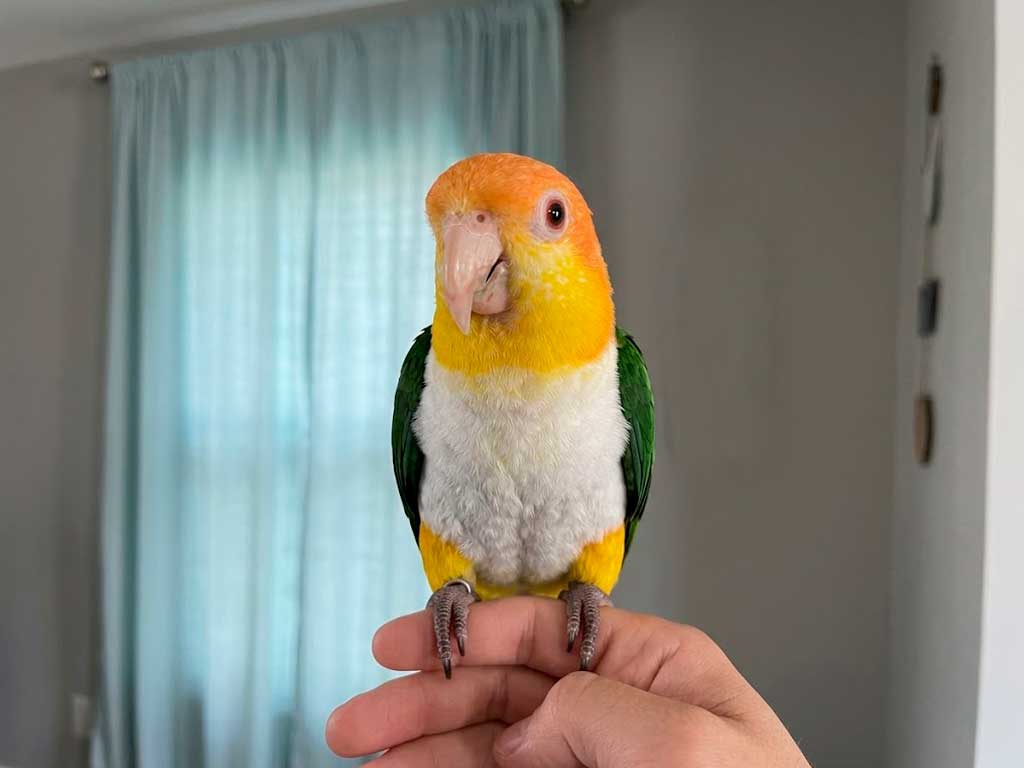
White-bellied caiques (Pionites leucogaster) swap the black cap for orange, keep the white belly and green wings, and tend to run a touch calmer than their black-headed cousins, though “calmer” for a caique still means constantly busy.
Both species reach about 9 inches long, weigh around 150 to 170 grams, and can live 25 to 30 years with good care. Care needs are essentially identical between them; the choice usually comes down to coloring and which temperament description sounds like a better fit.
Housing: Cage Size and Setup
Aim for a cage at least 24 inches wide, 24 inches deep, and 36 inches tall, with plenty of horizontal room for a bird that would rather bounce sideways than fly. Bar spacing should sit around 1/2 to 5/8 inch.
Caiques are natural hole-nesters in the wild, and that instinct doesn’t disappear in a living room. They’ll investigate any gap they can fit into, behind furniture, inside a cabinet, wherever, so block off small openings in the room before letting the bird out to explore. It’s a genuinely different safety consideration than most parrots on this site require.
These birds are enthusiastic, near-constant chewers. Replace perches regularly, and offer branches from apple or other fruit trees along with willow for gnawing; a caique that can’t wear down its beak naturally is at risk of overgrowth. Frequent bathing matters too, several times a week if the bird enjoys it, since it keeps plumage in good condition.
Fill the cage with foraging toys, ladders, and ropes rather than relying on perches alone. Because caiques would rather hop and climb than fly between two points, a floor-level play area or a low stand gives them a way to explore that feels natural, and it’s worth keeping that space just as stocked with chewable and destructible toys as the cage itself.
Diet: What Caiques Eat
Build the diet around a high-quality pellet, with fresh fruit playing a bigger role for caiques than it does for most parrots. Apples (including the pips, which aren’t harmful to birds), grapes, pears, oranges, and seasonal berries are all good options, and tropical fruits like mango, guava, and passion fruit add variety.
Round things out with fresh vegetables and a modest seed portion. Skip high-fat, seed-only diets entirely, since they’re a fast track to obesity and liver problems in this species.
Avoid avocado, chocolate, caffeine, and anything high in salt or sugar, same as with any parrot.
Temperament: The Clowns of the Parrot World
Caiques move like they’ve had too much coffee, and that’s not an exaggeration most owners would push back on. They hop rather than fly when given the choice, roll onto their backs to play, and “surf” across soft surfaces like towels or paper just for the fun of it. Their strong, zygodactyl feet, two toes forward and two back, make them exceptional climbers and acrobats.
That same fearlessness has a downside. Caiques have no real sense of their own small size and will confidently approach a dog, a cat, or anything else that catches their interest, which can end badly without close supervision. They’re also strong-willed and need firm, consistent, kind training from an early age; without it, nipping and stubborn behavior tend to show up.
Noise-wise, caiques aren’t the loudest birds on this site, but their calls are high-pitched and can carry, especially when the bird wants attention and isn’t getting it. Talking ability is modest at best; a caique’s charm comes from its physical comedy and expressiveness, not its vocabulary.
One Bird or Two?
Unlike some small parrots that do better alone, caiques are genuinely social and often want an avian companion in addition to their human relationship. A single caique that doesn’t bond closely with its owner can seem noticeably lonely.
Introductions matter enormously here. Caiques can react instantly and aggressively to an unfamiliar bird, so a new introduction should happen gradually, adjoining cages first, supervised time together after, rather than putting two birds in one cage right away. If a second caique isn’t in the cards, another small South American parrot, like a conure, can sometimes fill the same social role.
Common Health Issues
Psittacine beak and feather disease (PBFD) and proventricular dilatation disease (PDD) affect caiques as they do other parrots, making an annual avian vet exam and testing new birds before introducing them to a flock worthwhile here too.
One notable exception among parrots: caiques that need a wing clip generally don’t seem to suffer for it the way many other species do. They stay just as active and playful on the ground and around furniture, since hopping and climbing were always more their style than sustained flight anyway.
How Much Does a Caique Cost?
Expect to pay somewhere between $800 and $1,500 for the bird itself, depending on species and source. Setup costs, cage, perches, toys, and dishes, add a meaningful amount on top, and food and annual vet visits continue for a lifespan that can stretch past 25 years.
Choosing an Ethical Source
A pet caique should always be captive-bred. Look for a legitimate breeder who is transparent about a chick’s history and willing to let you see the parent birds without hesitation, and who is upfront if a bird carries any hybrid or unusual lineage rather than presenting it as something it isn’t.