Neolamprologus leleupi: The Complete Care Guide
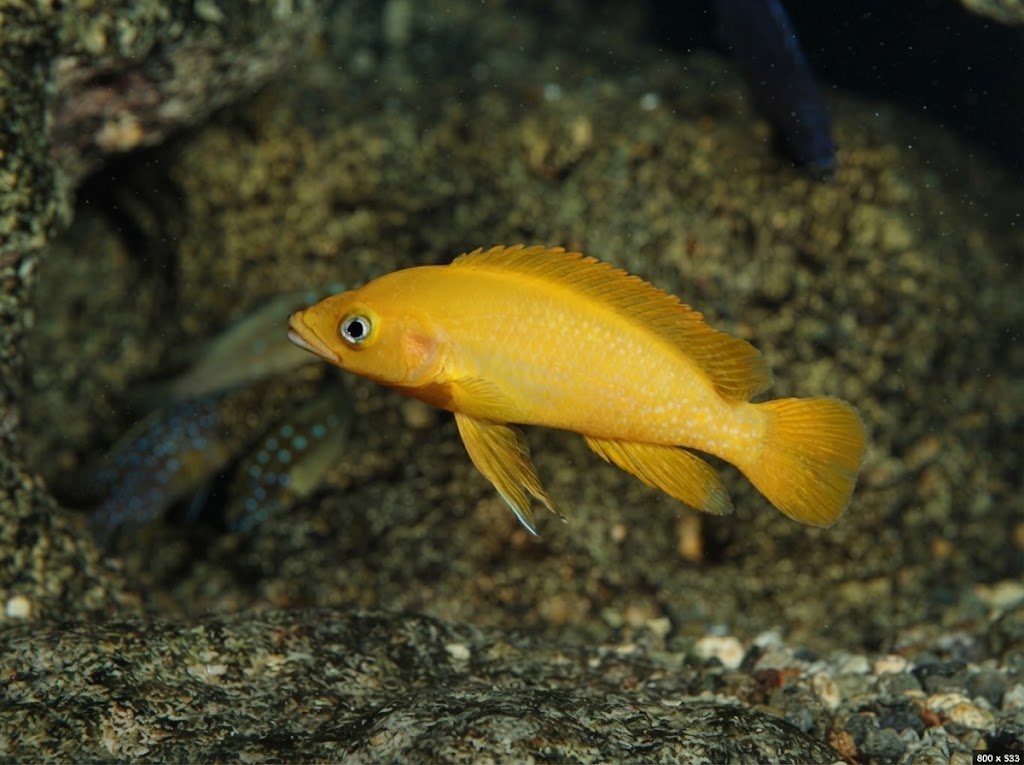
Neolamprologus leleupi is one of those Tanganyika cichlids that looks deceptively simple. A yellow fish, a pile of rocks, some hard water, and you might think the setup is straightforward. In practice, the hard part is managing territory. This species can reach about 10–12 cm, lives around rocky areas of Lake Tanganyika, and becomes particularly serious about its chosen cave when it pairs and breeds.
This guide covers the practical side of neolamprologus leleupi care, including tank size, water chemistry, aquascaping, feeding, aggression, tank mates, sexing, and breeding.
Neolamprologus leleupi at a Glance
| Parameter | Recommended target |
|---|---|
| Scientific name | Neolamprologus leleupi |
| Common names | Lemon Cichlid, Leleupi Cichlid |
| Family | Cichlidae |
| Origin | Lake Tanganyika, East Africa |
| Adult size | About 4 inches, with large males reaching around 4.7 inches |
| Temperature | 75–79°F (24–26°C) |
| pH | 7.5–8.5, with stable alkaline water preferred |
| Hardness | Hard, mineral-rich water |
| Diet | Carnivorous-leaning omnivore/invertivore |
| Temperament | Territorial and aggressive around defended areas |
| Breeding | Cave or hidden-substrate spawning |
| Activity | Mostly diurnal |
| Typical habitat | Rocky areas, crevices, caves |
Fishipedia lists an average size of 10 cm and a maximum of 12 cm, while FishBase records a maximum of 10 cm and notes that the species is associated with recesses in its rocky biotope.
What Makes Neolamprologus leleupi Different?
The first thing to understand is that Neolamprologus leleupi is a rock-dwelling Tanganyikan cichlid with a strong territorial instinct.
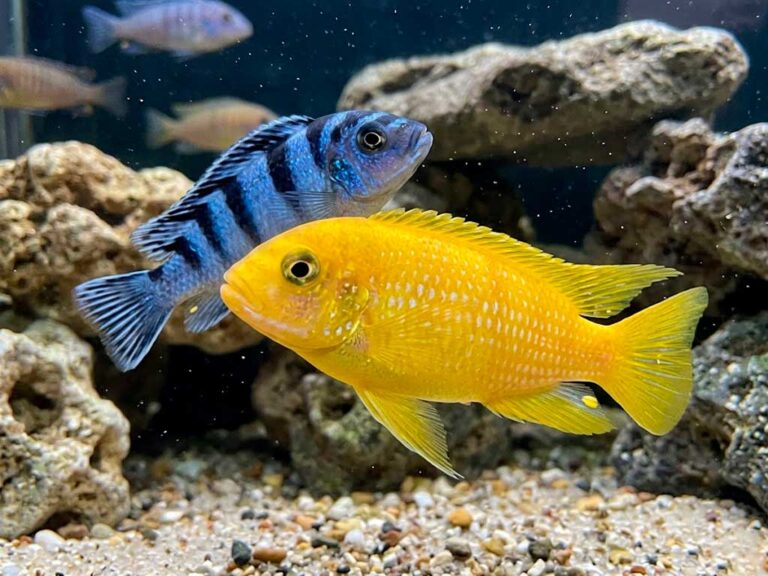
It is commonly sold in yellow or orange forms, which is where names such as Lemon Cichlid and Orange Leleupi come from. Color can vary between populations and aquarium strains, so I would not use color alone to identify a particular geographic form.
The fish spends much of its time close to rockwork, moving through cracks and defending useful pieces of habitat. FishBase describes it as a fish that usually occurs in recesses of the biotope and feeds on invertebrates found in the biofilm and deeper substrate recesses.
That detail matters when you build the aquarium. Open water with a few decorative rocks does not give this fish the same environment as a properly structured Tanganyika setup.
Natural Habitat and Distribution
Neolamprologus leleupi is endemic to Lake Tanganyika in East Africa, with its distribution associated with the southern half of the lake. FishBase lists the Democratic Republic of the Congo among its distribution information, while Fishipedia also identifies Lake Tanganyika and the DRC as part of its natural range.
The natural environment is characterized by rocks, stones, cracks, and sheltered recesses. The species is not a plant-dependent fish. Its world is much more about hardscape than vegetation.
Water is alkaline and relatively hard. FishBase lists a natural pH range of 7.5–8.0 and hardness of 12–15 dH, with a natural temperature range of 24–26°C.
In practice, stability matters more than chasing a number every morning. A tank that stays consistently alkaline and mineral-rich is easier to manage than one where the pH repeatedly rises and falls.
Neolamprologus leleupi Tank Size
Tank size is one area where recommendations vary considerably depending on whether you are keeping a pair, a group, or a community of Tanganyikan cichlids.
FishBase records a minimum aquarium length of 80 cm, while Fishipedia recommends a 200-liter aquarium for a group of at least five fish.
For a practical home aquarium, I would approach it this way:
- A single established pair: around 30 gallons can work when the aquarium is heavily structured with rockwork and caves.
- A group: give them substantially more floor space. Around 55 gallons or larger gives you much more room to create separate territories.
- A Tanganyika community: 75 gallons or larger is a much more comfortable starting point because you need room for multiple territories and enough distance between species.
The important measurement is not just water volume. Footprint matters.
A tall aquarium with limited floor space does little to solve territorial disputes. A longer tank gives fish the ability to move around one another and allows the rockwork to create visual barriers.
How to Set Up a Neolamprologus leleupi Aquarium
The aquascape should look more like a rocky shoreline than a planted community tank.
Start with a stable base of rocks. Build caves and narrow passages rather than creating one giant pile that leaves every fish competing for the same shelter.
You want several usable territories.
A good arrangement gives each fish or pair somewhere to retreat without constantly swimming through another fish’s defended area.
Substrate
Fine sand works well and fits the natural appearance of Lake Tanganyika habitats.
A thin to moderate sand bed is enough. There is no reason to build an extremely deep substrate layer unless another part of your aquarium requires it.
Avoid sharp gravel that can cause problems when fish forage close to the bottom.
Rockwork
Rockwork is the most important part of the layout.
Create several caves and openings of different sizes. Some should be narrow enough to feel secure, while others should provide larger passageways.
Stack rocks securely. Cichlids can rearrange small pieces of substrate, and unstable rockwork can become dangerous if a fish digs underneath it.
I also like to leave some clear visual breaks between territories. If two fish can stare directly at each other across the entire aquarium, aggression often becomes more persistent.
Neolamprologus leleupi Water Parameters
This species comes from one of the world’s major African rift lakes, so soft, acidic community-tank water is a poor match.
A practical target is:
| Parameter | Target |
|---|---|
| Temperature | 75–79°F (24–26°C) |
| pH | 7.5–8.5 |
| GH | Around 12–15 dGH or appropriately hard |
| KH | Moderate to high |
| Ammonia | 0 ppm |
| Nitrite | 0 ppm |
| Nitrate | Keep consistently low |
Fishipedia gives 24–26°C, pH 7.5–8, and GH 12–15 for the natural environment. It also recommends keeping nitrate below 50 mg/L.
I would treat 50 mg/L as an upper limit rather than a target. Cleaner water gives you more margin, especially when several territorial cichlids share a relatively small footprint.
The biggest mistake is chasing pH with chemicals while ignoring the hardness and buffering capacity underneath it.
If your source water is naturally soft, establish a stable mineral profile before adding the fish. Test your water rather than guessing from the local tap-water reputation.
Filtration and Water Movement
Neolamprologus leleupi benefits from clean, well-oxygenated water.
Use filtration appropriate for the aquarium’s actual bioload, not simply the manufacturer’s maximum tank rating.
A good setup can combine biological filtration with enough mechanical filtration to remove suspended waste from the rockwork.
Moderate circulation is useful, but you do not need to turn the aquarium into a washing machine. The goal is oxygenation and consistent water quality while leaving calmer areas around caves where fish can settle.
Regular maintenance is more important than buying the largest filter you can fit.
Feeding Neolamprologus leleupi
Fishipedia classifies Neolamprologus leleupi as omnivorous and recommends a varied diet that can include dry, fresh, and frozen foods. FishBase describes its natural feeding behavior as focused on invertebrates found in the biofilm and recesses of the substrate.
That combination gives you a useful feeding strategy.
A quality cichlid pellet or small granule can form the base of the diet. Supplement it with appropriate frozen foods such as mysis or other small aquatic invertebrate foods.
Feed modest portions.
Fishipedia recommends meals that are consumed within roughly 2–3 minutes and warns that excess food quickly contributes to ammonia, nitrite, and nitrate problems.
For a Tanganyika aquarium, overfeeding is especially frustrating because you are putting extra organic waste into a system where water chemistry already needs to remain stable.
Two small feedings can be preferable to one oversized meal if your fish respond well to that schedule.
How Aggressive Is Neolamprologus leleupi?
This is where many new keepers underestimate the species.
Neolamprologus leleupi is territorial. Fishipedia specifically notes strong territorial behavior and aggressive interactions with other territorial fish, as well as conflict between members of the same species.
A fish defending a cave is behaving normally.
The problem starts when the aquarium gives it nowhere else to go.
Rockwork should therefore be used to break lines of sight. If the dominant fish can see every corner of the tank from one territory, it effectively controls the whole aquarium.
A smaller, well-designed territory can sometimes work better than a larger empty aquarium.
Breeding can intensify this behavior. Once a pair has eggs or fry in a cave, expect them to defend that area much more seriously.
Neolamprologus leleupi Tank Mates
Tank mates should be chosen according to territory, swimming zone, temperament, and aquarium footprint.
Other Lake Tanganyika species can work in a properly designed aquarium, but there is no universal combination that is safe in every tank.
Species that constantly compete for the same caves and rock territories create problems.
Fast open-water Tanganyikan species can occupy a different part of the aquarium, while certain rock-dwelling species may require more careful planning because their territories overlap.
Avoid mixing N. leleupi with fish that need very different water chemistry.
You should also be cautious about keeping several strongly territorial species together simply because they all come from Lake Tanganyika. Origin does not automatically make them compatible.
For a deeper look at African cichlid husbandry, see our Tropheus Cichlid Care Guide.
And if you are planning a larger Tanganyika community, our Frontosa Cichlid Tanganyika Care Guide covers a very different type of Tanganyikan setup.
Male vs. Female Neolamprologus leleupi
Sexing Neolamprologus leleupi by appearance can be difficult.
Fishipedia notes that adult males are larger than females.
Size alone is not a reliable way to identify every fish, especially with younger specimens.
For this reason, aquarists who want a breeding pair often have better results by starting with several juveniles and allowing a compatible pair to form naturally.
Once a pair establishes a territory, the behavior becomes much more informative than trying to judge sex from color.
Breeding Neolamprologus leleupi
Neolamprologus leleupi is a cave or hidden-substrate spawner.
The female deposits eggs in a protected location, while the pair defends the surrounding territory. Fishipedia classifies the species as an oviparous fish that lays on hidden substrate and confirms egg protection as part of its breeding behavior.
The best breeding setup is therefore simple:
- Provide several caves before the fish pair.
- Keep water parameters stable.
- Feed a varied, appropriate diet.
- Give the pair a defined territory.
- Avoid overcrowding the breeding area.
Do not be surprised when a normally manageable pair becomes much more aggressive after spawning.
This is also why removing excess fish from a breeding setup can become necessary. A pair that tolerated young or unrelated fish before breeding may suddenly decide that every nearby fish is an intruder.
How to Encourage a Pair
Starting with a group of juveniles can be more practical than trying to buy a guaranteed male and female.
Let them grow together in a properly sized aquarium with enough rockwork.
As the fish mature, a compatible pair may establish itself. Once that happens, observe the remaining fish carefully.
The important part is having somewhere for subordinate fish to escape.
A tank where the dominant pair controls every cave becomes a trap for the other fish.
Common Neolamprologus leleupi Care Mistakes
Using soft water
This is one of the easiest mistakes to avoid. Lake Tanganyika cichlids need alkaline, mineral-rich water.
Underestimating aggression
A yellow 4-inch fish may look harmless in a store tank. Give it a cave and a breeding partner, and the behavior can look very different.
Building one large cave
One impressive centerpiece is often less useful than several smaller territories.
Keeping too many fish in a short tank
Volume alone does not solve territorial pressure. Floor length and sight breaks matter.
Overfeeding
Extra food becomes extra waste. Keep portions small and watch how quickly the fish finish them.
Changing water chemistry too quickly
Stable parameters are more useful than constantly adjusting the tank toward a slightly different number.
Adding tank mates without a territory plan
Every species needs somewhere to live. If two species both want the same rocks and caves, conflict is predictable.
Is Neolamprologus leleupi a Good Fish for Beginners?
It depends on what you mean by beginner.
Someone keeping their first tropical community aquarium would probably have an easier start with a less territorial species.
An aquarist who already understands the nitrogen cycle, tests water regularly, and can maintain hard alkaline water may find Neolamprologus leleupi quite manageable.
The fish itself is not unusually fragile. The challenge is designing the environment around its territorial behavior.
That distinction matters.
You are not simply keeping a yellow cichlid. You are building a small rocky territory system and then managing the relationships inside it.
Neolamprologus leleupi vs. Other Tanganyika Cichlids
One useful way to understand this species is to compare it with other Tanganyika fish rather than treating all African cichlids as interchangeable.
Tropheus are heavily associated with grazing behavior and specialized diets, which makes their feeding strategy a major part of their care.
Neolamprologus leleupi is more closely tied to rocky crevices and territorial cave spaces.
Cyphotilapia frontosa, meanwhile, grows dramatically larger and requires an entirely different approach to tank size and aquascaping.
You can explore these differences in our Tropheus Cichlid Care Guide and Frontosa Cichlid Tanganyika Care Guide.
For another African cichlid with a very different profile, see our Labidochromis caeruleus Care Guide.
Frequently Asked Questions
The Numbers That Matter Most
A successful Neolamprologus leleupi aquarium comes down to a few practical numbers and decisions.
Keep the temperature around 75–79°F (24–26°C), maintain alkaline, hard water, keep ammonia and nitrite at zero, and provide enough floor space for territories rather than relying on volume alone.
Then build the rocks carefully.
Give the fish several caves instead of one dominant shelter. Break sight lines. Keep feeding controlled. Watch what happens when a pair begins defending a spawning site.
The most useful upgrade you can make is often not another piece of equipment. It is better territory design.
For an aquarist who can keep stable Tanganyika water and is willing to respect the species’ territorial nature, Neolamprologus leleupi can be one of the most rewarding rock-dwelling cichlids to keep.