Demasoni Cichlid (Chindongo Demasoni): Care Guide & Stocking
Stocking advice for the demasoni cichlid runs from one male with a few females to a colony of twelve or more, and the gap between those recommendations is the most useful thing to understand before buying. In practice, every source agrees on the underlying problem: this tiny Lake Malawi mbuna is fiercely aggressive toward its own kind, and the stocking plan is the main tool for managing that.
This guide covers where the sources agree and disagree, the odd way this fish hugs rockwork, why sexing it is so hard, and why a species bred by fish farms in large numbers still carries a Vulnerable IUCN rating.
Quick Identity Card
| Trait | Detail |
| Scientific name | Chindongo demasoni (Konings, 1994), formerly Pseudotropheus demasoni |
| Common names | Demasoni Cichlid, Midnight Demasoni |
| Family | Cichlidae (mbuna, Lake Malawi) |
| Origin | Ndumbi Point to Pombo Rocks, Tanzanian coast of Lake Malawi |
| Adult size | About 8 cm (3.2 in) in most references; formal maximum 10 cm SL |
| Diet | Herbivore-leaning grazer of algae and the tiny life in it |
| Temperament | Territorial, highly aggressive toward its own kind and look-alikes |
| Water temperature | 24 to 26°C (75 to 79°F); 23 to 28°C reported |
| pH | 7.5 to 8.8 |
| GH (hardness) | Roughly 8 to 20 dGH, up to 25 reported |
| Minimum tank | Sources range from about 190 L (50 US gal) to 300 L (80 US gal) |
| Breeding | Maternal mouthbrooder |
| IUCN status | Vulnerable (2018) |
Origin and a Name Two Camps Still Use
Ad Konings described the species in 1994 as Pseudotropheus demasoni, in a paper whose title already flagged its most awkward trait: it is sexually monomorphic, meaning males and females look alike. The name honors Laif DeMason, a cichlid importer, exporter, and breeder from Homestead, Florida.
In 2016 the literature split. A paper by Li and colleagues placed the species in the newly introduced genus Chindongo, alongside other members of the Pseudotropheus elongatus group, and Eschmeyer’s Catalog of Fishes now lists Chindongo demasoni as the valid name. Konings himself and Stauffer and colleagues kept using Pseudotropheus in work published that same year. Shops and older care sheets use either name, so searching under both is the safest way to find information or fish.
Natural Habitat
The species is known only from a short stretch of Tanzanian coast on the northeastern side of Lake Malawi, between Ndumbi Point and Pombo Rocks, south of the Ruhuhu River. It lives on rocky reefs battered by waves, in shallow water that sources place anywhere from about 3 to 10 meters deep. There it grazes the algae mat (aufwuchs) coating the stone and shelters in crevices and caves.
Identification, Size, and the Sexing Problem
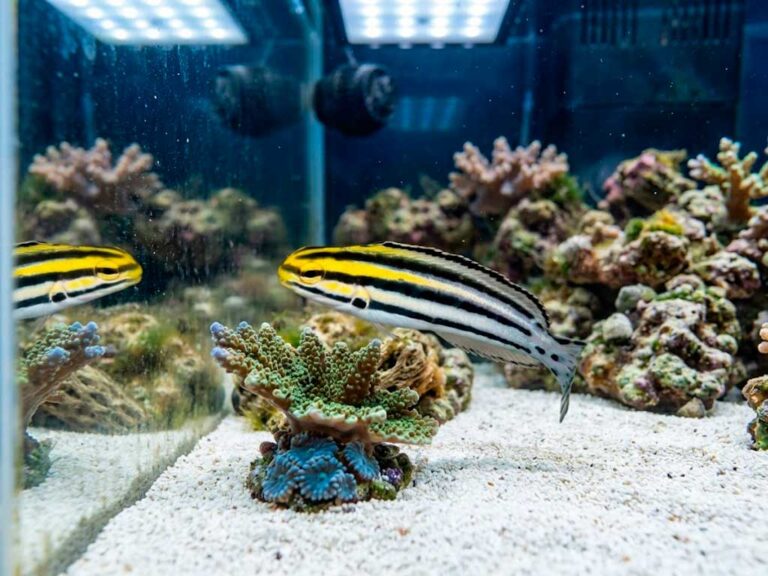
Both sexes wear the same livery: a dark blue body crossed by black vertical bars, with lighter bars in pale blue to white alternating between them, running over the fins and head. Under stress the pattern fades to a much paler version of itself.
Adult size is one of the most searched details, and the sources vary. Most care references list around 8 cm (3.2 in) as the top size, with males larger than females, one source puts females at no more than 6 cm, and the formal maximum is 10 cm SL. Plan for the larger figures.
Sexing is where the species frustrates keepers. The original description calls it sexually monomorphic, and coloration alone won’t sort the sexes reliably. The clues that do help are size, since adult males run larger, along with longer ventral fins, egg-spots on the anal fin (females may lack them), and behavior, because males are far more territorial. Some males also show whitish wear around the mouth from digging in gravel. A few care sheets claim males have bolder barring, so treat color-based sexing claims with caution.
Stocking a Demasoni Cichlid Group: Where the Sources Disagree
Here’s what actually matters before buying: reputable sources give genuinely different stocking plans for this fish. A specialist UK retailer recommends a colony of twelve or more, arguing that numbers spread the aggression so no single fish becomes the permanent target, while groups of two or three see a dominant fish harass and kill weaker ones. Fishkeeper also describes the species as best kept crowded in a well-maintained tank with plenty of rockwork.
Acuario Adictos takes a different route: one male with several females in at least 200 L, two males only in larger tanks, and an ideal setup of around 400 L holding two males and eight to ten females. Fishipedia suggests at least four fish in 300 L, with roughly three females per male.
The common ground is more useful than the differences. Every one of these plans keeps males from crowding each other in small tanks, favors more females than males, and leans on rockwork and volume. In practice, the safer reading is to go bigger on volume than the smallest figures cited, keep at most one male in a modest tank, and add numbers only when the tank can carry them.
An Odd Way of Moving
Acuario Adictos describes a habit that sets this mbuna apart: it hugs walls, rocks, caves, and the substrate, seemingly never exposing its belly, and it follows the contours of the rockwork even if that means swimming upside down. That constant contact with stone is a good reason to build the tank around a solid rock structure with plenty of caves, instead of a few decorative pieces.
Digging matters too. The species digs in sand or gravel and can uproot plants or rearrange decor, so a planted tank is a poor fit.
Diet and Feeding
In the wild this mbuna grazes aufwuchs, the layer of algae and tiny animals growing on the rock, so the aquarium diet should lean plant-based. Sources disagree on how strictly herbivorous it is, but a safe core is spirulina flakes, algae-based tablets, and vegetables such as lettuce and nori, alongside any good granulated African cichlid food.
Occasional live or frozen extras like Artemia nauplii, daphnia, or mosquito larvae add variety. One specialist retailer warns against red mosquito larvae (bloodworms), which it links to digestive problems. The feeding guide for ornamental fish covers building a balanced rotation in more depth.
Tank Requirements and Water Parameters
Volume recommendations run from about 190 L (50 US gallons) in retail listings to 200 L, 250 L, and 300 L (roughly 80 US gallons) in specialist care sheets, and the higher figures make more sense for any group larger than a harem. The tank should be built around stacked rock with plenty of caves and crevices, over sand or fine gravel, with good oxygenation, water movement, and lighting strong enough to grow some algae. The African cichlid tank setup guide covers building that kind of system from the ground up.
Water needs to stay hard and alkaline like the rest of Lake Malawi: temperature between 24 and 26°C (75 to 79°F), with 23 to 28°C reported as tolerable, pH from 7.5 to 8.8, and general hardness roughly 8 to 20 dGH, with up to 25 dGH reported. Fishipedia adds a practical tip: limestone-type rock such as travertine helps support the alkaline chemistry. Sudden swings stress the fish far more than moderate variation in any of these numbers, so stability matters more than chasing an exact target.
Tankmates and Compatibility
Sources split on how this fish treats other species: one calls it peaceful toward unrelated fish, while another calls it particularly virulent toward other territorial species. They agree on the vulnerable targets. Look-alikes with similar coloring and any fish smaller than a demasoni are at risk, which rules out other blue-and-black barred mbuna and small tankmates. One retailer also advises against mixing it with invertebrates or non-mbuna fish, and Fishipedia recommends against keeping several species of the same genus together, to avoid hybrids.
The Malawi mbuna covered in this series show how wide the temperament range is. The yellow lab in the Labidochromis caeruleus guide is notably peaceful, while the Melanochromis auratus guide covers one of the most combative mbuna of all. Demasoni sit closer to the combative end, so a gentle tankmate can be outmatched.
Breeding
Demasoni are maternal mouthbrooders, and dominant males are polygamous. Courtship features a T-shaped display in which the male vibrates his whole body. Eggs are laid on the substrate, the female collects them in her mouth, and incubation is reported at 21 to 30 days.
Good water hygiene supports spawning readiness. Hiding places and visual barriers help protect weaker fish from the territorial fighting that breeding can trigger, which one source warns can turn deadly.
Buying a Colony
Because stocking advice varies so much, the price of a single fish says little about the real cost. Retailers commonly sell juveniles around 4 to 6 cm, often as trios or with bulk discounts, and availability is described as occasional, so asking a specialist shop ahead of time can help. Ask whether the fish are farm-bred, and size the tank for adults instead of the juveniles in the shop.
Conservation Status
The IUCN assessed Chindongo demasoni as Vulnerable in 2018, the most serious rating among the Malawi mbuna covered in this series so far. The reason is geography: the species lives on one short stretch of coast, which leaves it exposed to overfishing by ornamental collectors. Some care sheets still list it as Not Evaluated, but the 2018 assessment is the current one.
Ad Konings, who described the species, wrote that twelve years after its discovery he was pleased to find it still living at Pombo Rocks, with the population appearing stable. He also noted that its popularity has led large fish farms to breed it in bulk, so the natural population doesn’t need to be exploited. That makes the sourcing choice simple: buy farm-bred fish.