African Cichlid Tank Setup: The Complete Guide to Getting It Right
African cichlid tank setup is not the same as setting up a community aquarium. The rules are different, the priorities are different, and the margin for error is smaller.
Get it right and you have one of the most stunning displays in freshwater fishkeeping. Get it wrong and you face constant aggression, disease outbreaks, and fish deaths that experienced hobbyists have learned to avoid.
This guide covers everything about the physical setup: tank size, substrate, rockwork, filtration, water chemistry, lighting, and the nitrogen cycle. No species profiles. No stocking lists. Just the tank itself, built correctly from day one.
What Makes Tank Setup Different
African cichlids come from the East African Rift Valley lakes. These are ancient, chemically stable bodies of water with hard, alkaline water, rocky substrates, and very little plant life.
That origin shapes every decision you make. These fish did not evolve in the soft, neutral water of a community tank. They expect specific chemistry, specific structure, and specific filtration capacity. Meeting those expectations is not optional if you want healthy, colorful fish.
The other critical factor is aggression. African cichlids are territorial by nature. The tank setup itself is your primary tool for managing that aggression. The right substrate, the right rockwork, and the right tank dimensions reduce conflict far more effectively than any stocking strategy alone.
Tank Size: Longer Is Better
The single most common mistake in African cichlid tank setup is choosing a tank that is too small or shaped incorrectly.
These fish need horizontal space, not vertical height. A tall, narrow 75-gallon corner tank is far less functional than a long, wide 75-gallon rectangle. What matters is floor space and swimming length.
Practical minimum sizes by group:
- Mbuna (rock-dwelling cichlids): 55 gallons absolute minimum; 75 gallons strongly preferred. Mbuna are intensely territorial and require constant movement to disperse aggression. Undersized tanks produce relentless chasing that ends in death.
- Peacocks and Haps (open-water swimmers): 75 gallons minimum; 125 gallons ideal. These fish swim in open water and need room to patrol without constantly entering each other’s territory.
- Large predatory cichlids (Frontosa, large Haps): 125 gallons minimum; 150-200 gallons preferred.
One rule applies to all groups: always buy the largest tank your space and budget allows. Every aquarist who has kept African cichlids long-term will tell you they wish they had started bigger.
Tank footprint matters more than volume. A 75-gallon tank should measure at least 48 inches in length and 18 inches in depth. Avoid tall, narrow designs entirely. Cichlids patrol horizontally, not vertically.
Substrate: Why Aragonite Is the Standard
Your substrate choice in an African cichlid tank setup directly affects water chemistry. This is not a cosmetic decision.
African cichlids require hard, alkaline water with a pH between 7.8 and 9.0, depending on the lake of origin. Achieving and maintaining that chemistry starts at the bottom of the tank.
Aragonite sand is the industry standard for good reason. Aragonite is primarily calcium carbonate, which dissolves slowly in water and naturally buffers pH upward toward the alkaline range. It provides passive, ongoing pH support without chemical intervention.
Use a grain size of 1-2mm. Finer sand compacts over time, traps waste in anaerobic pockets, and causes long-term water quality problems. Coarser gravel traps waste between particles. The medium grain size of quality aragonite avoids both issues.
Maintain a depth of 1.5 to 2 inches across the tank floor. This gives cichlids enough substrate to sift through naturally, which is an important behavioral outlet, without creating dead zones where harmful bacteria thrive.
Pool filter sand is an acceptable lower-cost alternative, but it does not buffer pH. If you use it, add crushed coral in a mesh bag inside your filter to compensate. Roughly half a cup of crushed coral per 20 gallons of tank water provides sufficient supplemental buffering.
Avoid colored gravel entirely. Dyes and coatings can leach into water over time, and gravel simply does not function as well as sand for these fish.
Rockwork: Your Most Powerful Aggression Management Tool
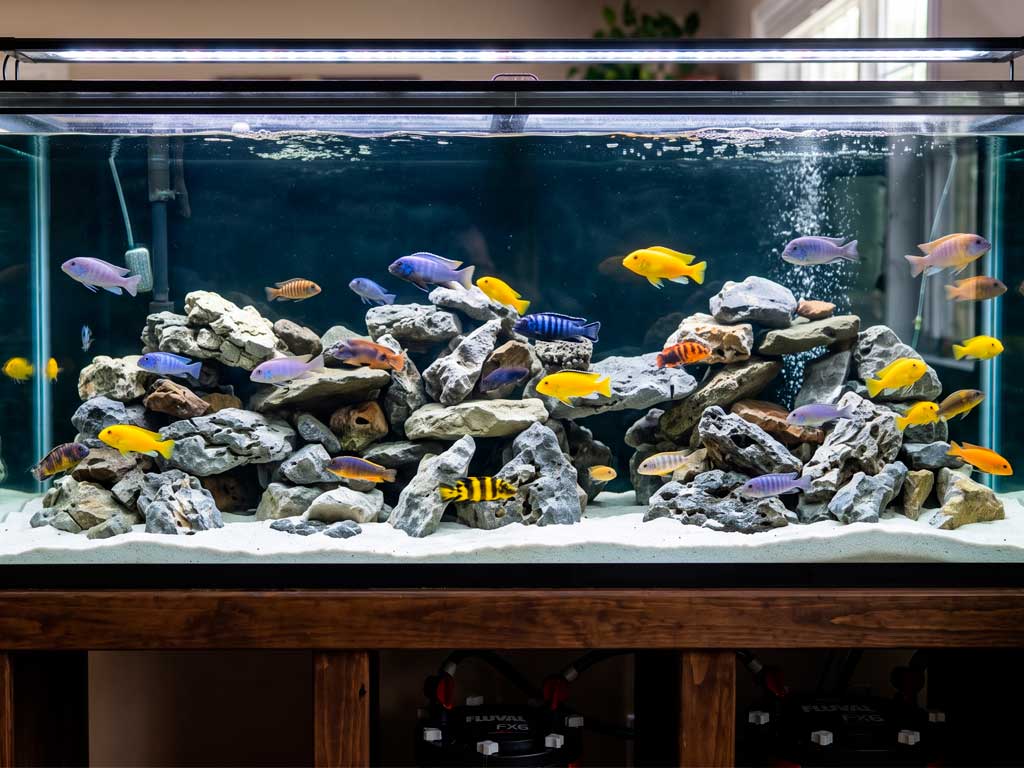
Rocks in an African cichlid tank setup are not decoration. They are functional infrastructure that determines whether your fish can coexist.
African cichlids establish territories, and those territories are defined by visual barriers. When a dominant fish cannot see every corner of the tank at once, subordinate fish can find refuge and reduce stress. Without adequate rockwork, dominant cichlids patrol constantly and exhaust or kill weaker fish.
The foundation rule: Never place rocks directly on sand. African cichlids dig. A fish that digs under a rock stack sitting on sand can cause the entire structure to collapse, crushing fish and cracking glass. Instead, place your largest foundation rocks directly on the bare glass bottom of the tank first. Then add substrate around and between them.
After positioning your base layer, secure any tall or unstable stacks with aquarium-safe silicone or reef epoxy. This is especially important in tanks with strong diggers.
What to build:
- Create multiple distinct rock piles, not one central pile. Several smaller formations give more fish their own territory anchor point.
- Include caves, overhangs, and tunnels in every pile. Aim for at least one cave per fish, then add 30-50% more than you think you need.
- Use rocks to break sightlines. A subordinate fish being chased needs to be able to disappear around a corner.
- Leave open swimming space in the center of the tank, particularly for peacock and hap setups.
Safe rock types for African cichlids:
- Texas Holey Rock (porous limestone, also buffers pH)
- Lace Rock
- Limestone
- Granite and basalt (do not buffer pH but are safe and attractive)
Rock types to avoid:
- Anything with metallic veins or streaks (potential heavy metal leaching)
- Painted or sealed decorative rocks
- Marble (raises pH to dangerously high levels)
A black background behind the tank dramatically improves the visual impact of both the rockwork and the fish. It also makes equipment behind the glass invisible. This is one of the cheapest improvements you can make and one of the most effective.
Water Chemistry for Tank Setup
Stable water chemistry is more important than perfect chemistry. A tank that holds steady at pH 8.0 is far healthier than one that swings between 7.6 and 8.4 daily.
Target parameters:
| Parameter | Malawi and Victoria | Tanganyika |
|---|---|---|
| pH | 7.8-8.4 | 8.6-9.0 |
| GH (general hardness) | 10-20 dGH | 10-20 dGH |
| KH (carbonate hardness) | 10-20 dKH | 10-20 dKH |
| Temperature | 76-82°F (24-28°C) | 74-80°F (23-26°C) |
Do not mix fish from different lakes in the same tank. Their pH requirements conflict directly, and compromise parameters make both groups uncomfortable.
Achieving and maintaining these parameters:
Aragonite substrate handles most of the buffering passively. Add crushed coral in your filter for supplemental support. If your tap water is very soft or acidic, use a Rift Lake mineral supplement at water change time. These products replicate the mineral profile of the East African lakes more accurately than baking soda and Epsom salt combinations, which lack calcium, potassium, and trace elements.
Water change schedule: Perform 20-30% water changes weekly. Always treat new water with a dechlorinator before adding it. Match the temperature of the new water to the tank temperature before adding it. A sudden temperature shift of even 3-4 degrees can trigger ich outbreaks in otherwise healthy fish.
Testing: During the first month of the tank, test pH, GH, and KH twice weekly. Once parameters stabilize, test weekly. Keep records. A pattern of gradual pH drop over weeks tells you the aragonite needs supplementing before it causes problems.
Filtration: The Most Common Failure Point
Inadequate filtration is the number one reason African cichlid tanks fail after setup.
These fish eat aggressively and produce considerable waste. Standard community tank filtration calculations do not apply here. For African cichlids, target a turnover rate of 8 to 10 times the tank volume per hour through your filter.
For a 75-gallon tank, that means 600 to 750 gallons per hour of filtration capacity. For a 55-gallon tank, aim for 440 to 550 gallons per hour.
Best filtration options for African cichlid tank setup:
Canister filters provide the best combination of mechanical filtration, biological capacity, and water clarity. They hold large volumes of biomedia and can be loaded with crushed coral for additional pH buffering. The Fluval FX series is the most widely used in the hobby for tanks 75 gallons and above.
Sump systems are the most powerful option for large, heavily stocked tanks. They hold significantly more biomedia than any canister filter, are easy to maintain, and keep equipment outside the display tank. They require more planning during setup but are worth it for tanks 125 gallons and above.
Hang-on-back filters are acceptable for smaller tanks below 55 gallons. For larger tanks, use two HOB filters rather than one, or pair a HOB with a canister as backup.
Filter media layering: From top to bottom, arrange mechanical filtration first (coarse sponge or filter floss to catch particles), then biological media (ceramic rings, bio-balls, or lava rock), then a supplemental layer of crushed coral in a mesh bag. Avoid activated carbon in an African cichlid setup. Carbon disrupts the buffering chemistry and needs to be replaced too frequently to be cost-effective.
Add a powerhead or circulation pump to eliminate dead spots in large tanks. Position it to push water along the bottom toward the filter intake. African cichlids from Malawi live in a lake that experiences significant wave action. Moderate circulation benefits both their behavior and water quality.
Lighting
Lighting in an African cichlid tank setup serves two purposes: making the fish look their best and maintaining a consistent day-night cycle.
African cichlids do not require specialized lighting for plant growth. They need moderate light at a spectrum that enhances their natural coloration.
Use a LED fixture in the 6,500K to 10,000K range. The higher end of this spectrum brings out blue and yellow pigments particularly well. Set your light on a timer for 10 to 12 hours per day. Consistent light cycles reduce stress and support natural breeding behaviors.
Avoid overlit tanks. Excessive light promotes aggressive algae blooms and can bleach the color of some cichlids over time. If algae becomes a problem, reduce the photoperiod by one to two hours before any other intervention.
The Nitrogen Cycle: Do Not Skip This Step
This is the most impatience-inducing part of African cichlid tank setup, and the most important.
A new tank has no beneficial bacteria. Those bacteria, primarily Nitrosomonas and Nitrospira species, are what convert toxic ammonia from fish waste into nitrite, then into relatively harmless nitrate. Without an established colony, ammonia builds to lethal levels within days of adding fish.
Fishless cycling method:
Add a commercial bacterial starter culture to your new tank. Then add a measured source of ammonia (pure ammonium chloride solution, without surfactants) to reach 2 to 3 ppm. This feeds the bacteria while they colonize the filter media.
Test ammonia, nitrite, and nitrate daily. Watch for this sequence:
- Ammonia rises, then falls as bacteria consume it.
- Nitrite rises sharply. This is the most toxic phase. Do not add fish.
- Nitrite falls and nitrate begins to appear.
- Both ammonia and nitrite read zero within 24 hours of dosing. The cycle is complete.
This process typically takes 4 to 6 weeks without a bacterial starter, or 10 to 21 days with one. Adding seeded media from an established tank compresses the timeline further.
Before adding fish, perform a 90% water change to remove accumulated nitrate from the cycling period. Then add your first fish slowly, no more than 30-40% of your intended stocking at once.
The 4 Setup Mistakes That Crash Tanks
After analyzing what consistently goes wrong, these are the four errors responsible for the vast majority of failures:
1. Rocks on sand. Fish dig. Structures collapse. Glass cracks. Always place foundation rocks on bare glass before adding substrate.
2. Undersized filtration. African cichlids produce far more waste than their size suggests. A filter that works perfectly for a community tank will fail under cichlid bioload within weeks. Target 8-10x hourly turnover.
3. Adding fish before the cycle is complete. This is the single most common beginner error. A tank that looks clear is not necessarily safe. Test for zero ammonia and zero nitrite before adding any fish.
4. Too few caves. One cave for six fish is not a setup for six fish. It is a setup for one fish. Build excess refuge capacity. Fish ignore unused caves; they cannot ignore having nowhere to hide.
African Cichlid Tank Setup Checklist
Use this before adding your first fish:
- Tank footprint is at least 48 inches long for any group of cichlids
- Foundation rocks placed directly on bare glass
- Aragonite or buffered sand substrate, 1.5-2 inches deep
- Multiple rock formations with at least one cave per intended fish, plus 30-50% more
- Filter rated for 8-10x hourly turnover
- Crushed coral in filter media
- Heater set to correct temperature for your lake group
- Tank fully cycled: ammonia zero, nitrite zero, measurable nitrate
- 90% water change performed post-cycle
- pH, GH, and KH tested and within target range
- Black background applied to the outside of the rear glass
Frequently Asked Questions
What is the best substrate for an African cichlid tank? Aragonite sand with a grain size of 1-2mm is the best option. It buffers pH naturally and supports the sifting behavior these fish exhibit in the wild. Pool filter sand works as a lower-cost alternative but requires crushed coral in the filter to compensate for the lack of buffering.
How much filtration do African cichlids need? Target 8 to 10 times the tank volume per hour through your filter. African cichlids produce significantly more waste than typical freshwater fish, and inadequate filtration is the most common reason setups fail. Canister filters are the preferred option for tanks 55 gallons and above.
How long does the nitrogen cycle take for a new African cichlid tank? With a commercial bacterial starter culture, the cycle typically completes in 10 to 21 days. Without one, expect 4 to 6 weeks. Never add fish before both ammonia and nitrite read zero on a test kit.
What pH do African cichlids need? Lake Malawi and Lake Victoria cichlids thrive at pH 7.8 to 8.4. Lake Tanganyika species require a higher pH of 8.6 to 9.0. Do not mix fish from different lakes, as their chemistry requirements are incompatible.
How many rocks do I need for an African cichlid tank? More than you think. Aim for at least one cave per fish in the tank, then add an additional 30 to 50 percent beyond that. Dominant fish control the most desirable caves, and subordinate fish need genuine alternatives or they will be stressed to the point of disease.
Now that your tank is ready, the next step is choosing which cichlids to put in it. Start with our complete care guide on the Frontosa Cichlid to see whether this Lake Tanganyika showpiece is the right fit for your new setup.
For a deeper breakdown of how pH, KH, and GH interact, our aquarium water chemistry guide covers the buffering effect that keeps hard, alkaline water stable, and for choosing the right equipment for a heavy cichlid bioload, see our complete filtration guide.