Amazon Frogbit Care Guide: Roots, Light & Growth
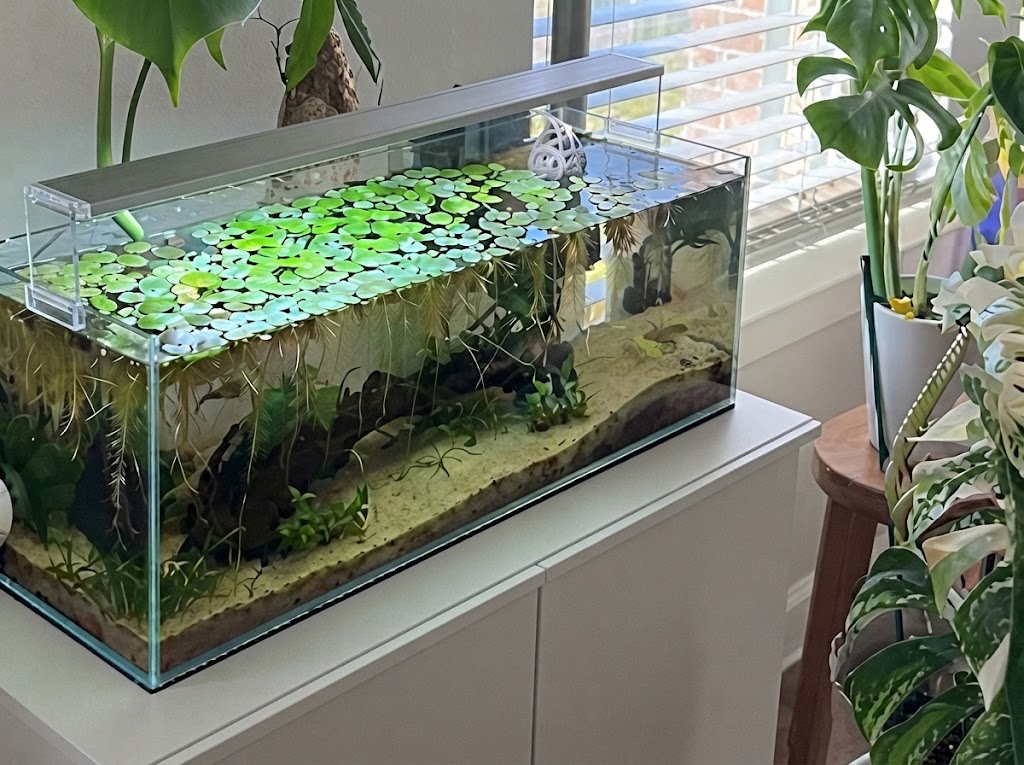
Amazon frogbit (Limnobium laevigatum) is one of the easiest floating aquarium plants to grow, but it has one requirement that causes most failures: the tops of its leaves need to stay dry. Water splashing onto the leaves, condensation dripping from a lid, or aggressive surface movement can turn an otherwise healthy plant into a melting mess.
Once that problem is controlled, Amazon frogbit grows quickly, sends long roots into the water column, and provides shade and cover for fish and shrimp. It also takes nutrients directly from the water, which makes it useful in planted aquariums where nitrate and other dissolved nutrients need to be managed.
This guide covers Amazon frogbit care from the first handful of floating rosettes to long-term maintenance, including lighting, roots, fertilizer, CO₂, water movement, propagation, melting leaves, and surface control.
Amazon Frogbit Care at a Glance
| Scientific name | Limnobium laevigatum |
| Common name | Amazon frogbit |
| Plant type | Floating freshwater plant |
| Difficulty | Easy |
| Growth rate | Fast to moderate-fast |
| Light | Low to moderate |
| CO₂ | Not required |
| Substrate | None |
| Feeding | Water column |
| Temperature | About 68–82°F (20–28°C) |
| pH | About 6.0–7.5 |
| Propagation | Runners / stolons |
| Placement | Floating at the surface |
What Is Amazon Frogbit?
Amazon frogbit is a floating aquatic plant associated with tropical and subtropical regions of Central and South America. In aquarium literature it is commonly identified as Limnobium laevigatum, although you may also see the newer name Hydrocharis laevigata in some sources.
Queensland Government uses Hydrocharis laevigata as the scientific name and lists Limnobium laevigatum as a synonym. See the Queensland Government Amazon frogbit information.
The plant forms small rosettes at the water surface. Rounded leaves sit above the water while fine roots hang underneath and absorb nutrients from the water column.
Those roots are one of its biggest attractions. They create a sheltered zone for small fish and shrimp, while the floating leaves cast shade over the aquarium below.
Tropica notes that the roots can provide protection for gouramis and other surface-oriented fish that naturally use floating plant roots as cover.
How Amazon Frogbit Grows
Amazon frogbit spreads through runners, also called stolons. A mature rosette produces a short connecting stem, and a new daughter plant develops at the end.
Once the daughter plant has developed enough roots and leaves, it can be separated from the parent.
This is why a small starting portion can become a substantial surface population surprisingly quickly. Queensland Government specifically notes that Amazon frogbit can develop rapidly and form dense mats of runners in suitable waterways.
For an aquarium, that growth is useful until the surface becomes too crowded.
A good frogbit population should leave some open water. If the plants cover the entire surface, they can reduce the light reaching submerged plants and make maintenance much harder.
Does Amazon Frogbit Need to Be Planted?
No. Amazon frogbit is a floating plant and should not be planted in the substrate.
Its roots hang freely below the rosette. They absorb nutrients from the surrounding water, so there is no reason to bury them.
This also means you can add frogbit to an established aquarium without disturbing the substrate or uprooting other plants.
Simply place the healthy rosettes on the surface and give them enough room to spread.
The Most Important Rule: Keep the Leaves Dry
This is the part of Amazon frogbit care I would check first whenever the plant starts melting.
The leaves are designed to float above the water. When water repeatedly lands on the upper surface, the plant can become waterlogged and begin to deteriorate. AquariumStocking identifies keeping the leaf tops dry as the central care requirement, while other aquarium sources point to splashing and condensation as common causes of melt.
- Strong surface agitation. A filter outlet aimed directly across the surface can push water over the leaves.
- Condensation. A tightly covered aquarium can collect water droplets on the lid, which then fall directly onto the frogbit.
- Bubbles and splashing. Air stones, aggressive aeration, and some filter returns can constantly wet the leaves.
You do not need a completely still surface. You need a surface that lets the frogbit remain floating naturally without repeatedly washing water across the leaves.
Amazon Frogbit Lighting Requirements
Amazon frogbit has a relatively low light demand. Tropica rates Limnobium laevigatum as a low-light plant, although adequate light is still necessary for healthy growth.
The bigger issue is how quickly the floating plants multiply.
A dense layer of frogbit can shade the aquarium beneath it. If you already keep Java fern, Anubias, mosses, or other lower-light plants, that shade may be helpful at first and excessive later.
Watch the lower plants rather than judging the frogbit alone.
If the submerged plants begin stretching toward the light or losing their normal appearance, thin the frogbit population.
For more help balancing aquarium intensity and photoperiod, see our aquarium lighting guide.
Does Amazon Frogbit Need CO₂?
No. Amazon frogbit can grow without injected CO₂, making it a good fit for low-tech aquariums.
Tropica gives Limnobium laevigatum a low CO₂ requirement, and AquariumStocking lists CO₂ as unnecessary.
CO₂ injection can be useful in a high-tech planted aquarium, but it is not something you need to install just to keep frogbit alive.
Its growth rate is already high under suitable conditions.
Does Amazon Frogbit Need Fertilizer?
Amazon frogbit feeds primarily from the water column, so liquid fertilizer is more relevant than root tabs.
This is important when choosing products. Root fertilizer is designed for plants that obtain substantial nutrition through their roots in the substrate. Frogbit is sitting at the surface with its roots suspended directly in the aquarium water.
If the aquarium has enough available nutrients, frogbit may grow without additional fertilization. Tropica also notes that its growth slows when nutrient availability decreases, making the plant a useful visual indicator of nutrient levels.
For a planted tank where nutrients are limited, a complete liquid micronutrient supplement can make more sense.
Seachem Flourish Comprehensive is the Seachem product from the supplied product list that fits this use most naturally. It provides micronutrients including calcium, magnesium, iron, vitamins, and amino acids.
FROM AMAZON.COM
Seachem Flourish Freshwater Plant Supplement
A comprehensive plant supplement with minerals, trace elements, and vitamins to support healthy growth in freshwater planted tanks.
Buy on Amazon.comHappy Pet Zone may earn a commission when you click through to Amazon.com, at no extra cost to you. As an Amazon Associate, we earn from qualifying purchases.
Do not automatically increase fertilizer because frogbit looks slow for a few days. Check light, surface conditions, plant density, and water quality first.
Does Amazon Frogbit Need Root Tabs?
No.
Amazon frogbit does not need root tabs because it is not rooted in aquarium substrate. Its roots remain suspended in the water column.
Root tabs can still be useful elsewhere in a mixed planted aquarium. For example, Amazon swords and cryptocorynes have very different feeding habits and can benefit from substrate nutrition. The supplied Seachem product information specifically describes Flourish Tabs for plants that feed through their roots.
For frogbit itself, focus on the water column.
Amazon Frogbit Water Parameters
Amazon frogbit is adaptable and does not require an unusually narrow water chemistry range.
A stable community-aquarium environment is more useful than constantly adjusting the pH to chase an exact number.
| Temperature | 68–82°F (20–28°C) |
| pH | About 6.0–7.5 |
| Hardness | Soft to moderately hard |
| CO₂ | Optional |
| Substrate | Not required |
AquariumStocking lists 20–28°C, pH 6.0–7.5, and 2–15 dGH for its Amazon frogbit care profile.
If you are having broader problems with plant growth, use our aquarium water chemistry guide to look at stability rather than changing several parameters at once.
Why Are My Amazon Frogbit Leaves Turning Yellow?
Yellowing leaves can have several causes, but the first thing I would inspect is the leaf surface.
If water has been sitting on the tops of the leaves, correct that before adding more fertilizer.
- Older leaves. Individual older leaves can naturally deteriorate as the plant replaces them.
- Poor nutrient availability. A very lean aquarium may not provide enough nutrition for rapid floating-plant growth.
- Excessive crowding. A dense population can interfere with healthy positioning and light distribution.
- Physical damage. Filter flow, splashing, or a lid pressing against the plant can damage the rosettes.
- Transition stress. Newly introduced plants sometimes lose older growth while adapting to aquarium conditions.
Do not judge the entire plant from one yellow leaf. Look at the newest leaves and the condition of the roots.
Why Is My Amazon Frogbit Melting?
Amazon frogbit melt usually means the plant is under some form of stress.
The most common aquarium-specific problem is wet foliage. Aquarium Plants Factory also identifies water on the leaf surface as a major cause of yellowing, softening, and rot.
Check these points in order: make sure filter flow is not washing across the leaves; check whether condensation is dripping from the aquarium lid; remove badly damaged leaves; give the remaining plants more open surface space; check whether the aquarium is extremely low in nutrients; and wait for new growth before making several additional changes.
Healthy new leaves are a better indicator of recovery than an old leaf that is already damaged.
How Long Do Amazon Frogbit Roots Get?
The roots can become surprisingly long.
AquariumStocking reports mature roots reaching roughly 15–25 cm, while other aquarium references report even longer roots under favorable conditions.
Long roots are not automatically a sign of a problem.
They can provide valuable cover for shrimp and fry, especially in breeding or species-focused aquariums. They can also give surface-oriented fish a more natural environment.
If the roots become too long for the aquarium, you can trim them carefully. There is no need to remove an entire healthy rosette simply because its roots have extended downward.
Can You Trim Amazon Frogbit Roots?
Yes.
Use clean scissors and remove only as much as necessary. Avoid repeatedly cutting the entire root system back to almost nothing.
The plant uses those roots for nutrient absorption and as structural support below the rosette. If the roots are simply longer than you prefer, a moderate trim is enough.
For a shrimp aquarium, I would usually keep more root length. The dense hanging roots can become one of the most useful parts of the plant.
How to Propagate Amazon Frogbit
Propagation is simple because the plant does most of the work.
A mature rosette produces a runner. A new plant forms along that runner, develops its own leaves and roots, and eventually becomes independent.
Once the daughter plant is large enough, separate it with clean scissors.
You do not need to replant it. Put the new rosette on the surface and allow it to establish naturally.
Tropica describes Limnobium laevigatum as a fast-growing surface plant, while Queensland Government documents its ability to spread through runners and young plants that can be moved easily by water.
That second point matters outside the aquarium too.
How Fast Does Amazon Frogbit Grow?
Amazon frogbit can grow quickly when light and nutrients are available.
Tropica describes it as very easy and fast-growing, while Queensland Government notes that adult plants can develop rapidly and form dense mats.
The actual rate depends on the aquarium.
A heavily stocked tank with abundant nutrients can produce more growth than an extremely lean setup. Light, temperature, water movement, and available nutrients all influence the rate.
For that reason, regular thinning is part of normal frogbit maintenance.
How to Control Amazon Frogbit
The easiest way to control frogbit is to remove excess plants before they cover the entire surface.
During your weekly maintenance, lift out the extra rosettes and runners with a net or your hand.
Keep enough plants to create the amount of shade and root cover you actually want.
A useful visual target is an aquarium with clear open surface areas rather than one completely covered by floating leaves.
If the surface becomes a solid green mat, submerged plants may receive too little light. Water exchange at the surface can also become less effective depending on the aquarium design.
Amazon Frogbit and Surface Flow
Strong surface flow is one of the easiest ways to create problems.
Amazon frogbit is happiest in a relatively calm section of the aquarium. A powerful filter return can push the plants into corners, flip leaves, submerge rosettes, or damage the roots.
If your filter produces too much movement, redirect the outlet or create a calmer area where the frogbit can remain floating.
You can still maintain good gas exchange. The goal is controlled surface movement rather than a completely motionless surface.
Can Amazon Frogbit Grow in a Covered Aquarium?
Yes, but a covered tank needs careful observation.
The main concern is condensation.
If water collects on the underside of the lid and drips continuously onto the leaves, the frogbit may begin to deteriorate even though the water parameters are excellent.
An open aquarium gives frogbit more room to grow naturally, which is one reason Tropica specifically highlights it for open aquariums.
If you keep a lid, watch where condensation forms and where those droplets land.
Amazon Frogbit for Betta Tanks
Amazon frogbit can work well in a betta aquarium because it provides shade and hanging roots near the surface.
The plant also gives the upper part of the aquarium more structure, which can make a bare tank feel less exposed.
The important limitation is surface access.
Do not allow frogbit to completely cover the area where your betta needs to reach the surface. Keep some open water and make sure filter flow is not forcing the floating plants across the entire tank.
Amazon Frogbit for Shrimp and Fry
The long roots are especially useful in shrimp and breeding aquariums.
Biofilm can develop along the root surfaces, giving shrimp additional grazing area. Small fry can also use the hanging roots as cover.
The roots create a three-dimensional zone between the surface and the rest of the aquarium that is difficult to reproduce with a low-growing plant.
If you keep shrimp, resist the temptation to trim all the roots short just for appearance.
Amazon Frogbit vs. Other Floating Plants
Amazon frogbit has a distinctive combination of round surface leaves and long hanging roots.
Its main advantage is the root curtain. Its main maintenance cost is the speed at which it can multiply.
Compared with slower-growing floating plants, frogbit demands more frequent thinning. Compared with very small floaters, its individual rosettes are easier to remove and control.
That makes it particularly useful when you want floating-plant cover without creating a carpet of tiny individual leaves.
Amazon Frogbit Common Problems
| Yellow leaves | Wet foliage, old leaves, nutrient availability |
| Soft or melting leaves | Water sitting on leaves or physical damage |
| Roots disappearing | Root damage, overcrowding, poor plant condition |
| Plants pushed underwater | Excessive surface flow |
| Surface completely covered | Thin the population |
| Slow growth | Light and nutrient availability |
| Lower plants losing light | Remove excess frogbit |
| Leaves touching condensation | Adjust lid or surface arrangement |
Most frogbit problems are easier to solve when you inspect the physical environment before changing water chemistry.
Is Amazon Frogbit Invasive?
This deserves a clear warning because the answer depends on where you live.
Amazon frogbit has escaped cultivation and become invasive in parts of the world. Queensland Government reports established populations in multiple Queensland waterways and classifies Amazon frogbit as a restricted invasive plant under Queensland’s Biosecurity Act 2014. In Queensland, keeping, giving away, selling, or releasing it is prohibited under the listed restrictions.
That does not mean the same legal restrictions apply everywhere.
Check your local regulations before buying or keeping Amazon frogbit, particularly if you live in a region with aquatic-weed controls.
Never dump unwanted aquarium plants into ponds, streams, drains, lakes, or natural waterways. Queensland’s official material specifically identifies aquarium and water-feature releases as a likely pathway for spread.
Dispose of unwanted frogbit through a method that prevents it from reaching natural water.
A Simple Amazon Frogbit Maintenance Routine
Once a week, inspect the floating plants before doing anything else.
Check that the leaf surfaces are staying dry, the filter is not pushing plants underwater, the roots are healthy, excessive runners are not covering the surface, lower aquarium plants are still receiving enough light, and damaged leaves are removed.
If the frogbit is healthy, this routine takes very little time.
The plant itself is easy. Managing its growth is the part that determines whether it remains useful or becomes a nuisance.
Frequently Asked Questions
Amazon frogbit is an excellent low-tech floating plant when you want fast growth, shade, and long roots without installing CO₂ or changing your substrate.
The main parameter to watch is not a number on a test kit. It is the condition of the leaves at the water surface.
Keep the foliage dry, provide reasonable light, maintain a calm area for the rosettes, and thin the population before it covers the entire tank. Do that consistently and Amazon frogbit can become one of the easiest plants in your aquarium to maintain.
For a planted tank, that is a pretty good trade.