Neolamprologus ocellatus: The Complete Care Guide
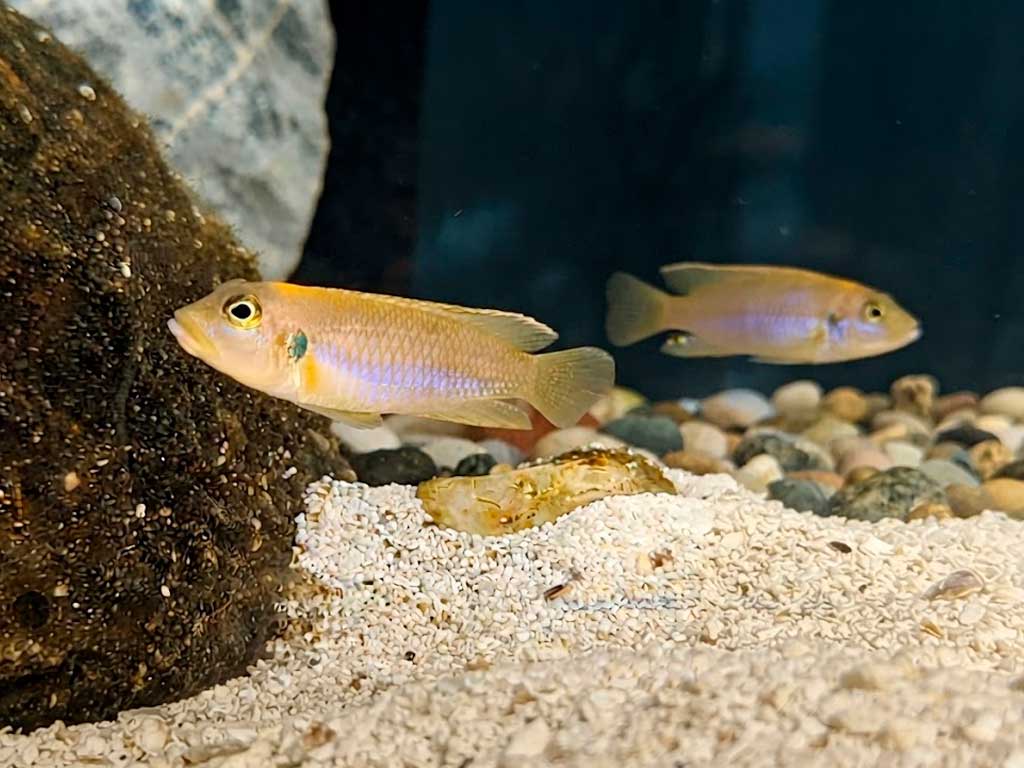
A fish barely 6 cm long can still control a surprising amount of aquarium territory. Neolamprologus ocellatus is a classic Lake Tanganyika shell-dwelling cichlid, and its entire routine revolves around one valuable piece of real estate: an empty snail shell.
This is a small fish with very big cichlid behavior. It digs sand, moves shells, defends its territory, courts a mate, and can challenge fish several times its own size when a shell is involved.
For successful Neolamprologus ocellatus care, the priorities are straightforward. Give it fine sand, plenty of empty shells, hard alkaline water, good oxygenation, and enough floor space for individual territories. The details matter because the fish will rearrange your carefully planned aquascape anyway.
Neolamprologus ocellatus at a Glance
| Parameter | Recommended target |
|---|---|
| Scientific name | Neolamprologus ocellatus |
| Common names | Ocellated Shell-Dweller, Ocellatus Shellie, Gold Ocellatus |
| Family | Cichlidae |
| Origin | Lake Tanganyika, East Africa |
| Adult size | About 2–2.5 inches (5–6 cm) |
| Temperature | 75–79°F (24–26°C) |
| pH | About 8.0–9.0 |
| GH | Hard, mineral-rich water |
| KH | Moderate to high |
| Diet | Small carnivorous foods and quality micro-pellets |
| Temperament | Territorial, especially around shells |
| Breeding | Shell spawning |
| Swimming zone | Bottom |
| Habitat | Sandy shell beds |
Current species references place N. ocellatus at roughly 5.8 cm maximum length and associate it with hard, alkaline Lake Tanganyika water. Males grow larger than females.
What Makes Neolamprologus ocellatus Special?
Most aquarium fish use caves, plants, driftwood, or rockwork as shelter.
Neolamprologus ocellatus has a much more specific requirement. Empty snail shells become homes, breeding sites, hiding places, and territorial boundaries.
In the wild, these fish are associated with sandy bottoms covered with empty shells. The shells provide protection and a place to retreat when danger approaches.
That behavior carries directly into the aquarium.
Give an ocellatus a shell and it may bury part of it, move it, defend the surrounding sand, and repeatedly return to the same spot. The fish does not need a complicated aquascape to be interesting. Watching one excavate a shell bed is the entertainment.
The other thing that catches new keepers off guard is the temperament.
The fish is small, but the territory around its shell can be defended aggressively. The size of the fish tells you very little about the size of the attitude.
Natural Habitat and Distribution
Neolamprologus ocellatus is endemic to Lake Tanganyika in East Africa.
Its natural environment is strongly associated with sandy bottoms and accumulations of empty snail shells. Aquarist Atlas describes shell beds made from Neothauma tanganyicense shells as a defining feature of its habitat.
The species lives close to the bottom, where each shell becomes a useful shelter and potential spawning site.
The water of Lake Tanganyika is hard and alkaline. Current species data place the natural temperature roughly around 23–25°C and pH around 8–9, with substantial mineral content.
That chemistry should guide the aquarium from the beginning.
If your tap water is naturally hard and alkaline, keeping this species may be relatively straightforward. If your source water is very soft and acidic, you need a reliable method for establishing and maintaining the appropriate mineral and buffering conditions.
Neolamprologus ocellatus Tank Size
Tank size recommendations for shell dwellers vary because different aquarists are describing different stocking plans.
A single pair has very different space requirements from a larger group or a Tanganyika community.
For a practical setup, I would use these guidelines:
- Pair: A small aquarium with a generous footprint can work when it is dedicated to the pair and properly arranged.
- Small group: Around 20 gallons or larger gives you more room to spread shells and territories.
- Community aquarium: 30–40 gallons or more is a safer starting point when other Tanganyikan species are involved.
The key word here is footprint.
A tall aquarium with little bottom area does not give a shell-dweller much useful territory. A longer aquarium gives you space to separate shell clusters and create visual breaks.
Aquarium Co-Op notes that shell dwellers can be kept in a 20-gallon aquarium, while current species-specific care references recommend larger footprints when keeping more individuals or mixing species.
The Most Important Part of the Setup: Sand and Shells
If you want natural Neolamprologus ocellatus behavior, the bottom of the aquarium needs to be designed around the fish.
Fine sand is ideal.
These fish dig and manipulate the substrate around their shells. Coarser gravel makes that behavior harder and does not recreate the sandy shell-bed environment.
Spread the sand across the full bottom rather than leaving one small patch.
Then add the shells.
You want more shells than fish.
That gives individual fish choices and allows them to establish territories without immediately fighting over the only available shelter.
Empty escargot shells are commonly used in aquariums as substitutes for natural Tanganyika snail shells. The important point is that the shell needs to be large enough for the fish to use but not so enormous that it becomes useless as a secure retreat.
And do not expect the layout to stay where you put it.
That is part of the species’ appeal.
How Many Shells Should You Provide?
A simple starting point is at least one shell per fish, with several extras.
If you have six fish, do not place exactly six shells in a neat row and call the setup finished.
Give them options.
Place some shells farther apart and others in loose groups. Leave open sand between territories.
The fish will decide what they actually want.
This is one of those situations where the aquarist’s idea of a perfect aquascape is less important than giving the fish enough material to make their own decisions.
Neolamprologus ocellatus Water Parameters
Stable water is more important than chasing a particular number.
A practical target range is:
| Parameter | Target |
|---|---|
| Temperature | 75–79°F (24–26°C) |
| pH | 8.0–9.0 |
| GH | About 10–20+ dGH |
| KH | Moderate to high |
| Ammonia | 0 ppm |
| Nitrite | 0 ppm |
| Nitrate | Keep low with regular maintenance |
Current species references place N. ocellatus in hard, alkaline water, with pH around 8–9 and substantial hardness.
NAscapers recommends 24–27°C, pH 7.5–8.5, GH 12–25 dGH, and KH 9–15 dKH for aquarium specimens.
There is some variation among published care sheets, so I would focus on the overlap: warm, hard, alkaline, well-buffered, stable water.
If your water is naturally soft, do not solve the problem by repeatedly adding random pH-raising products. Build a stable mineral and carbonate system instead.
Test your source water for pH, GH, and KH before purchasing the fish.
The numbers don’t lie: knowing what comes out of your tap is far more useful than guessing.
Filtration and Oxygenation
Lake Tanganyika cichlids benefit from clean, oxygen-rich water.
Use filtration appropriate for the actual bioload. A filter rated for a much larger aquarium can be useful, but filter size alone does not replace maintenance.
Moderate water movement is appropriate.
You want good oxygenation and circulation without blasting the shell bed so strongly that the fish cannot settle comfortably around its territory.
A pre-filter sponge on an intake is also worth considering if you are raising fry.
Keep the aquarium covered with a tight-fitting lid. These fish spend most of their time near the bottom, but territorial chases can still send a small cichlid toward the surface.
Feeding Neolamprologus ocellatus
Neolamprologus ocellatus is a small predator of invertebrate-sized foods in its natural environment.
Current species references describe a micro-carnivorous diet that includes small crustaceans, insect larvae, and other small organisms associated with the substrate and water around the shell.
In an aquarium, use small foods that the fish can easily consume.
A good feeding routine can include:
- High-quality micro-pellets
- Small cichlid granules
- Frozen cyclops
- Daphnia
- Baby brine shrimp
- Finely sized mysis
- Occasional suitable frozen invertebrate foods
Tetra also lists flakes, granules, prepared foods, and Artemia among suitable foods.
Small portions are better than dumping a large amount of food over the shell bed.
Watch the fish eat. If food is disappearing quickly and the fish remain active, the portion may be appropriate. If food is settling into the sand, reduce the amount.
Neolamprologus ocellatus Behavior
This is probably the most interesting part of keeping the species.
An ocellatus does not simply occupy a shell.
It treats the shell and surrounding sand as property.
The fish may use its mouth to move sand, alter the shell’s position, and excavate the area around it. It can also bury part of the shell so that only the opening remains exposed.
Once a fish claims a shell, another fish entering the territory can trigger a surprisingly intense response.
This is why shell spacing matters.
If every shell is placed directly beside the next one, you create a crowded neighborhood with very little territorial separation.
Spread them out.
Let the fish establish boundaries.
Are Neolamprologus ocellatus Aggressive?
They are territorial, and that distinction is important.
An ocellatus is unlikely to behave like a large predatory cichlid that spends the entire day attacking everything in sight. Its aggression is more focused.
The shell is the center of the conflict.
A fish defending its shell may chase, nip, or drive another fish away. Aquarists have even reported ocellatus attacking hands placed too close to their territory.
This behavior becomes more pronounced around breeding.
If an aquarium has enough shells and floor space, the fish can establish separate territories. If there are too few shells, the dominant fish can monopolize the best locations.
Male vs. Female Neolamprologus ocellatus
Adult males are larger than females.
Species references generally place males around 5–6 cm and females somewhat smaller.
Young fish can be difficult to sex reliably.
If breeding is the goal, purchasing a single supposedly guaranteed male and female is not always the easiest route.
A small group of juveniles can allow compatible fish to pair naturally, provided the aquarium has enough territory.
Do not judge sex from color alone.
Different geographic forms and aquarium strains can vary in coloration, and individual condition affects appearance.
Neolamprologus ocellatus Gold
The term Neolamprologus ocellatus gold is commonly used in the aquarium trade for a yellow or golden color form.
Color should be treated separately from the basic care requirements.
A gold ocellatus still needs the same hard, alkaline Tanganyika-style water, fine sand, shells, oxygenation, and territory management.
If a seller uses a locality name or strain name, keep that information with the fish’s records. Geographic forms can matter to serious Tanganyika keepers, especially when maintaining species purity.
Breeding Neolamprologus ocellatus
Breeding is one of the reasons shell dwellers are so popular.
The female uses a shell as a spawning site, laying eggs inside the protected cavity. The shell gives the eggs a degree of physical protection while the adults defend the surrounding territory.
Current species references describe N. ocellatus as a substrate spawner that breeds inside empty Neothauma snail shells. Eggs hatch in roughly three days, with fry becoming free-swimming later in the development process.
The aquarium does not need complicated breeding equipment.
What it needs is the right environment.
Provide:
- Several suitable shells.
- Fine sand.
- Stable alkaline water.
- Good oxygenation.
- Small, nutritious foods.
- Enough territory for the adults.
Once a pair begins spawning, expect territorial behavior to increase.
Raising Neolamprologus ocellatus Fry
Fry are small and benefit from appropriately sized foods.
Newly hatched baby brine shrimp can work well, as can other appropriately sized fry foods.
Feed small amounts frequently enough to keep young fish growing without allowing uneaten food to accumulate across the shell bed.
A sponge pre-filter can help protect tiny fry from being drawn into the filtration system.
Do not rush to remove every juvenile from the aquarium.
In a well-designed shell-dweller setup, observing different generations developing around the same shell field can be one of the most rewarding parts of the hobby.
Neolamprologus ocellatus Tank Mates
Tank mates require more thought than the fish’s small size might suggest.
The safest approach is usually a dedicated shell-dweller setup.
A carefully planned Tanganyika community can work, but species should occupy different niches and the aquarium needs enough space to prevent constant territorial overlap.
Avoid adding another aggressive bottom-dwelling species simply because it has similar water requirements.
Compatible chemistry is only one part of compatibility.
A fish that wants the same sand, shells, and bottom territory may become a direct competitor.
For broader African cichlid husbandry, see our Tropheus Cichlid Care Guide.
For a very different Lake Tanganyika setup centered around a much larger species, see our Frontosa Cichlid Tanganyika Care Guide.
Can Neolamprologus ocellatus Live With Other Shell Dwellers?
I would be cautious.
Several shell-dwelling species can occupy similar areas and compete for shells and sand territories.
Mixing shell dwellers is not simply a matter of putting several species into a larger tank and hoping they sort it out.
There can also be concerns about territorial conflict and hybridization when closely related fish are maintained together.
If your goal is to observe natural behavior and eventually breed the fish, a species-focused aquarium is much easier to manage.
Common Neolamprologus ocellatus Care Mistakes
Too few shells
This is probably the most obvious problem. More shells give fish more choices and reduce competition over a single shelter.
Using coarse gravel
Ocellatus are diggers. Fine sand allows them to manipulate the substrate naturally.
Treating them like peaceful nano fish
They are small, but they are still cichlids. A fish defending its shell can be surprisingly forceful.
Ignoring the aquarium footprint
A deep or tall tank with limited floor area is less useful than a longer aquarium with plenty of sand.
Keeping soft acidic water
This species comes from Lake Tanganyika. Hard, alkaline, mineral-rich water is part of the basic setup.
Overcrowding the shell bed
Adding more fish is not always a solution to aggression. Sometimes it simply creates more competition.
Rearranging the shells constantly
Let the fish work. If they move a shell three inches from where you placed it, that is information about what they prefer.
Neolamprologus ocellatus vs. Neolamprologus multifasciatus
These two species are often confused because both are famous shell dwellers from Lake Tanganyika.
Their behavior is different enough to matter.
Neolamprologus multifasciatus is extremely small and is famous for colonial behavior, with groups living among dense shell beds.
N. ocellatus is larger and has a reputation for being more forceful around individual territories.
That difference affects how you plan the aquarium.
If you are building a colony-centered shell bed, multifasciatus may be the species you have in mind. If you want a larger shell dweller with more pronounced territorial behavior, ocellatus is a different experience.
Both need the same general foundation: fine sand, empty shells, hard alkaline water, clean filtration, and careful territory management.
Is Neolamprologus ocellatus Good for Beginners?
Yes, with one qualification.
It is a small fish, but it is not a completely passive beginner fish.
The water chemistry is straightforward if your source water already suits Tanganyika cichlids. The diet is manageable. Breeding can occur without complicated equipment.
The challenge is understanding territorial behavior.
If you give the fish enough shells and floor space, much of that behavior becomes fascinating rather than frustrating.
If you cram several fish into a small shell field with nowhere to retreat, the same behavior becomes a problem.
The fish is easy to understand once you stop designing the aquarium around the fish’s body size and start designing it around its territory.
Frequently Asked Questions
Build the Shell Bed First
The best Neolamprologus ocellatus aquarium starts with the bottom, not the fish.
Use fine sand. Add plenty of empty shells. Spread them across the available floor space and leave enough room for each fish to claim an area.
Then establish stable, hard, alkaline water and strong biological filtration.
After that, let the fish do what they do.
They will move sand. They will move shells. They will claim territory. They may completely ignore the layout you spent an afternoon creating.
That’s fine.
For this species, the rearrangement is part of the display.
Keep the temperature around 75–79°F (24–26°C), maintain stable alkaline water around pH 8–9, provide more shells than fish, and give the shell bed enough floor space to support separate territories.
Those are the numbers and decisions that matter most.