Neolamprologus Multifasciatus: Complete Care Guide for the Shell-Dwelling Cichlid
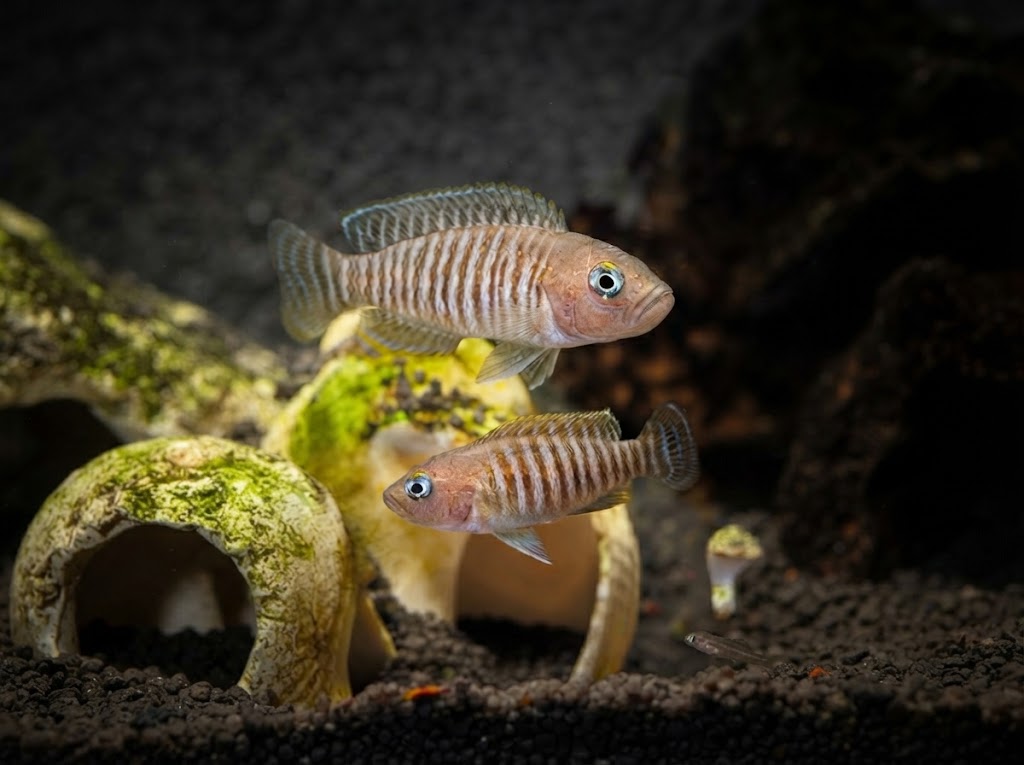
A Neolamprologus multifasciatus colony can turn a small patch of sand and empty shells into one of the most interesting freshwater aquariums you can watch. These tiny Lake Tanganyika cichlids dig, claim individual shells, defend small territories, and form surprisingly complex social groups.
In practice, their size is the easy part. The real challenge is building the aquarium around their natural behavior and keeping the water hard, alkaline, and stable.
This guide covers the species from the ground up: identification, natural habitat, tank setup, shells, water parameters, diet, colony behavior, tank mates, and breeding. If you are planning a multifasciatus tank, the shell bed deserves as much attention as the fish themselves.
Neolamprologus Multifasciatus at a Glance
| Feature | Details |
|---|---|
| Scientific name | Neolamprologus multifasciatus |
| Common names | Multifasciatus, Multi, Multie, Shell-Dwelling Cichlid |
| Family | Cichlidae |
| Origin | Lake Tanganyika, East Africa |
| Adult size | About 1.2–2 inches |
| Water type | Hard, alkaline freshwater |
| Temperature | About 75–81°F (24–27°C) |
| pH | About 7.5–9.0 |
| Diet | Omnivorous with a strong carnivorous tendency |
| Behavior | Territorial and highly active around shells |
| Social structure | Colonial |
| Breeding | Shell spawning |
| Aquarium style | Sand substrate with abundant empty shells |
The species was described by George Albert Boulenger in 1906 and has also appeared in the hobby under the older name Lamprologus multifasciatus.
That synonym still matters when researching older books, forum posts, or aquarium listings.
What Makes Neolamprologus Multifasciatus Different?
The first thing you notice is the size. A mature fish can be only a few centimeters long, yet it behaves like a much larger territorial cichlid.
That combination is what makes the species so interesting.
Wild N. multifasciatus live around shell beds in Lake Tanganyika. Recent behavioral research describes stable territorial groups that can persist for years, with dominant males, females, juveniles, and subordinate males living within the same social structure. Individual fish defend their own home shells while the group also protects its broader territory.
That behavior changes how you should think about the aquarium.
You are not simply keeping a few tiny fish over some decorative shells. You are creating a small territory-based colony.
The fish will move sand around their shells, establish boundaries, retreat into the shells when threatened, and adjust the layout you created. A carefully arranged shell bed can look very different after a few weeks.
Natural Habitat and Origin
Neolamprologus multifasciatus is endemic to Lake Tanganyika in East Africa.
The species is associated with sandy areas containing dense concentrations of empty snail shells. Those shells provide shelter and spawning sites while the surrounding sand gives the fish room to excavate.
This explains several of the aquarium requirements that otherwise seem unusual.
Fine sand matters because the fish naturally manipulate it. Shells matter because they form the center of individual territories. Hard, alkaline water matters because Lake Tanganyika has very different chemistry from many common tropical freshwater habitats.
Fishipedia reports natural temperatures around 75–82°F (24–28°C), with alkaline water and relatively high hardness.
The aquarium does not need to reproduce every number from the lake perfectly. Stability is the part I would prioritize.
How Big Does Neolamprologus Multifasciatus Get?
Most adults remain around 1–1.5 inches long, while large males can approach 2 inches.
Males are generally larger than females. The difference becomes easier to see as the fish mature.
That tiny adult size is one reason the species has become so popular among aquarists who want cichlid behavior without dedicating an enormous aquarium to the project.
But small fish do not automatically mean a small footprint is irrelevant.
The colony needs horizontal space for separate shell territories. A longer aquarium gives subordinate fish somewhere to move when a dominant individual claims an area.
Neolamprologus Multifasciatus Tank Setup
The basic setup is simple:
- fine sand + empty shells + hard alkaline water + filtration + open territory.
The details are where the aquarium starts to work properly.
Substrate
Use fine sand rather than coarse gravel.
Multifasciatus spend a surprising amount of time excavating. They move sand away from shells, build small mounds, and continually modify the area around their territory.
This is more than decoration. Digging is part of their normal behavior.
A relatively shallow sand bed is enough for most aquariums, provided the fish have enough loose material to move around. Avoid sharp substrates that could damage the mouth or underside of a fish repeatedly working the bottom.
One of the most interesting observations from hobbyists is how quickly a colony can rearrange a carefully prepared aquarium. The shell layout you create on day one may not resemble the same territory a month later.
Let them remodel it.
Shells
Shells are the defining feature of this aquarium.
Empty snail shells are commonly used, including Neothauma-type shells and suitable escargot shells. The important point is providing enough shells for the colony rather than giving each fish exactly one.
More choice generally means less pressure over individual shells.
Place the shells directly on the sand with the openings accessible. You can group them into several loose clusters rather than creating one large pile.
That gives the fish opportunities to establish separate territories.
Avoid treating the shells as permanent decorations. The fish will move them, bury them, uncover them, and sometimes completely reorganize the area.
That’s exactly what you want to see.
Filtration and Flow
Use filtration capable of maintaining consistently clean water without turning the tank into a washing machine.
A sponge filter can work well in a smaller species-only setup. An appropriately sized hang-on-back or canister filter can also work, provided the flow is controlled.
If the aquarium contains fry, protect filter intakes with a pre-filter sponge.
Strong turbulence across the sand is unnecessary. Aim for good oxygenation and circulation while keeping the shell bed relatively calm.
Neolamprologus Multifasciatus Water Parameters
Water chemistry is one area where these fish deserve more attention than their size suggests.
They come from Lake Tanganyika, where the water is hard and alkaline. A stable mineral profile is more useful than constantly chasing one exact pH number.
| Parameter | Practical target |
|---|---|
| Temperature | 75–81°F (24–27°C) |
| pH | 7.8–8.8 |
| GH | Around 10–20 dGH |
| KH | Moderate to high |
| Nitrate | Keep as low as practical |
Different care sources publish slightly different ranges. Fishipedia, for example, lists broader natural ranges and gives a different aquarium pH recommendation than several specialist aquarium sources.
Here’s what actually matters: avoid soft, acidic water and avoid unstable chemistry.
If your tap water is already hard and alkaline, you may need very little modification.
If your source water is soft, test it first. Then consider a stable buffering strategy such as appropriate calcareous substrate or Rift Lake mineral products rather than repeatedly dosing a product that causes rapid pH swings.
A pH of 8.1 that stays at 8.1 is generally more useful than chasing 8.5 today and 7.7 tomorrow.
Water Changes
Regular water changes are important because these are active fish living close to the substrate.
A practical routine is around 20–30% weekly, adjusted according to stocking, filtration, feeding, and test results.
Match the new water reasonably closely to the aquarium in temperature and chemistry.
Test ammonia and nitrite whenever something seems wrong, after major maintenance, or when establishing a new aquarium. Nitrate is useful for judging whether your maintenance schedule is keeping pace with the biological load.
The numbers tell you more than the calendar does.
Feeding Neolamprologus Multifasciatus
Neolamprologus multifasciatus has an omnivorous diet with a strong carnivorous tendency.
In an aquarium, feed a quality small pellet or granule as the everyday staple and vary the diet with suitable frozen or other prepared foods.
Small portions work better than dumping a large meal into the tank.
Their mouths are tiny, so particle size matters. Food should be small enough that the fish can eat it comfortably without spending most of the feeding period trying to break it apart.
A simple feeding routine might include:
- Small high-quality cichlid granules as the staple.
- Frozen foods such as brine shrimp or similarly sized options occasionally.
- Small portions offered once or twice daily depending on colony size and condition.
- Enough food for the fish to consume promptly.
Watch the sand after feeding.
Uneaten food disappears into the substrate and becomes a water-quality problem later. That is particularly easy to miss in a shell-dweller aquarium because so much of the activity happens at the bottom.
Colony Behavior and Aggression
Calling multifasciatus “peaceful” can be misleading.
They are small, but they are territorial.
Each fish can become intensely attached to its shell and the small area surrounding it. Females can become particularly defensive around spawning sites, while males may defend larger territories.
At the same time, their social system is fascinating.
Research published in 2026 describes stable groups containing a dominant male, adult females, juveniles, and subordinate males. Group members defend individual home shells while also participating in defense of the larger territory.
That is a very different social picture from a simple community fish swimming around randomly.
Expect chasing and displays.
Some aggression is normal. The concern is persistent harassment that prevents subordinate fish from feeding, forces them into constant hiding, or produces physical damage.
This is where shell abundance and aquarium footprint become useful management tools.
How Many Multifasciatus Should You Keep?
A colony is generally a better starting point than a single pair.
Starting with a group of juveniles allows the social structure to develop naturally as the fish mature.
Exact stocking recommendations vary considerably between sources, and there is no single number that fits every aquarium. Tank footprint, shell density, filtration, sex ratio, and the number of established territories all change the outcome.
For a small dedicated setup, think in terms of a colony with room to expand, rather than buying the maximum number of fish the tank can technically hold.
The other issue is reproduction.
Once the fish begin breeding regularly, your original stocking level becomes irrelevant. The colony can grow.
Have a plan for surplus juveniles before the tank reaches that point.
Breeding Neolamprologus Multifasciatus
Breeding is one of the reasons this species has such a strong following.
They spawn inside shells, so you do not need elaborate breeding caves or specialized equipment.
Provide plenty of appropriate shells, stable water, good nutrition, and enough space for females to establish territories.
The female uses a shell as a spawning site, while the male participates in fertilization. The eggs and young remain associated with the shell territory during the early stages of development.
The parents and older colony members may interact with young fish in ways that make the aquarium especially interesting to observe.
Do not expect every fry to survive.
In a mature colony, some young fish will survive and others will disappear. That is normal population pressure inside a closed aquarium.
If you want to raise large numbers of juveniles, a separate grow-out setup gives you much more control.
Can You Keep Multifasciatus With Other Fish?
This is where I would keep expectations conservative.
Neolamprologus multifasciatus is territorial, tiny, and strongly tied to the bottom. It is also vulnerable to much larger or predatory fish.
Fishipedia specifically warns against combining them with large fish and notes that territorial tank mates can create serious conflict when space is inadequate.
For a first setup, a species-only colony is the cleanest option.
It lets you observe the natural behavior without asking the fish to compete with another species for territory.
If you decide to build a mixed Lake Tanganyika aquarium, choose tank mates based on adult size, temperament, territory, swimming zone, and water chemistry rather than simply choosing other African cichlids.
Lake Tanganyika contains many cichlids with completely different lifestyles.
“Same lake” is not enough.
Common Mistakes With Multifasciatus
Using gravel instead of sand
The fish are adapted to manipulating soft substrate. Gravel removes a large part of their natural digging behavior.
Providing too few shells
A handful of attractive shells may look good to us. It does not necessarily give a colony enough territorial options. More shells allow fish to choose and rearrange their living space.
Treating them like ordinary nano fish
Their adult size makes them look like nano-community candidates.
Their behavior says otherwise.
These are territorial cichlids with very specific water requirements.
Keeping the water too soft
A soft-water aquarium designed for tetras or South American dwarf cichlids is a poor match. Test your source water before buying the fish.
Overfeeding
Small fish still produce waste, and food left among shells can be surprisingly difficult to notice. Feed small portions and watch what actually gets eaten.
Rearranging the shells constantly
You may want the aquarium to look neat.
The fish have other plans.
Once a colony establishes territories, frequent rescapes can disrupt the social structure and create unnecessary conflict.
Is Neolamprologus Multifasciatus Right for Your Aquarium?
This species makes sense if you enjoy watching behavior more than simply looking at colorful fish.
A multifasciatus aquarium can be visually understated. The fish are small, the substrate is mostly sand, and the decoration may consist of little more than shells.
Then you notice one fish excavating a mound.
Another disappears into a shell.
A female drives a larger male away from her territory.
A juvenile appears where you did not expect one.
Ten minutes later, the whole layout looks slightly different.
That is the appeal.
The aquarium becomes a small behavioral study rather than a static display.
For that reason, I would build the tank around the shell bed first and choose the fish second.
Frequently Asked Questions
Build the Shell Bed Before You Buy the Fish
Neolamprologus multifasciatus is a tiny cichlid with very non-tiny behavior.
Start with fine sand. Add more shells than you think you need. Keep the water hard, alkaline, and stable. Give the colony room to establish territories, then resist the temptation to redesign the aquarium every time the fish move something.
The best part of keeping multis is watching the colony make decisions for itself.
Give them the right framework and let them dig.