Poison Dart Frog: The Complete Guide to the Dendrobatidae Family
The poison dart frog is one of nature’s most extraordinary contradictions: a creature no bigger than a thumbnail that carries enough toxin to kill a grown adult. Yet thousands of hobbyists keep them in home terrariums, and in captivity, they lose that toxicity entirely.
This guide covers the entire Dendrobatidae family, not just one species. You’ll learn how their poison works, which species are commonly kept as pets, what they need to thrive in captivity, and why they matter far beyond the hobby world.
By the end, you’ll understand why dart frogs are considered one of the most advanced and rewarding amphibian groups in the hobby, and exactly what that commitment looks like in practice.
What Is a Poison Dart Frog?
Poison dart frogs belong to the family Dendrobatidae, a diverse group of over 170 species native to the tropical rainforests of Central and South America. They are small, diurnal amphibians, meaning they are most active during the day, which makes them unusual among frogs and highly visible in a terrarium setting.
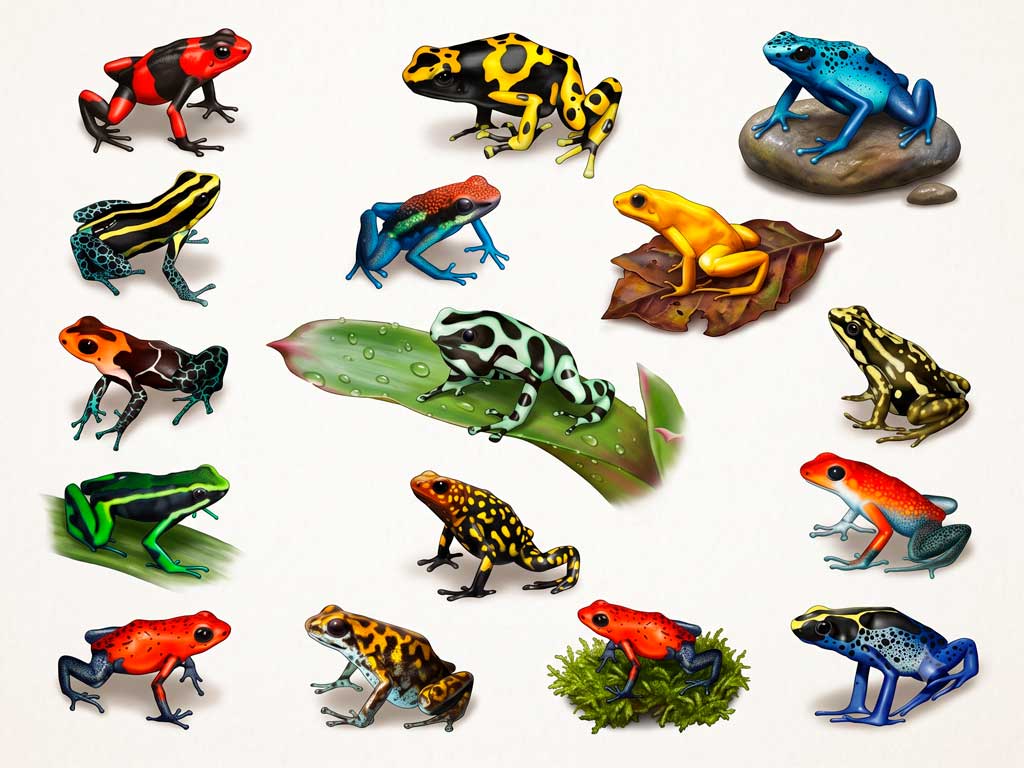
Their defining feature is aposematism: the use of vivid coloration as a warning signal to predators. Bright red, electric blue, neon yellow, and vivid orange patterns all communicate the same message to would-be attackers: eating this frog is a very bad idea.
Importantly, not all species in the Dendrobatidae family are equally toxic. Toxicity varies dramatically between genera and even between populations of the same species.
The Dendrobatidae Family: Key Genera
Rather than treating dart frogs as a single group, it helps to understand them at the genus level. Each genus has distinct characteristics that influence both care requirements and behavior in captivity.
| Genus | Common Name | Toxicity | Difficulty in Captivity |
|---|---|---|---|
| Dendrobates | Dart frogs | Moderate to high (wild) | Intermediate |
| Oophaga | Thumbnail dart frogs | High (wild) | Advanced |
| Phyllobates | Poison frogs | Highest of all (wild) | Intermediate |
| Ranitomeya | Thumbnail dart frogs | Moderate (wild) | Advanced |
| Epipedobates | Phantasmal poison frogs | Moderate (wild) | Intermediate |
| Allobates | Rocket frogs | Low to none | Beginner-friendly |
The most commonly kept genera in the hobby are Dendrobates and Ranitomeya, largely because they breed reliably in captivity and are widely available from ethical breeders.
How Does Dart Frog Poison Actually Work?
This is the question everyone asks, and the answer is more interesting than most people expect.
Wild dart frogs do not produce their own poison. Instead, they sequester alkaloid compounds from the ants, mites, and beetles they consume in the wild. Over generations of evolution, their skin glands developed the ability to absorb and store these toxins rather than metabolize them.
The most potent species, the golden poison frog (Phyllobates terribilis), carries batrachotoxin in its skin. This compound interferes with the sodium channels of nerve cells, causing uncontrolled muscle contractions and, at sufficient doses, cardiac arrest. The golden poison frog is thought to have enough toxin to kill 20,000 mice, and its herpetologist discoverer named it Phyllobates terribilis to underscore its lethal nature.
Here is the critical fact for hobbyists: captive-bred dart frogs are not toxic. When raised in captivity and fed insects without alkaloids, dart frogs lose their toxicity entirely. A captive-bred Phyllobates terribilis can be handled (carefully, with moistened gloves) without any risk of poisoning. This is why the species is widely kept in captivity despite its fearsome reputation.
Where Do Poison Dart Frogs Live?
Poison dart frogs inhabit the tropical rainforests of Central and South America. The high humidity of these environments allows them to live away from permanent bodies of water, which is unusual for amphibians.
Different genera occupy different ecological niches. Some, like Dendrobates tinctorius, live on the forest floor among leaf litter. Others, like Ranitomeya species, spend much of their time in the canopy, living inside bromeliads and using the water pooled in their leaves as breeding sites.
This ecological variation matters for captive care. Understanding where a specific species evolved shapes every decision about enclosure design, humidity management, and breeding setup.
Poison Dart Frogs as Pets: What You Need to Know
There is moderate risk associated with keeping poison dart frogs as pets. That said, for the right keeper, they are among the most rewarding amphibians available. Here is an honest assessment of what that commitment involves.
Species Suitable for Beginners
Not every dart frog is equally demanding. These species are generally recommended for first-time dart frog keepers:
- Dendrobates tinctorius (dyeing poison frog): hardy, available captive-bred, tolerant of minor husbandry variations.
- Dendrobates auratus (green and black poison dart frog): adaptable and widely available.
- Allobates femoralis (rocket frog): minimal toxicity, easier dietary requirements.
Avoid starting with Oophaga or Ranitomeya species. Both genera have more precise dietary requirements and are significantly more sensitive to humidity fluctuations.
Enclosure Requirements
Dart frogs need a bioactive vivarium, not a bare terrarium. A living ecosystem with live plants, a substrate that supports microfauna, and stable humidity is the foundation of long-term success with this family.
Tank size: A 10-gallon tank supports a pair of smaller species. Most keepers use 15-gallon tall enclosures or larger, as the additional height accommodates the vertical movement many species exhibit naturally. A ready-to-use option, such as the 15 Gallon Tall Reptile Glass Tank 12″x12″x24″ tall glass terrarium for reptiles, comes pre-assembled with a drainage system, ideal for these types of species.
Humidity: Target a humidity range of 70 to 90% and a temperature gradient between 68°F and no higher than 80°F. Temperatures above 82°F cause rapid stress and can be fatal. Dart frogs are cool-environment animals compared to many reptiles.
Substrate: Use a drainage layer (hydroton or lava rock) topped with an ABG-style substrate mix: tree fern fiber, long-fiber sphagnum moss, organic topsoil, and orchid bark. This system retains moisture while preventing standing water that would drown microfauna.
Microfauna: Springtails and isopods are essential. They consume waste, fungal growth, and uneaten food, keeping the enclosure clean and disease-free without constant keeper intervention.
Lighting: A low-level UVB light is recommended to encourage natural behaviors and establish a normal day/night cycle. A 5% UVB bulb on a 12-hour timer meets this requirement.
Diet and Feeding
All dart frogs are insectivores. Their small size means they require small prey, and their dietary breadth in captivity is narrower than in the wild.
Primary food sources:
- Flightless fruit flies (Drosophila melanogaster for juveniles, D. hydei for adults)
- Springtails
- Isopods (small species like Trichorhina tomentosa)
- Pinhead crickets (for larger species)
Gut-load all feeder insects 24 hours before offering them. Dust prey with a vitamin and calcium supplement at every other feeding. Dart frogs are unforgiving of nutritional deficiencies, and metabolic bone disease develops quickly in specimens that are not supplemented consistently.
Feeding frequency: Offer food every day or every other day. Dart frogs have high metabolisms for their size, and juveniles should be fed daily without exception.
Breeding Poison Dart Frogs
Breeding dart frogs is considered advanced-level amphibian husbandry, but it follows the same core principles that govern frog reproduction more broadly.
Most dart frog species are dedicated parents by amphibian standards. Males call to attract females, and once eggs are laid on a leaf or bromeliad surface, at least one parent actively tends them. Some Oophaga species transport tadpoles on their backs to individual water-filled bromeliads and return regularly to feed them unfertilized eggs.
Dart frogs are most active during the day, searching for food and caring for their young. This daytime activity cycle makes observing breeding behavior significantly easier than with nocturnal species.
Seasonal conditioning, a gradual reduction in temperature and misting frequency followed by a return to peak humidity and more frequent rainfall simulation, triggers breeding behavior in most captive species. For a full breakdown of environmental triggers, rain chamber setup, and tadpole care, our complete guide to breeding frogs at home covers the process step by step.
Conservation Status and Legal Considerations
Many poison dart frog species have appeared on the endangered list for a number of years, as deforestation and human infrastructure projects continue to encroach on their natural habitat.
Chytridiomycosis, a disease found in amphibians, kills thousands of animals each year. Rising temperatures make it easier for bacteria to incubate in tropical environments, putting species like poison dart frogs directly at risk.
From a legal standpoint, most dart frog species are listed under CITES Appendix II, meaning international trade is monitored and regulated. Always obtain a poison dart frog from a reputable captive breeding source. Wild-caught specimens introduce disease risk into your collection and contribute to population decline in already-stressed wild populations.
4 Common Mistakes With Dart Frog Husbandry
- Starting with an advanced species. Oophaga pumilio (strawberry poison frog) is beautiful and widely photographed online, which makes it a common first purchase. It is also one of the most sensitive species in the family. Start with Dendrobates or Allobates and build your skills first.
- Using tap water directly. Dart frogs have highly permeable skin and absorb whatever is in their water supply. Chlorine and chloramine in untreated tap water damage skin tissue over time. Use reverse osmosis water or a reliable dechlorinator, and let misting water sit for 24 hours.
- Overheating the enclosure. Many keepers assume tropical animals want warmth. Dart frogs are rainforest floor animals that evolved in consistently cool, shaded environments. Anything above 82°F causes rapid physiological stress.
- Skipping microfauna. A vivarium without springtails and isopods becomes a fungal and bacterial breeding ground within weeks. Adding a cleanup crew colony before introducing frogs is not optional; it is the maintenance system.
Frequently Asked Questions About Poison Dart Frogs
1. Are poison dart frogs dangerous to keep as pets? Captive-bred dart frogs are not toxic. Their toxicity depends entirely on their diet in the wild, and captive specimens raised on fruit flies and crickets carry no poison. Standard hygiene precautions (washing hands after handling, not touching your face) are sufficient.
2. How long do poison dart frogs live? In the wild, dart frogs typically live 3 to 15 years. In captivity with proper husbandry, some species can reach 20 years.
3. Can you handle poison dart frogs? Limit handling to essential maintenance. Poison dart frogs have delicate porous skin and should not be handled unless absolutely necessary. If you must handle them, wear moistened powder-free gloves.
4. How many dart frog species exist? The Dendrobatidae family contains over 170 described species, divided into roughly 13 genera. New species continue to be described as researchers survey remote rainforest areas.
5. Do dart frogs need UVB lighting? Yes. While not strictly fatal without it, low-level UVB exposure supports immune function, calcium metabolism, and natural behavioral patterns including breeding activity.
6. What is the easiest dart frog to keep? Dendrobates tinctorius and Dendrobates auratus are the most beginner-friendly species. Both are hardy, widely available captive-bred, and tolerate minor husbandry variations better than more sensitive genera.
7. Can dart frogs live together? Some species are communal and do well in groups of the same species if the enclosure is large enough. Never mix species, and always house animals of similar size together to prevent larger frogs from eating smaller ones.
8. What do dart frogs eat in captivity? Flightless fruit flies make up the bulk of most dart frog diets in captivity. Supplement with springtails, isopods, and pinhead crickets depending on the species and size of the frog.
9. Why is my dart frog not eating? The most common causes are temperature stress (too warm), enclosure that is too bright (stress from insufficient hiding spots), recent transport stress, or the wrong prey size. Review each factor before assuming illness.
10. Do dart frogs need a bioactive vivarium? Strongly recommended. A bioactive setup with live plants, drainage layer, and microfauna colony maintains stable humidity far more consistently than misting alone and dramatically reduces disease risk over the long term.
Start by choosing the right species for your experience level. That single decision shapes every other aspect of dart frog keeping, from enclosure size to feeding schedule. Dendrobates species give you the full dart frog experience with a margin for error that more sensitive genera simply do not.
More Frog Care Guides on Happy Pet Zone
Poison dart frogs are just one of several amphibian species we cover in depth. If you’re expanding your collection or simply researching before you commit, these guides are a good next stop.
Thinking about breeding your dart frogs down the line? Our complete guide to breeding frogs at home covers environmental triggers, rain chamber setup, and tadpole care from start to finish.
Curious about other striking species? Our tomato frog care guide covers the vivid Dyscophus genus, including how to distinguish between the CITES-protected and legally available species before you buy. And if you’re drawn to larger, more prehistoric-looking frogs, our Pacman frog care guide breaks down the Ceratophrys genus in full detail.
Every frog has different needs, but the fundamentals stay consistent: stable humidity, clean water, the right substrate, and a diet matched to natural feeding behavior. Happy Pet Zone keeps building out this library so you always have somewhere reliable to check next.