Miniature Bull Terrier: Temperament, Care, Health & Owner Tips
The Miniature Bull Terrier is one of the most distinctive-looking dogs on the planet and one of the most misunderstood.
Compact, muscular, comically confident, and fiercely loyal, this breed packs the full personality of its larger cousin into a much smaller frame.
In this article, you’ll get a complete breakdown of everything that matters: the breed’s fascinating history, its unique physical profile, its bold temperament, and the specific care it needs to thrive.
Plus, you’ll find honest advice on whether the Mini Bull Terrier is the right fit for your home.
History and Origin of the Miniature Bull Terrier
The Miniature Bull Terrier’s story is one of near-extinction and passionate revival.
In the early 19th century, breeders in England began selectively crossing Bulldogs with the now-extinct White English Terrier, among other breeds, to produce the original Bull Terrier. This dog was designed for working purposes primarily rat-catching and smaller specimens of the breed naturally emerged from those early breeding programs.
For a while, the miniature version thrived. Then, breeders pushed the size reduction too far. The dogs became so small and lightly built that serious physical deformities began to appear, and the breed’s popularity collapsed. In 1918, the Kennel Club removed the Miniature Bull Terrier from its official registry entirely.
Fortunately, a dedicated group of enthusiasts refused to let the breed disappear. They worked carefully to stabilize the miniature at a healthy size, and by 1938 a dedicated breed club was formed. The Miniature Bull Terrier was back and this time, on solid ground.
Today the breed is recognized by the UK Kennel Club in the Terrier group and has a loyal following in both the UK and the United States. Its charm hasn’t faded one bit.
Physical Characteristics of the Miniature Bull Terrier
Think of the Miniature Bull Terrier as the standard Bull Terrier’s identical twin just scaled down.
Key measurements:
- Height: Maximum 35.5 cm at the shoulder
- Weight: 11–15 kg
- Build: Muscular, compact, and surprisingly heavy for its size
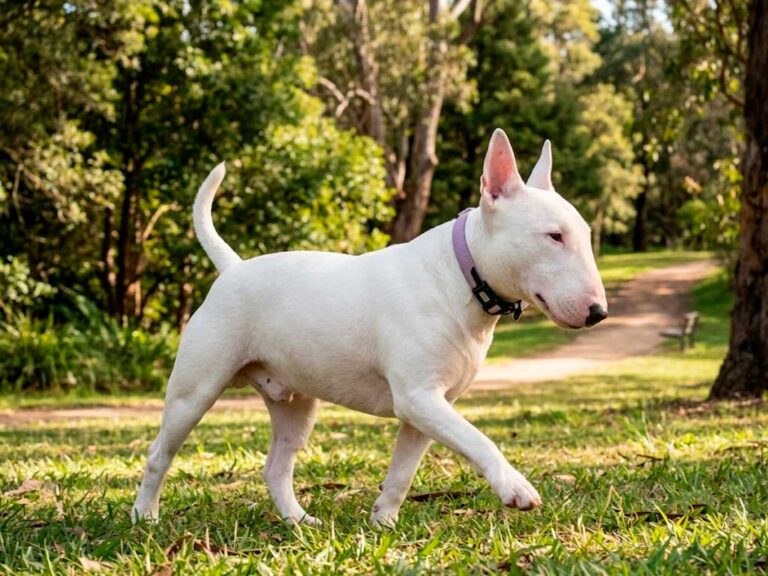
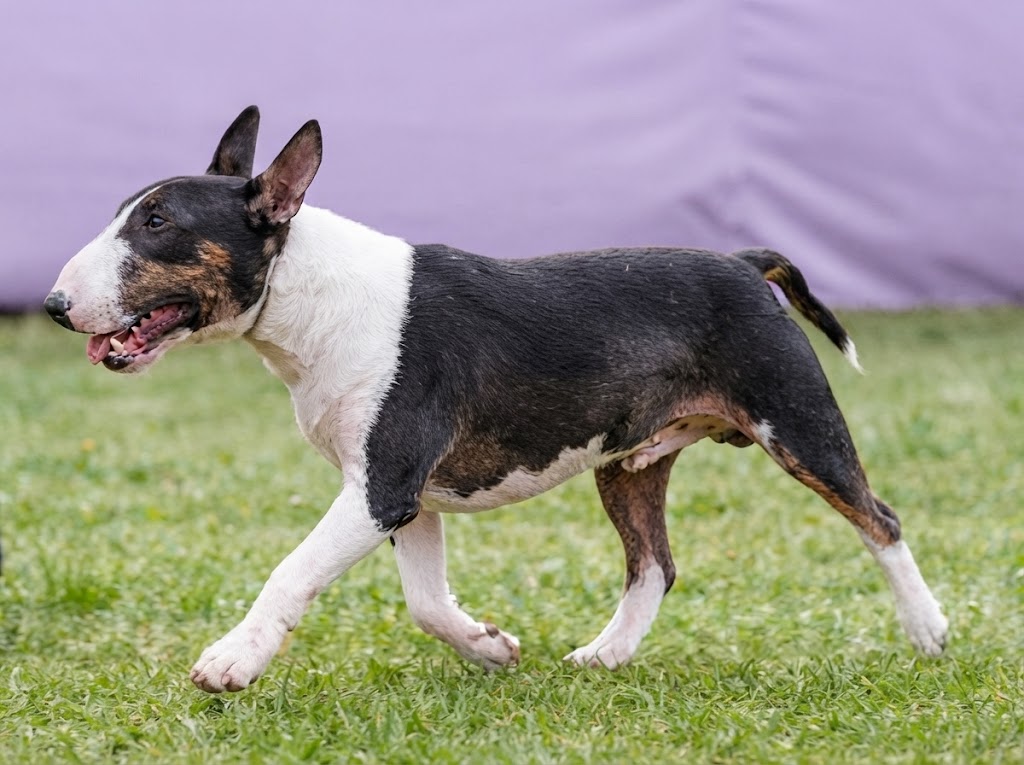
The most iconic feature of this breed is its egg-shaped head fully rounded at the top, tapering down to the nose, with no visible stop (the indentation between the eyes). It’s an unusual silhouette you won’t find in any other breed.
Other notable physical traits include:
- Small, triangular eyes set obliquely in the skull, with a dark, penetrating gaze
- Upright, pointed ears that sit close together on top of the head
- A short, thick neck flowing into a broad chest and well-arched back
- A short, low-set tail carried horizontally
The coat is short, flat, and hard to the touch, with a slight gloss. During winter months, a softer undercoat develops for added warmth.
Coat colors and patterns include:
- Pure white — the most classic and well-known coloring
- White with colored markings — including black, brindle, red, or fawn patches
- Solid colors — such as brindle, red, black, or fawn, with or without white markings
- Tricolor — black, white, and tan combinations
Temperament and Personality of the Miniature Bull Terrier
Here’s something every potential owner should know up front: the Miniature Bull Terrier has absolutely no idea it’s small.
This is a breed that will square up to any dog, regardless of size. It’s bold, fearless, and full of self-assurance. At the same time, it’s deeply affectionate with its family and has a clownish, playful streak that makes it endlessly entertaining to live with.
Core personality traits include:
- Energetic and spirited — this dog rarely sits still for long
- People-oriented — it bonds closely with its family and craves attention and company
- Stubborn — when properly motivated, it responds well to training; without motivation, it will simply do things its own way
- Tenacious — a terrier to the core, with a strong prey drive and a tendency to pull on the leash
- Alert and vocal — it makes an effective watchdog and will bark to announce visitors or perceived threats
One important consideration: early socialization is non-negotiable. Mini Bull Terriers introduced properly to other dogs, children, and new environments from puppyhood grow up to be far more balanced adults. Without that foundation, their natural boldness can tip into problematic behavior.
This breed can live with children in an active family setting, but as with any dog, all interactions with young children should be supervised by an adult.
Care
Diet and Nutrition
The Miniature Bull Terrier is a muscular, active breed that needs a diet designed to support that physique without leading to excess weight gain.
Practical feeding recommendations:
- Feed your Mini Bull Terrier twice daily, following the portion guidance on your chosen food
- Choose a high-quality complete dog food appropriate to your dog’s life stage puppy, adult, or senior
- Always provide access to fresh, clean water, especially after exercise
- Monitor body weight consistently this breed’s stocky build can sometimes mask gradual weight gain
- Avoid overfeeding with treats, particularly during training; use small, high-value rewards instead
Because the breed has a known predisposition to kidney issues, it’s worth discussing protein levels with your vet, particularly if you’re feeding a high-protein working-dog formula.
Exercise Requirements
The Miniature Bull Terrier needs around one hour of exercise per day at a minimum. And here’s the thing it will happily take more if you offer it.
Exercise that works well for this breed:
- Brisk daily walks (on a well-fitted harness, given their tendency to pull)
- Fetch and interactive play sessions in a securely fenced yard
- Agility training, which channels their energy and intelligence productively
- Scent games and puzzle activities that stimulate the brain
Because this breed tends to pull strongly on the leash, leash training should start from day one. A Mini Bull Terrier that hasn’t learned loose-leash walking can become genuinely difficult to handle, despite its relatively modest size.
Mental stimulation is equally important. A bored Mini Bull Terrier will find its own entertainment and that rarely ends well for your furniture.
Grooming Needs
This is one of the lowest-maintenance coats in the dog world.
Weekly grooming routine:
- Brush once a week with a soft-bristle brush or grooming mitt to remove loose hair and maintain coat shine
- During shedding periods, increase brushing to two or three times a week to prevent dead hair from accumulating on upholstery and clothing
- Bathe as needed approximately every 6–8 weeks, or when visibly dirty
Beyond the coat, don’t overlook the basics: trim nails regularly, check and clean ears weekly, and maintain dental hygiene with regular brushing or dental chews.
Training and Education
Training a Miniature Bull Terrier is a rewarding challenge emphasis on both rewarding and challenge.
This breed is genuinely smart. It understands what you want quickly. The question is whether it decides to comply. That stubborn streak is real, and owners who aren’t consistent will find their Mini Bull Terrier has cheerfully taken charge of the household.
Training principles that work with this breed:
- Start socialization as early as possible — puppy classes are highly recommended
- Use positive reinforcement exclusively — harsh corrections backfire badly with this sensitive breed; they respond to praise, play, and food rewards
- Keep training sessions short and varied — 10–15 minutes is often more effective than a long session that loses their attention
- Be patient and consistent — set clear rules and enforce them every single time
- Focus early on leash manners — this is the single most practical skill to prioritize
Leash training deserves special mention. The Mini Bull Terrier’s natural instinct is to pull, and it has the muscle to make that genuinely uncomfortable on longer walks. Teaching loose-leash walking from puppyhood, using a front-clip harness if needed, is one of the most valuable investments of time you can make with this breed.
Health and Longevity
The Miniature Bull Terrier has a life expectancy of 11 to 14 years, which is solid for a purebred dog of its size and build.
However, several health conditions are associated with this breed, and prospective owners should be aware of them:
- Deafness: The most commonly reported health issue in the breed. It occurs most frequently in white-coated individuals and can affect one or both ears. Responsible breeders test puppies using a BAER (Brainstem Auditory Evoked Response) test before rehoming.
- Hereditary kidney disease: Some lines carry a predisposition to a condition called hereditary nephritis, which can seriously affect kidney function. Genetic testing of breeding stock is strongly encouraged.
- Heart problems: Mitral valve disease and other cardiac conditions have been documented in the breed. Cardiac screening of breeding animals is recommended.
- Skin disorders: Relatively common in the breed; these range from minor allergies to more persistent inflammatory conditions.
How to protect your dog’s health:
- Source your puppy from a breeder who screens for all known hereditary conditions and provides documentation
- Schedule annual veterinary check-ups
- Request a BAER hearing test if one wasn’t done before rehoming
- Watch for changes in coat condition, energy levels, or urination patterns, and report them to your vet promptly
It’s also worth noting: avoid breeders who pursue extreme physical traits, such as an exaggerated head shape or very low body weight. Responsible breeding matters enormously for this breed’s long-term health.
Is the Miniature Bull Terrier the Right Dog for You?
The Miniature Bull Terrier is one of those breeds that inspires real devotion in its fans. But it’s not a breed that suits every home.
This breed is a great match if:
- You want a loyal, entertaining, and people-oriented companion
- You lead a reasonably active lifestyle and can commit to daily exercise
- You have some prior experience with dogs and understand the importance of consistent training
- You’re prepared to invest time in early socialization and leash training
- You’re ready for a dog with a big personality that may occasionally test your patience
This breed may not suit you if:
- You’re a first-time dog owner looking for an easy, compliant companion
- You have very young children without experience managing confident, boisterous dogs
- You want a calm, low-energy indoor dog
- You’re not prepared to deal with potential health management related to deafness or kidney monitoring
The bottom line: with the right owner, the Miniature Bull Terrier is an absolutely extraordinary companion — funny, loving, and endlessly characterful. Get the foundation right, and you’ll have a dog that makes every single day more interesting.
Frequently Asked Questions About the Miniature Bull Terrier
1. How is the Miniature Bull Terrier different from the standard Bull Terrier?
The two breeds are identical in type, temperament, and physical structure — the only difference is size. The Miniature Bull Terrier stands no taller than 35.5 cm at the shoulder and weighs 11–15 kg, while the standard Bull Terrier is considerably larger. Both are recognized as separate breeds by the UK Kennel Club.
2. Are Miniature Bull Terriers good with other dogs?
They can be, but early socialization is essential. This breed has a bold, fearless temperament and will not back down from confrontations with larger dogs. Proper introductions from puppyhood and consistent training significantly improve how well Mini Bull Terriers coexist with other dogs.
3. Do Miniature Bull Terriers suffer from deafness?
Yes, deafness is the most common health issue in the breed, particularly in white-coated individuals. Responsible breeders conduct BAER hearing tests on puppies before sale. Always ask for documentation of hearing test results when choosing a puppy.
4. How much exercise does a Miniature Bull Terrier need?
At least one hour per day, split between walks and active play. This breed will happily do more if offered. Mental stimulation through training, puzzle toys, or games is just as important as physical exercise to prevent boredom-related behavior.
5. Are Miniature Bull Terriers easy to train?
They’re intelligent but stubborn, which means training requires patience, consistency, and the right motivators. Most Mini Bull Terriers respond extremely well to food rewards and play-based training. They’re not the easiest breed for first-time owners, but with commitment, they’re absolutely trainable.
Want to explore similar breeds? Take a look at the Bull Terrier and the Staffordshire Bull Terrier two close relatives that share the same tenacious spirit in different packages.