Smooth-Coat Chihuahua: The Tiny Dog With an 18-Year Lifespan (And a Lot to Say About It)
The smooth-coat Chihuahua is the world’s smallest dog breed — and statistically, one of the longest-lived. We’re talking about a dog that routinely reaches 14, 16, even 18 years old. That’s not a typo. In this complete owner’s breakdown, you’ll discover the real personality behind the celebrity hype, the health risks no breeder’s website highlights, and what two decades of life with a Chihuahua actually looks like day to day.
History and Origin of the Smooth-Coat Chihuahua
Before the Chihuahua became the most photographed dog in celebrity handbags, it had a genuinely remarkable story.
The breed traces its roots to the Techichi — a small, mute companion dog revered by the Toltec civilization of ancient Mexico as early as the 9th century AD. The Techichi held spiritual significance: wealthy Toltecs and later Aztecs believed these dogs could guide the souls of the deceased through the underworld and ward off evil spirits. They were so valued that they were ceremonially buried alongside their owners.
The modern Chihuahua likely emerged from crossbreeding the Techichi with a small, hairless dog brought from Asia — though historians still debate the exact lineage. What’s documented is that the breed takes its name from Chihuahua, the northern Mexican state where American travelers first encountered and began exporting these dogs to the United States in the mid-1800s.
The American Kennel Club recognized the Chihuahua in 1904, making it one of the earliest registered toy breeds. Today it consistently ranks in the top 30 most popular breeds in the US.
One naming note worth mentioning: the breed is sometimes searched online as “chiguagua” — but the correct spelling is always Chihuahua.
Physical Characteristics
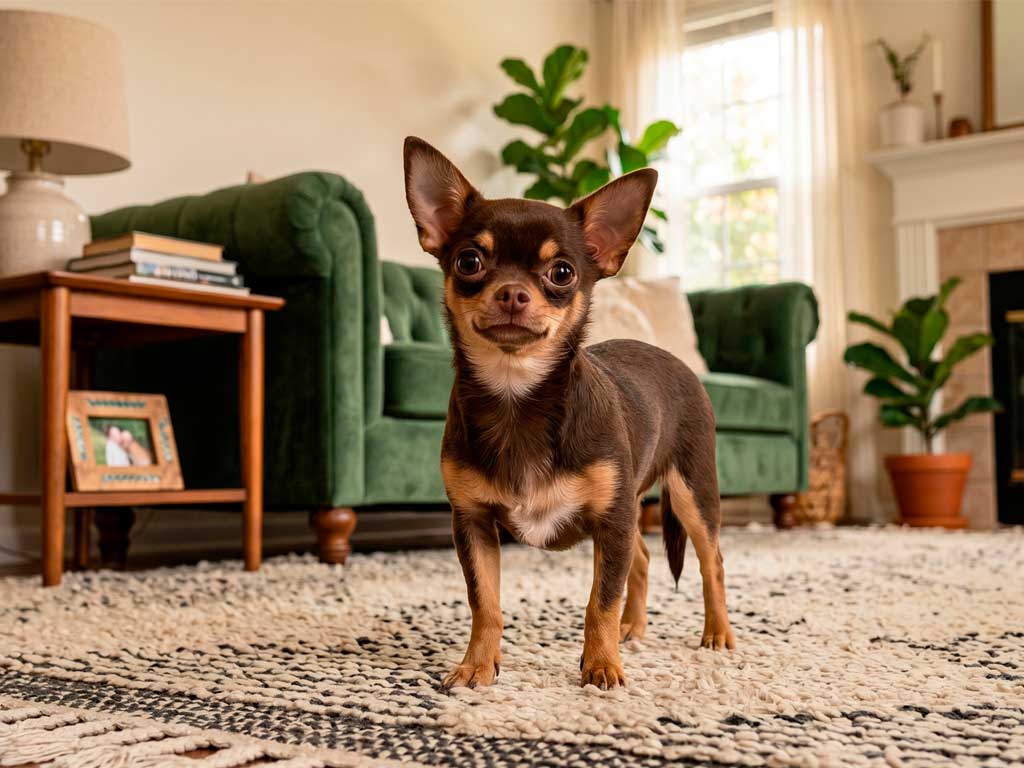
The smooth-coat Chihuahua is compact, symmetrical, and built with surprising precision for such a tiny animal.
Key physical specs at a glance:
- Height: 6–9 inches (15–23 cm)
- Weight: 4–6 lbs (1.8–2.7 kg)
- Coat: Short, close-lying, and glossy — the defining feature of this variety
- Colors: An exceptionally wide range — solid black, white, fawn, chocolate, gray, or silver; tri-color combinations; brindle, merle, and spotted patterns
- Head shape: Distinctively rounded, apple-domed skull with a short, pointed muzzle
- Ears: Large and erect, held at a 45-degree angle when relaxed, fully upright when alert
The smooth coat lies flat against the body, creating a sleek, polished silhouette. It requires far less grooming maintenance than the long-coat variety — a genuine practical advantage for busy owners.
One structural detail every prospective owner should understand: many Chihuahuas are born with a molera, a soft spot on the top of the skull that functions similarly to a human infant’s fontanel. In some dogs it closes as they mature; in others it remains open permanently. It’s a breed-specific characteristic, not automatically a sign of illness, but it does mean the skull needs protection from knocks and falls throughout the dog’s life.
Also notable: Chihuahuas have the largest brain-to-body ratio of any dog breed. This contributes directly to their sharp intelligence — and their equally sharp opinions about everything.
Temperament and Personality
Here’s the most important thing to understand about the smooth-coat Chihuahua before you commit: this is not a decorative breed.
It is a fully formed dog — alert, opinionated, emotionally complex — that simply happens to weigh less than most house cats.
Fiercely devoted. Chihuahuas bond intensely with one or two people and express that devotion constantly. They want to be wherever their person is — on the couch, in bed, in the bathroom. Separation is genuinely distressing for them.
Suspicious of strangers. Without deliberate early socialization, a Chihuahua can become anxious and reactive around unfamiliar people and animals. They don’t experience this as aggression — it’s insecurity presenting itself as noise and posturing. The solution is socialization, not reassurance.
Territorial and vocal. Chihuahuas are natural alert dogs. They notice everything and announce most of it. Training a reliable “quiet” cue is not optional if you have neighbors within earshot.
Cliquey with other dogs. Chihuahuas tend to prefer the company of other Chihuahuas over different breeds. They can coexist with mixed-breed households, but require patient introductions and ongoing management.
Not well-suited to very young children. Their fragile frame makes rough handling genuinely dangerous. Older, calm children who understand how to interact respectfully with small dogs are a much better fit.
Smooth-Coat Chihuahua Care
Diet and Nutrition
Small dogs run hot metabolically — they burn energy quickly and have proportionally tiny stomachs.
Feed a high-quality small-breed dog food with appropriately sized kibble. Small-breed formulations are calorie-dense enough to fuel a fast metabolism without requiring large meal volumes, and the smaller kibble size encourages proper chewing and supports digestion.
Serve two to three small meals per day. Chihuahua puppies in particular are prone to hypoglycemia (dangerously low blood sugar), a real medical risk that multiple daily feedings help prevent. Never leave a young Chihuahua without access to food for extended periods.
Dental nutrition matters more with this breed than almost any other. Dry kibble provides mild mechanical abrasion that helps slow tartar buildup. It’s not a substitute for brushing — but it helps.
Avoid free-feeding. Chihuahuas are enthusiastic eaters and will overeat if given the chance, despite their tiny size.
Exercise Requirements
The smooth-coat Chihuahua is energetic but their exercise demands are genuinely modest.
Around 30 minutes of activity daily is typically sufficient — split across two short walks plus indoor playtime. They’re surprisingly quick and agile, and enjoy games of chase, tug, and fetch indoors.
Two non-negotiable considerations:
Always use a harness, not a collar. The Chihuahua’s trachea is structurally delicate and vulnerable to collapse under leash pressure at the neck. A properly fitted, lightweight harness distributes force safely across the chest. This isn’t a preference — it’s a welfare issue.
Cold weather management is essential. Chihuahuas have minimal body fat, a tiny surface area, and a short coat that provides almost no insulation. In cool or cold climates, a well-fitted dog coat or sweater for outdoor walks is a practical necessity, not an indulgence. Watch for shivering — though note that Chihuahuas also shiver when excited or anxious, not just when cold.
Grooming Needs
This is where the smooth coat earns its advantage over the long-coat variety.
Weekly maintenance is all this coat requires:
- A quick brush with a soft bristle brush or rubber grooming mitt once a week removes loose hair and stimulates the skin
- Bathe every 4–6 weeks with a gentle, moisturizing dog shampoo
- Trim nails every 3–4 weeks
- Clean ears weekly to prevent wax buildup
The one grooming habit that cannot be skipped: daily tooth brushing. Chihuahuas have small mouths packed with relatively large teeth — a combination that accelerates tartar buildup and gum disease dramatically. Dental disease is the single most preventable serious health issue in this breed. Start a brushing routine as a puppy so the dog accepts it as normal.
Shedding is year-round but minimal in volume due to the breed’s size. A weekly brush keeps it under control.
Training and Education
The smooth-coat Chihuahua is one of the smartest dogs you can own. Some have competed in heelwork-to-music competitions at Crufts — the UK’s premier dog show — performing synchronized routines with their handlers. That’s not a trick any dim-witted dog pulls off.
The challenge isn’t intelligence. It’s consistency on the owner’s part.
Start socialization immediately. The critical developmental window is 8–16 weeks. Expose puppies to different people, sounds, surfaces, dogs, and environments during this period. Skipping or minimizing socialization creates an anxious adult that’s difficult and stressful to live with.
Treat this dog like a real dog. The biggest training error Chihuahua owners make is excusing behaviors in a small dog that they would never tolerate in a large one. Growling, snapping, and guarding are not cute in a 5-pound dog. They’re warning signs that require the same consistent, calm correction as they would in any breed.
Housetraining requires patience and frequency. Chihuahuas have extremely small bladders and digestive systems. A puppy may need to go outside every 30–45 minutes. They won’t reliably hold through the night until they’re several months old. Plan accordingly and set a consistent outdoor schedule.
Use positive reinforcement exclusively. Treats work exceptionally well — just make sure they’re tiny. A Chihuahua’s daily caloric budget is small; standard training treats can throw off their nutrition meaningfully.
Health and Longevity
This is where the smooth-coat Chihuahua genuinely surprises people.
With a lifespan of 12 to 18 years — many reaching their mid-to-late teens — the Chihuahua outlives the vast majority of dog breeds. Some individuals have been documented living past 20 years.
However, that longevity comes with a set of breed-specific health vulnerabilities that every owner should know:
- Patellar luxation — the kneecap slips out of the groove, causing intermittent lameness. Severity ranges from occasional, self-resolving episodes to surgical cases.
- Tracheal collapse — the cartilage rings of the windpipe weaken and flatten, producing a distinctive honking cough. Harness use dramatically reduces risk.
- Hydrocephalus — fluid accumulation around the brain, linked to the characteristic domed skull. Ranges from clinically silent to seriously debilitating.
- Legg-Calvé-Perthes disease — degeneration of the hip joint in young dogs, causing pain and progressive lameness.
- Patent ductus arteriosus — a congenital heart defect where an extra blood vessel remains open after birth, placing strain on the heart.
- Mitral valve disease — heart valve deterioration more common in older individuals.
- Keratoconjunctivitis sicca (dry eye) — inadequate tear production causes painful corneal irritation requiring lifelong management.
- Dental disease — near-universal without active preventive care; leads to pain, tooth loss, and systemic infection if untreated.
Work with a vet experienced in toy and small breeds. Schedule wellness checkups twice yearly from age 7 onward, when age-related conditions become more likely to emerge.
Is the Smooth-Coat Chihuahua the Right Dog for You?
Let’s be direct.
This breed is an excellent fit if you:
- Live in a small space — apartment, condo, or compact home
- Are home for most of the day (or can take the dog with you)
- Want an intensely loyal companion with genuine intelligence and personality
- Have the time and commitment for daily dental care and regular vet visits
- Appreciate a low-maintenance coat without sacrificing personality
- Can invest in early socialization and consistent training
Think very carefully if you:
- Have toddlers or very young children at home
- Work long hours and can’t manage the separation anxiety this breed develops
- Travel frequently without the ability to bring the dog along
- Want an immediately friendly, social dog — that’s not this breed’s baseline
- Live somewhere warm year-round (manageable, but requires awareness)
- Are not prepared for a potential 15-to-18-year commitment
The smooth-coat Chihuahua rewards ownership that takes it seriously. In return, you get one of the most loyal, entertaining, and surprisingly long-lived companions in the dog world.
Frequently Asked Questions About the Smooth-Coat Chihuahua
1. How long do smooth-coat Chihuahuas live? The average lifespan is 12 to 18 years, making the Chihuahua one of the longest-lived dog breeds in existence. With excellent nutrition, regular veterinary care, and attentive daily management, many individuals reach their mid-to-late teens in good health.
2. Why does my Chihuahua shiver so much? Chihuahuas shiver for three different reasons: cold, excitement, and anxiety. Their minimal body fat and short coat make them genuinely sensitive to temperature drops — but shivering also occurs when they’re overstimulated or stressed. A warm dog coat resolves the cold issue; the behavioral causes are addressed through calm, consistent handling and proper socialization.
3. Are smooth-coat Chihuahuas easier to groom than long-coat ones? Yes, considerably. The smooth coat requires only a brief weekly brushing with a soft bristle brush or rubber mitt and a bath every 4–6 weeks. The one non-negotiable for both varieties is daily tooth brushing, given the breed’s extreme susceptibility to dental disease.
4. Can a Chihuahua be left alone during the day? This is one of the breed’s genuine challenges. Chihuahuas bond intensely with their people and are highly prone to separation anxiety. Dogs left alone for long hours regularly often develop excessive barking, destructive behaviors, and chronic stress. They thrive in households where someone is present for most of the day, or with another dog for company.
5. What’s the difference between a smooth-coat and a long-coat Chihuahua? Coat length is the only meaningful distinction — both are the same breed with identical temperament, size, and health profile. The long coat results from a recessive gene and requires more grooming time. The smooth coat is lower maintenance and gives the dog a sleeker, more streamlined appearance.
If you’re ready to welcome a smooth-coat Chihuahua into your home, source your puppy through a reputable breeder who conducts health screenings and socializes litters from birth — or consider adopting an adult from a Chihuahua rescue. Start dental care and socialization from day one. That investment pays off over the next 15-plus years.