
Renal Support Dog Food: Is JustFoodForDogs Renal Support Low Protein Worth Considering?

Choosing renal support dog food can feel overwhelming when your dog has been diagnosed with kidney disease. You want something nutritious that your dog will actually eat, but you also need to understand whether the formula matches your veterinarian’s treatment plan.
JustFoodForDogs Renal Support Low Protein is a fresh-frozen veterinary-support diet made with ground lamb, rice, vegetables, lamb liver, and selected nutrients. Its formula features controlled levels of protein, phosphorus, potassium, and sodium, along with omega-3 fatty acids and added B vitamins. However, there is one important detail to understand before buying: the manufacturer states that this product is intended for intermittent or supplemental feeding under veterinary supervision.
This review examines its ingredients, nutritional information, potential advantages, limitations, and the questions worth asking your veterinarian before placing an order.
What Is JustFoodForDogs Renal Support Low Protein?
JustFoodForDogs Renal Support Low Protein is a fresh-frozen diet formulated to support specific veterinary nutrition needs associated with kidney health. It uses a lamb-based recipe and controlled nutrient levels rather than following the same nutritional profile as ordinary adult maintenance food.
The manufacturer lists the following ingredients:
- Ground lamb
- Sushi rice
- Cauliflower
- Carrots
- Long-grain brown rice
- Lamb liver
- Sunflower oil
- Spinach
- Blueberries
- Omega Marine Microalgae Oil
- A Renal nutrient blend
The ingredient list provides a useful starting point when evaluating a food. Still, ingredients alone cannot tell you whether a renal formula is appropriate for an individual dog. The overall nutrient profile, calorie intake, laboratory results, appetite, body condition, and stage of kidney disease all matter.
You can read more about the brand’s other recipes and product range in our JustFoodForDogs review.
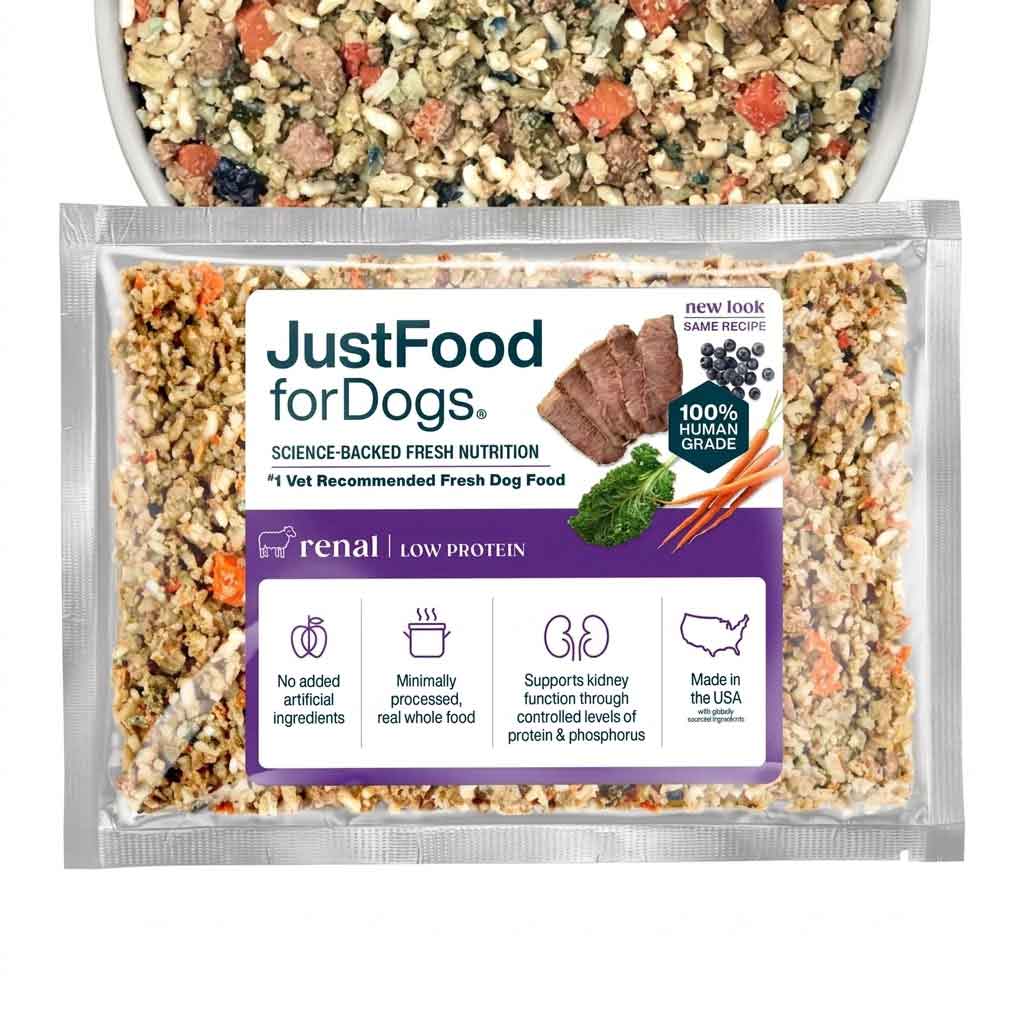
VETERINARY DIET FRESH DOG FOOD
Renal Support Low Protein
This formula is designed to help meet the nutritional needs of dogs with certain health conditions. Before placing your order, consult your veterinarian to determine whether it’s an appropriate choice for your dog.
- Human-grade ingredients
- No added preservatives
Happy Pet Zone may earn a commission from qualifying purchases made through affiliate links, at no extra cost to you.
Why Does Renal Support Dog Food Matter?
A dog with chronic kidney disease may need a carefully planned diet to help manage the condition. The kidneys play an important role in maintaining fluid balance and removing waste products from the blood. As kidney function changes, nutritional management may become part of the broader treatment plan.
Veterinary renal diets commonly focus on phosphorus restriction and controlled amounts of protein and sodium. They also need to provide adequate calories and maintain nutritional status. The right balance depends on the individual dog rather than a single rule that applies to every patient.
The International Renal Interest Society (IRIS) publishes staging and treatment recommendations for chronic kidney disease. Its guidance emphasizes tailoring treatment to the patient and monitoring how the dog responds.
Research also supports the role of dietary management in canine kidney disease. In a controlled clinical trial involving dogs with spontaneous chronic renal failure, a renal diet reduced uremic crises and mortality compared with an adult maintenance diet. That finding supports veterinary renal nutrition as a general approach; it does not establish that every renal food has the same results or that this specific JustFoodForDogs formula produces those outcomes.
You can read the published study here: Clinical evaluation of dietary modification for treatment of spontaneous chronic renal failure in dogs.
Guaranteed Analysis and Nutritional Information
The manufacturer’s product page lists the following guaranteed analysis for Renal Support Low Protein.
| Nutrient | Manufacturer’s declared value |
|---|---|
| Crude protein | 4–6% |
| Crude fat | Minimum 6% |
| Crude fiber | Maximum 2% |
| Moisture | Maximum 70% |
| Phosphorus | 0.06–0.09% |
| DHA | Minimum 0.01% |
| EPA | Minimum 0.01% |
| Calculated metabolizable energy | Approximately 1,608 kcal/kg |
Source: Official product information.
These figures need context. The food contains a high proportion of moisture, so its as-fed percentages should not be compared directly with the percentages on a dry kibble label. A dry-matter comparison is more meaningful when evaluating foods with different moisture levels.
The listed phosphorus range is particularly relevant to a renal diet. However, the guaranteed analysis is not a substitute for a complete nutritional assessment. Ask your veterinarian whether the product’s full nutrient profile matches your dog’s current requirements.
What Are the Potential Advantages?
A recipe with controlled nutrient levels
The manufacturer describes the formula as low in protein and phosphorus, with controlled levels of selected electrolytes. These characteristics may be relevant to some veterinary nutrition plans for dogs with kidney disease.
Whether those nutrient levels are suitable depends on the dog’s diagnosis and clinical status. Do not assume that a lower-protein food is automatically the best choice for every dog with kidney problems.
Fresh-frozen format
The recipe is sold frozen in individual packages and larger box options. For owners who prefer fresh-style food, this format may be convenient when freezer space and handling requirements fit their routine.
The food must be stored and thawed according to the manufacturer’s instructions. This is worth considering before ordering, especially if freezer capacity is limited.
Multiple familiar ingredients
The recipe includes lamb, rice, vegetables, lamb liver, and oils. Some owners may find it helpful to review a clearly listed ingredient panel when discussing dietary options with a veterinarian.
However, a familiar ingredient list does not prove that a food is suitable for a particular medical condition. Nutritional adequacy and the needs of the individual dog are more important than whether the ingredients sound appealing to people.
Omega-3 fatty acids
The declared analysis includes minimum levels of DHA and EPA, two omega-3 fatty acids. The manufacturer also identifies microalgae oil as an ingredient.
These nutrients can be relevant to a dog’s overall nutrition, but their presence alone does not demonstrate that this product will improve kidney function or slow disease progression.
The Most Important Limitation: Feeding Instructions
Before buying, pay close attention to the manufacturer’s stated feeding purpose.
JustFoodForDogs says that Renal Support Low Protein is intended for intermittent or supplemental feeding under veterinary supervision. This is an important distinction from a product explicitly labelled as complete and balanced for use as the sole daily diet.
Do not assume that you can feed this formula exclusively every day simply because it is marketed for kidney support. Ask your veterinarian how it should fit into your dog’s complete feeding plan, including the appropriate amount, duration, and any other food or supplements.
This question is especially important if your dog has lost weight, has a poor appetite, or has additional health problems that affect nutritional needs.
Is Low-Protein Food Always Better for Dogs With Kidney Disease?
No. Protein needs are not identical for every dog with kidney disease, and reducing protein without a clear plan can create nutritional problems.
A renal diet may use controlled amounts of high-quality protein while also managing phosphorus and other nutrients. The goal is to provide an appropriate overall diet for the patient, not to reduce protein as much as possible.
A dog’s stage of kidney disease, body condition, muscle mass, appetite, bloodwork, and other diagnoses all influence dietary decisions. For this reason, avoid switching foods based only on a product name or a general recommendation found online.
The research on canine kidney diets also needs to be interpreted carefully. Studies of renal diets support veterinary-guided nutritional management, but they do not prove that one particular commercial recipe is superior to every alternative.
For further background, see this study on dietary phosphorus and protein in dogs with chronic renal failure. The research found that dietary phosphorus affected survival in the experimental setting, while the amount of dietary protein did not significantly influence survival in that study. It was not a clinical trial of JustFoodForDogs Renal Support Low Protein.
How to Store and Handle the Food
Because this is a fresh-frozen product, storage is part of the buying decision.
The manufacturer provides these instructions:
- Keep unopened frozen meals in the freezer.
- Thaw the food in the refrigerator.
- Sealed, thawed packages can be kept refrigerated for up to seven days, according to the product page.
- Once opened, use the food within five days, following the manufacturer’s instructions.
Check the current package for the exact storage guidance, and do not leave thawed food at room temperature for extended periods. If you are uncertain whether a package has been stored safely, contact the manufacturer rather than guessing.
For help understanding portion calculations for this brand’s recipes, see our JustFoodForDogs Feeding Guide. Remember that a general feeding calculator cannot replace a veterinarian’s recommendations for a dog with a medical condition.
How to Decide Whether This Product Is Right for Your Dog
Before ordering Renal Support Low Protein, take these steps.
- Confirm the diagnosis and treatment plan. Ask your veterinarian which dietary goals matter most for your dog right now.
- Review the product’s feeding purpose. Confirm how a food intended for intermittent or supplemental feeding should be used in your dog’s plan.
- Discuss the nutrient profile. Ask whether the listed protein and phosphorus levels and the product’s full nutrient composition fit your dog’s needs.
- Consider appetite and body condition. A suitable plan needs to provide enough energy and help maintain an appropriate body condition and muscle mass.
- Plan storage and portioning. Make sure you can store frozen packages safely and follow the recommended handling instructions.
- Arrange follow-up monitoring. Ask when your dog’s laboratory results, weight, appetite, and clinical signs should be reassessed.
You can find general nutrition information in our Dog Nutrition: Food, Feeding & Diet Guides. For a dog with diagnosed kidney disease, use that information as background and rely on your veterinarian for individual dietary decisions.
Where to Buy JustFoodForDogs Renal Support Low Protein
You can review the available package sizes, current product details, and ordering information on the official JustFoodForDogs product page.
Before completing your purchase, confirm the current price, shipping conditions, package size, and veterinary requirements. Availability and product details can change, so the manufacturer’s current listing is the best place to check.
Happy Pet Zone may earn a commission if you purchase through links on this page, at no additional cost to you. This does not change the need to confirm the product’s suitability with your veterinarian.
Frequently Asked Questions
A Note About Veterinary Care
This article is for general educational purposes and does not replace veterinary advice. Kidney disease can affect dogs differently, and a diet that suits one patient may not suit another.
Consult your veterinarian before changing your dog’s food, and seek prompt veterinary attention if your dog stops eating, vomits repeatedly, becomes markedly weak, or shows a sudden change in drinking or urination.