Japanese Akita Dog Breed: The Complete Guide to Japan’s Most Noble Dog
There is something almost mythological about the Japanese Akita. Powerful and silent, deeply loyal yet unmistakably independent, this ancient breed carries centuries of Japanese history in every measured step it takes. It is not a dog that tries to impress you — it simply commands respect by existing. If you’re considering bringing an Akita into your home, this guide will give you the complete, honest picture of what life with this remarkable breed truly looks like.
History and Origin
The Japanese Akita — known in its homeland simply as the Akita Inu — originates from the Akita Prefecture in northern Japan, where it was first developed in the 17th century. It holds the distinction of being the largest of all native Japanese dog breeds and one of the country’s most treasured national symbols, officially designated as a Natural Monument of Japan in 1931.
The breed’s original purpose is a matter of some historical debate. Some accounts hold that Akitas were bred primarily as hunting dogs, used to track and hold large game including wild boar, deer, and the fearsome Yezo bear. Other historical records suggest the breed was also used in dog fighting, which was popular in Japan at the time. When dog fighting fell out of favor, the Akita transitioned fully into its role as a hunting and guard dog — a role its physical and mental traits made it exceptionally suited for.
By the late 19th century, the importation of foreign breeds began to dilute native Japanese bloodlines, pushing the Akita and other indigenous breeds to near extinction. In response, the Japanese Society for the Preservation of Dogs was established to protect and restore purebred native breeds. The effort succeeded, and the Akita survived.
The breed reached the Western world largely through Helen Keller, who brought the first Akita to the United States in 1937 after being gifted a puppy during a visit to Japan. American servicemen returning after World War II brought additional dogs home, and over time the American and Japanese lines diverged into what are today recognized as two distinct breeds: the Japanese Akita (Akita Inu) and the American Akita.
The most famous Akita of all time, however, is undoubtedly Hachikō — the loyal companion of Tokyo professor Hidesaburō Ueno. When the professor died unexpectedly at his office on May 25, 1925, Hachikō continued returning to Shibuya Station every single day for the next nine years, waiting for his owner who never came home. Hachikō passed away in 1935, and a bronze statue erected in his memory still stands at Shibuya Station today — one of the most visited landmarks in Tokyo.
Physical Characteristics
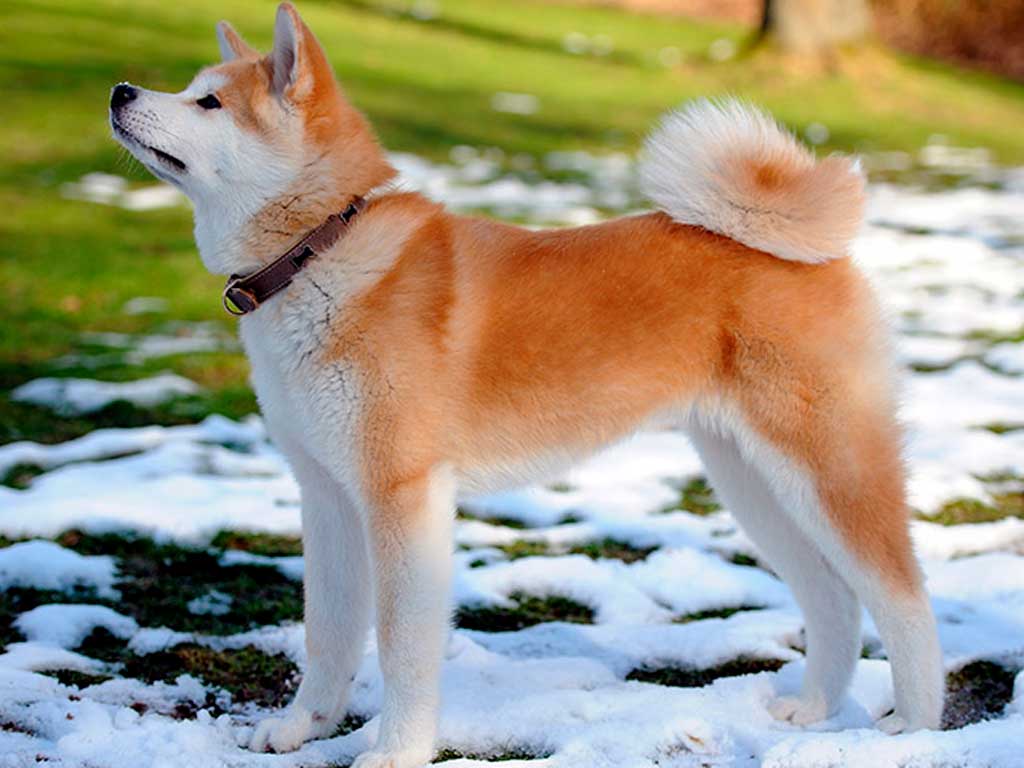
The Japanese Akita is a large, powerfully built spitz-type dog with a bear-like head, small triangular ears that tilt forward, and deep, dark, almond-shaped eyes that radiate calm intelligence. Males stand between 25 and 27.5 inches (64–70 cm) at the shoulder; females measure 23 to 25 inches (58–64 cm). Weight ranges from 75 to 110 pounds (34–50 kg) — substantial, muscular mass that underscores this dog’s working heritage.
The coat is a defining feature: thick, plush, and double-layered, with a dense undercoat and a straight, harsh outer coat. The Japanese Akita standard recognizes a more limited palette of colors than its American counterpart — primarily red fawn (aka), sesame (goma), brindle (tora), and pure white (shiro). A distinctive characteristic of the Japanese Akita is the urajiro — the pale cream or white shading on the cheeks, muzzle, throat, chest, and underside — which is considered an essential breed trait.
The tail is famously thick and carried curled over the back in the classic spitz fashion, adding to the breed’s impression of controlled power and self-possession. Every element of this dog’s appearance communicates the same message: dignified, capable, and entirely at ease.
Temperament and Personality
The Japanese Akita is a dog of profound contrasts. With its family, it is deeply devoted, gentle, and surprisingly affectionate — often described as cat-like in its cleanliness and the quiet, dignified way it expresses love. With strangers, it is reserved to the point of detachment, watching and assessing with calm, unhurried intelligence before deciding whether a newcomer is worthy of its attention.
This is not a breed that barks unnecessarily. The Akita is notably quiet for its size — a trait that actually makes it an effective guardian, since when it does vocalize, there is genuine reason. Its natural protective instincts are strong, and it will act to defend its family without hesitation when it perceives a genuine threat.
The prey drive and dog aggression tendencies in this breed are significant and should never be underestimated. Many Akitas — particularly same-sex pairs — do not coexist peacefully with other dogs without extensive, carefully managed socialization. Their hunting instinct also means that smaller animals in the household may not be safe without proper introduction and supervision.
This is emphatically not a breed for first-time dog owners. The Akita requires someone who understands how to lead with calm consistency, who can earn the dog’s respect without resorting to force, and who has the experience to recognize the difference between appropriate wariness and problematic behavior.
Care Guide
Diet and Nutrition
As a large, muscular working breed, the Japanese Akita needs a high-quality diet formulated for large dogs, with adequate protein to maintain lean muscle mass and the right balance of calcium, phosphorus, and other minerals to support joint health through its lifespan.
Like the Afghan Hound, the Akita is prone to bloat (gastric dilatation-volvulus) — a potentially fatal condition where the stomach twists after rapid eating or exercise. Feeding two to three smaller meals per day rather than one large serving significantly reduces this risk. Use a slow-feeder bowl if your dog tends to eat quickly, and enforce a rest period of at least an hour before and after meals.
Avoid overfeeding — excess weight puts serious strain on the joints of a heavy dog and can accelerate the development of hip dysplasia.
Exercise Requirements
The Akita needs one to two hours of exercise per day, ideally split across morning and evening sessions. These walks should be brisk and purposeful — this is not a dog that ambles. Off-leash exercise is possible in a securely fenced area, but given the breed’s strong prey drive and potential dog reactivity, it should never be let off-leash in public spaces where encounters with other animals or people are unpredictable.
The Akita is also remarkably adaptable about its schedule. If a walk is occasionally shortened or skipped due to weather or circumstance, it will accept this with characteristic stoicism — but consistent daily activity is essential for long-term physical and mental health.
Mental stimulation is equally important. Puzzle feeders, scent work, and obedience practice all help channel the Akita’s intelligence productively and prevent the boredom that can lead to destructive behavior.
Grooming Needs
The Akita’s thick double coat requires brushing two to three times per week under normal circumstances to remove loose hair, prevent matting, and keep the coat healthy. During the breed’s two major seasonal sheds — typically in spring and fall — daily brushing with a fine-toothed metal double-sided comb becomes necessary to manage the extraordinary volume of undercoat being released.
Be prepared: Akita shedding season is genuinely intense. Many owners describe it as finding tufts of fur on every surface of the home for several weeks. A high-velocity dog dryer used during baths can help blow out loose undercoat efficiently. Regular ear checks, nail trims, and dental care round out the grooming routine.
Training and Education
Training the Japanese Akita is one of the most rewarding and most demanding challenges in dog ownership. These dogs are highly intelligent and fully capable of learning complex commands — but they apply their own judgment about whether compliance is worth their effort at any given moment.
Consistency, calm authority, and positive reinforcement are the foundations of successful Akita training. They do not respond to harsh corrections, repetitive drilling, or owners who project anxiety or uncertainty. They respond to someone they genuinely respect — someone who is fair, clear, and predictable in their expectations.
Early socialization is absolutely non-negotiable. From the first weeks of puppyhood, an Akita must be exposed to a wide variety of people, environments, dogs, and situations. This does not eliminate the breed’s natural wariness, but it ensures that wariness remains appropriate rather than becoming defensive aggression.
Recall training should be a consistent focus throughout the dog’s life, though owners should remain realistic: in the presence of strong prey drive triggers, even a well-trained Akita may override its training. Management through leash and secure fencing is always the safest approach.
Health and Longevity
The Japanese Akita enjoys a lifespan of 10 to 15 years — an impressive range that reflects the breed’s fundamental robustness when well cared for. Like all large breeds, however, there are specific health conditions worth monitoring closely.
Key health considerations include:
- Hip Dysplasia — The most common structural concern in the breed. Responsible breeders screen breeding stock with hip and elbow evaluations. Maintaining a healthy weight significantly reduces the impact of this condition.
- Progressive Retinal Atrophy (PRA) — A hereditary eye condition that can lead to vision loss. Eye screening of breeding dogs is important.
- Autoimmune Disorders — The Akita has a higher-than-average predisposition to certain autoimmune conditions, including autoimmune hemolytic anemia and pemphigus. This also makes the breed sensitive to some medications — always inform your vet of this before any treatment.
- Bloat (GDV) — As with all deep-chested large breeds, this is a serious risk that warrants preventive feeding management.
- Hypothyroidism — Thyroid issues can occur in the breed; watch for weight gain, lethargy, and coat changes.
Is This the Right Dog for You?
The Japanese Akita is a once-in-a-lifetime dog for the right owner — and potentially a serious challenge for the wrong one. It is best suited to experienced owners with a calm, confident leadership style, a home with a securely fenced yard, and the time to invest in consistent daily training and socialization.
It thrives in a quieter household with older children or adults who understand and respect canine boundaries. Multi-pet households require very careful management, particularly with other dogs of the same sex.
If you are drawn to a dog with genuine depth of character — one that will observe the world with quiet intelligence, protect you without being asked, and love you with the kind of loyalty that inspired a nine-year vigil at a train station — the Japanese Akita may be exactly the dog you’ve been looking for.
FAQs About the Japanese Akita Dog Breed
What is the difference between a Japanese Akita and an American Akita? The two are now recognized as distinct breeds. The Japanese Akita (Akita Inu) is leaner, fox-like in the face, and limited to specific colors including red, sesame, brindle, and white with urajiro markings. The American Akita is heavier and more bear-like in build, and comes in a wider range of colors including black masks. Both share the same ancient lineage but diverged significantly after World War II.
Are Japanese Akitas good with children? Akitas can be gentle and loving with children they are raised with, but they require close supervision around young children and are generally better suited to homes with older kids (10+). Their size, strength, and sensitivity to rough handling make unsupervised interactions with toddlers inadvisable. Early socialization with children from puppyhood is essential.
Do Japanese Akitas get along with other dogs? This varies by individual, but the breed has a well-documented tendency toward same-sex dog aggression and can be territorial with unfamiliar dogs. Many Akitas do best as the only dog in the household, or with a carefully matched opposite-sex companion. Early, consistent socialization can help, but it does not eliminate the instinct entirely.
How much does a Japanese Akita puppy cost? In the US, Japanese Akita puppies from reputable, health-tested breeders typically range from $1,500 to $3,500 USD. In the UK, expect to pay £1,500 to £3,000. The Japanese Akita is rarer than the American variety in Western countries, which can push prices higher. Always prioritize breeders who conduct hip, elbow, and eye screenings on their breeding stock.
Is the Japanese Akita the right dog for a first-time owner? Honestly, no. The Japanese Akita is consistently recommended for experienced dog owners who understand how to establish trust-based leadership, manage a strong-willed dog, and navigate the breed’s specific social challenges. That said, a first-time owner who commits to working with a qualified trainer from day one, invests heavily in early socialization, and thoroughly researches the breed before acquiring one can absolutely succeed — it simply requires exceptional dedication.
Looking for a smaller cousin from the same country? The Shiba Inu shares similar Japanese roots in a much more compact, apartment-friendly package.