French Bulldog: Personality, Care, Health Risks & Owner Advice
The French Bulldog is one of the most popular dog breeds in the world right now — and it’s easy to see why. Compact, affectionate, low-maintenance on the exercise front, and absolutely full of personality, the Frenchie seems tailor-made for modern life.
But behind those famous bat ears and squishy face lies a breed with some serious health considerations every potential owner needs to understand before falling in love.
In this article, you’ll get the full picture: the French Bulldog’s surprising history, its distinctive looks, its irresistible temperament, and the honest truth about caring for — and financing — one of these lovable little dogs.
History and Origin of the French Bulldog
Here’s the twist most people don’t expect: the French Bulldog is not really French.
The breed traces its roots to Nottingham, England, where Toy Bulldogs — a miniaturized version of the English Bulldog — were enormously popular among the city’s lace-making community. When the Industrial Revolution disrupted the lace trade in the mid-19th century, many of these craftsmen emigrated to northern France, taking their small bulldogs with them.
In France, the breed evolved — most likely through crossbreeding with dogs such as the Pug and various terrier types. The result was a noticeably different dog: lighter in frame, more animated in personality, and sporting those now-iconic upright ears. French society fell for the breed immediately. Artists, bohemians, and Parisian socialites adopted the bouledogue français as a symbol of fashionable irreverence, and the dog even appeared in paintings by Degas and Toulouse-Lautrec.
One key detail shaped the breed’s modern appearance permanently. In the early days, French Bulldogs came in two ear types: the upright “bat ear” preferred by the French, and the folded “rose ear” favored by English breeders. After considerable debate — particularly between American and English breed enthusiasts — the bat ear was officially adopted as the breed standard, giving the French Bulldog the distinctive silhouette we recognize instantly today.
The breed was recognized by the UK Kennel Club in the Utility group and has since become one of the most registered breeds in both the UK and the United States.
Physical Characteristics of the French Bulldog
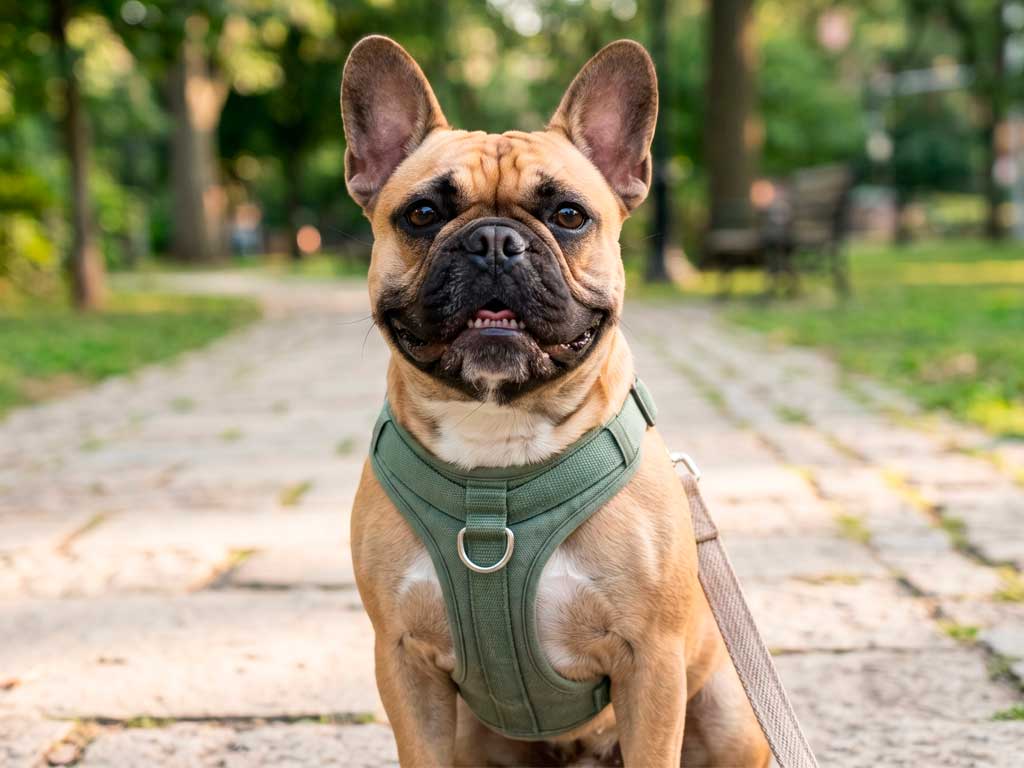
The French Bulldog is a small dog with a surprisingly solid, muscular build. Despite its compact size, this is not a fragile breed — it has strong bones, sturdy legs, and a powerful frame.
Key measurements:
- Height: 30–31 cm at the shoulder
- Weight: 7.5–12.5 kg
- Build: Compact, muscular, heavy for its size
The breed’s most recognizable features are its broad, flat face, large rounded eyes, and those large, upright bat ears set wide apart on a square head. The skull is flat between the ears, the muzzle is extremely short and broad, and the skin around the face forms soft wrinkles and folds.
The tail is naturally short — either straight or slightly screwed — and is carried low.
Coat characteristics:
- Short, smooth, close-lying, and soft to the touch
- Fine and glossy in appearance
- Requires minimal grooming effort
Coat colors include:
- Fawn — ranging from light cream to deep honey, the most classic Frenchie coloring
- Brindle — dark stripes over a lighter base coat
- Cream — pale, off-white
- Pied (bicolor) — predominantly white with patches of brindle or fawn
- Black, chocolate, or lilac — these colors exist but are not always recognized by the breed standard; always verify with the Kennel Club if purchasing for showing
Temperament and Personality of the French Bulldog
If you’ve ever spent time with a French Bulldog, you already know: they have a completely unique energy about them.
The Frenchie’s personality can shift in a matter of minutes from playful and mischievous to deeply, profoundly asleep in the sunniest spot in the room. This unpredictability is part of the charm. They’re equally happy entertaining you with their antics and ignoring you entirely while they snore on the sofa.
Core personality traits:
- Sociable and people-oriented — French Bulldogs were bred to be companions, and companionship is what they live for
- Affectionate — they bond closely with their owners and enjoy physical closeness; lap time is non-negotiable
- Playful but measured — bursts of enthusiasm followed by extended rest periods are the Frenchie’s natural rhythm
- Curious and alert — despite their relaxed appearance, they notice everything going on around them
- Stubborn — a classic free-thinker; they respond to positive reinforcement far better than pressure or repetition
- Surprisingly brave — a French Bulldog has little awareness of its actual size and will confidently approach much larger dogs
One thing worth knowing: the French Bulldog’s flat face makes it harder for other dogs to read its body language. The shortened muzzle limits facial expression, and the tiny tail reduces tail signaling. This can sometimes lead to misunderstandings with other dogs, so careful introductions and early socialization are important.
The French Bulldog is not much of a barker. This makes the breed an excellent choice for apartment living — neighbors will thank you.
Care
Diet and Nutrition
Small dogs have fast metabolisms, which means they burn energy quickly and need appropriately sized meals delivered consistently throughout the day.
Feeding recommendations for French Bulldogs:
- Choose a high-quality complete food formulated for small breeds — these are designed with the right nutrient ratios and smaller kibble pieces suited to a Frenchie’s shorter jaw
- Feed twice daily following the portions recommended on your food packaging
- Always provide access to fresh, clean water
- Monitor weight carefully — the French Bulldog’s stocky build can disguise gradual weight gain, and even small amounts of extra weight put additional pressure on the joints and respiratory system
- Keep treats modest in size and quantity; use them strategically during training rather than freely
A well-balanced diet, combined with appropriate portion control, can help a French Bulldog live comfortably into its early teens. Obesity is one of the most significant factors that worsens breathing difficulties in brachycephalic breeds, so keeping your Frenchie lean is genuinely health-critical.
Exercise Requirements
This is one of the French Bulldog’s most appealing traits for many owners: it doesn’t need a great deal of exercise.
Around one hour of gentle activity per day is sufficient for most adult Frenchies. That can be split into two shorter walks — and the dog will happily accept a slower pace.
Important exercise safety rules for French Bulldogs:
- Never exercise in hot or humid weather. The flat face severely limits this breed’s ability to cool itself through panting. Heat stroke is a genuine, life-threatening risk.
- In summer, walk only in the early morning or late evening when temperatures are lower
- Never put a coat or clothing on your Frenchie in warm weather — it traps heat against the body
- Avoid strenuous activity that causes excessive panting or labored breathing
- Keep swimming sessions fully supervised — most French Bulldogs cannot swim safely due to their heavy heads and short legs
Despite these limitations, the Frenchie genuinely enjoys interactive play indoors and mental stimulation through puzzle toys and games. This is a great way to keep the breed engaged without the physical risks.
Grooming Needs
The French Bulldog’s coat is one of the easiest to maintain of any breed.
Weekly grooming routine:
- Brush once a week with a soft-bristle brush or rubber grooming glove to remove loose hair and keep the coat glossy
- During shedding periods, increase to two or three times per week
However, the Frenchie’s facial folds and wrinkles require special attention — this is the grooming task most owners underestimate.
- Clean the facial folds regularly (at least weekly, ideally more often) using a soft damp cloth or specialist pet wipe
- Dry the folds thoroughly after cleaning — moisture trapped in the skin folds creates the perfect environment for bacterial and yeast infections
- Clean the ears weekly using a damp cloth around the outer ear canal; use cotton swabs only on the very outer canal, never deep inside
- Trim nails every two weeks — the French Bulldog doesn’t wear its nails down naturally through exercise
- Brush teeth regularly to prevent dental disease, which is common in small breeds
If you notice redness, swelling, discharge, or odor in any skin fold or ear, consult your vet promptly.
Training and Education
The French Bulldog is genuinely intelligent — but it’s also a free-thinker with a streak of stubbornness that can catch first-time owners off guard.
The good news: this breed responds extremely well to positive reinforcement training. Food rewards and play are highly effective motivators. Frenchies love to feel that training is fun rather than obligatory.
Training principles that work:
- Start early — puppyhood is the ideal window for socialization and basic commands
- Keep sessions short — 10–15 minutes is ideal; Frenchies lose interest in repetitive drills quickly
- Use high-value treats and praise as primary rewards
- Be consistent — set clear rules and apply them every time; this breed is good at exploiting inconsistency
- Focus on recall and basic obedience as the foundation before moving on to more complex skills
- Leash train from day one — while not as strong a puller as terrier breeds, a Frenchie that hasn’t learned loose-leash manners can make walks frustrating
One important note: avoid aversive training methods entirely with this breed. Harsh corrections or punishment-based approaches are counterproductive and can damage the trust relationship that makes Frenchies such rewarding companions.
The French Bulldog will not be the star of obedience competitions. But with patience and the right motivation, it will absolutely learn the basics — and do so with considerable charm.
Health and Longevity of the French Bulldog
This is the section every prospective French Bulldog owner must read carefully. The French Bulldog is a brachycephalic breed — meaning it has a deliberately shortened skull and flattened face. This is the source of the breed’s distinctive looks, and also the source of its most significant health challenges.
Life expectancy: 11–14 years with good care.
Brachycephalic Obstructive Airway Syndrome (BOAS)
This is the most critical health issue in the breed. BOAS is a collection of anatomical abnormalities — including narrowed nostrils, an elongated soft palate, and a narrowed trachea — that restrict airflow. Symptoms range from noisy breathing, snoring, and reduced exercise tolerance to severe respiratory distress in serious cases.
Many French Bulldogs will require corrective surgery as they grow up to improve their breathing. This is a significant financial consideration. Always ask breeders for the Kennel Club’s Respiratory Function Grading Scheme results for the puppy’s parents before purchasing.
Skin Fold Infections
The folds of skin around the face create warm, moist pockets that are prone to bacterial and yeast infections. Regular cleaning, as described in the grooming section, is the primary prevention tool.
Eye Ulcers
Because French Bulldogs have large, relatively prominent eyes that sit close to the surface, they are more susceptible to corneal ulcers — painful erosions of the eye’s surface. Any squinting, discharge, or cloudiness should be assessed by a vet without delay.
Additional Health Conditions
- Patellar luxation — where the kneecap slips out of position, causing lameness
- Hereditary cataracts — clouding of the lens that can lead to vision loss
- Intervertebral disc disease (IVDD) — degeneration of the spinal discs, which can cause pain or paralysis
- Degenerative myelopathy — a progressive neurological disease affecting the hind legs
- Hyperuricosuria — a condition where uric acid accumulates in the urinary tract, potentially causing bladder or kidney stones
What this means for owners:
- Budget carefully for veterinary costs — French Bulldogs tend to have higher-than-average lifetime vet bills
- Invest in comprehensive pet insurance before any pre-existing conditions are identified
- Choose a breeder who actively participates in health screening programmes and avoids extreme physical traits
- Never support breeders who prioritize appearance over the dog’s ability to breathe, move, and live comfortably
Is the French Bulldog the Right Dog for You?
The French Bulldog is one of the most rewarding breeds to own — but only for the right owner in the right situation.
The French Bulldog suits you well if:
- You live in an apartment or smaller home and want a dog that thrives indoors
- You want a low-to-moderate exercise breed that doesn’t need hours of outdoor activity
- You’re a first-time dog owner — the Frenchie’s gentle, adaptable nature makes it one of the more accessible breeds for beginners
- You enjoy affectionate, interactive companions that want to be close to you
- You work from home or have flexible hours — this breed does not tolerate long periods alone and is prone to separation anxiety if left for more than four to six hours regularly
- You can tolerate snoring, snuffling, and a range of vocal sounds — because there will be plenty
The French Bulldog may not be ideal if:
- You live in a hot climate without reliable air conditioning
- You want an athletic breed for running, hiking, or intensive outdoor activities
- You have very young children — supervision is always required, and a boisterous toddler and a flat-faced dog need careful management
- You’re not prepared for above-average veterinary costs and the possibility of surgical intervention
- You travel frequently and need a dog that can fly in the cabin — many airlines restrict brachycephalic breeds due to breathing risks at altitude
The bottom line: the French Bulldog offers extraordinary companionship, a genuine sense of humor, and a level of devotion that few breeds can match. Go in with clear eyes about the health realities, choose a responsible breeder, and you’ll have one of the most entertaining and loving housemates you’ve ever had.
Frequently Asked Questions About the French Bulldog
1. Can French Bulldogs be left alone all day?
With the right training, a French Bulldog can manage around four to six hours alone. However, this breed was purpose-built for human companionship and is genuinely prone to separation anxiety. If you work long hours away from home without a dog walker or daycare arrangement, a Frenchie may not be the best choice.
2. Do French Bulldogs bark a lot?
No — quite the opposite. The French Bulldog is one of the quieter breeds and tends not to bark excessively. This makes it particularly well-suited to apartment living. It does, however, communicate through a range of other sounds: gurgles, snuffles, yawns, and the occasional dramatic groan.
3. Is the French Bulldog a good dog for first-time owners?
Yes, generally. The breed is adaptable, relatively easy to train with positive reinforcement, and doesn’t require intense exercise. The main caveat is the health management component — prospective owners need to understand the veterinary commitments involved before choosing the breed.
4. Can French Bulldogs swim?
Most cannot swim safely. The combination of a heavy, flat head, short legs, and a compact body makes it very difficult for Frenchies to stay afloat. Never leave a French Bulldog unsupervised near water, and never assume it can swim without proper support.
5. How much does it cost to own a French Bulldog?
Beyond the purchase price, French Bulldogs tend to carry above-average ongoing costs due to their health profile. Veterinary bills — including potential surgery for breathing issues, skin conditions, and eye problems — can be substantial. Comprehensive pet insurance purchased before any conditions develop is strongly recommended for all Frenchie owners.
Considering similar breeds? The Boston Terrier shares the Frenchie’s compact size and apartment-friendly personality, while the Pug offers another charming take on the brachycephalic companion dog.