Border Terrier Dog Breed: Temperament, Care & What to Expect
Think small dog, big personality — and you’re already halfway to understanding the Border Terrier.
This is one of the most likeable terriers on the planet. Tough enough to have hunted foxes across the rough Scottish border country for centuries, yet gentle enough to curl up with a child at the end of the day. It’s a breed that punches well above its weight in personality, adaptability, and affection.
In this article, you’ll get the full picture: history, temperament, exercise needs, health considerations, and the honest answer to whether this dog is right for your life.
History and Origin
The Border Terrier is one of Britain’s oldest working terriers, and remarkably, it has changed very little since it first appeared in the 18th century.
The breed emerged along the border country between England and Scotland — harsh, remote terrain where farmers needed a dog that could do two very specific jobs. First, it had to be fast and long-legged enough to keep pace with foxhounds on a hunt. Second, it had to be small and fearless enough to go underground and flush a fox out of its den. That combination of traits — speed, bravery, compact size, and relentless energy — defines the Border Terrier to this day.
Originally known as the Reedwater Terrier and the Coquetdale Terrier after the valleys where it worked, the breed was formally renamed the Border Terrier and recognized by the Kennel Club in 1920. Unlike many terrier breeds that were later reshaped by show standards, the Border Terrier remained close to its working roots — a fact that explains both its robust health and its practical, no-fuss appearance.
Today, working Border Terriers still exist in rural Britain, though the vast majority are kept as companion dogs. The transition from working terrier to family pet has been a natural one — because the qualities that made it a great hunting dog also make it a genuinely wonderful companion.
Physical Characteristics
The Border Terrier is a small but sturdy dog, built for function rather than fashion.
Males typically weigh between 6 and 7 kg; females between 5 and 6 kg. Height at the withers ranges from 28 to 30.5 cm. Despite its small frame, this is not a delicate dog. The body is well-proportioned, narrow enough to squeeze into a fox’s earth, and athletic enough to run considerable distances without tiring.
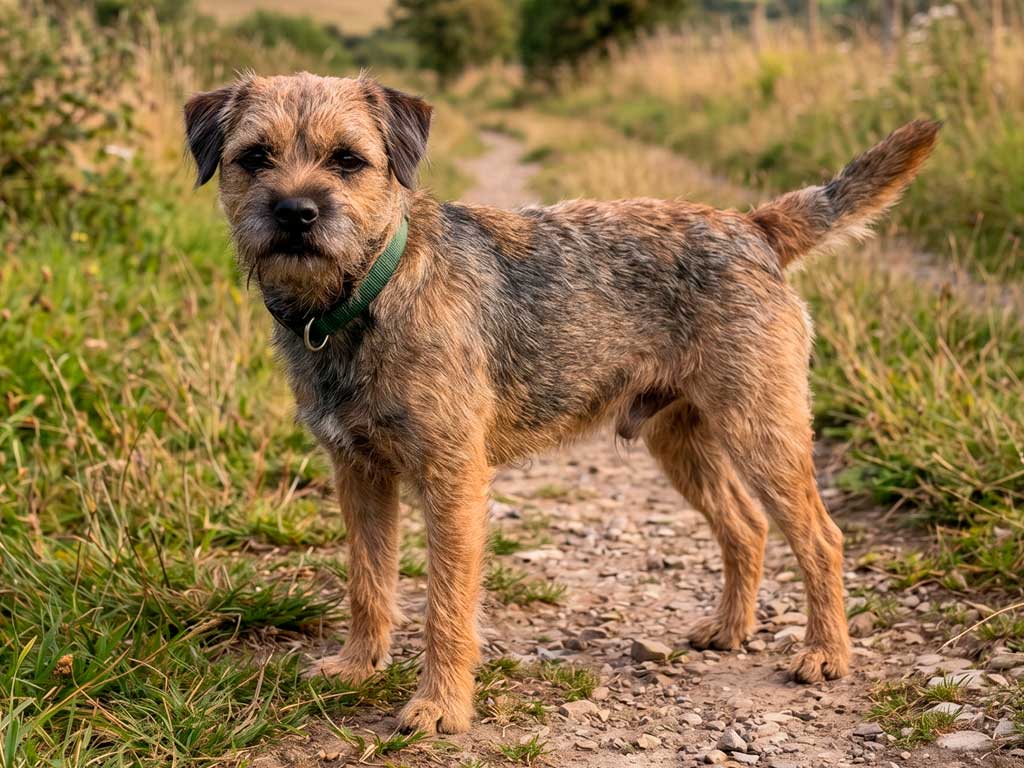
One of the breed’s most distinctive physical features is the “otter head” — a broad, flat skull with a short, strong muzzle that resembles the head of an otter when viewed from above or the side. The eyes are dark, keen, and full of expression. The ears are small, V-shaped, and fold forward close to the cheek.
The coat is the other defining characteristic. The Border Terrier has a dense, wiry outer coat over a soft, thick undercoat. The rough texture was not a stylistic choice — it served as practical protection against thorns, rocks, and the bites of the animals it hunted. The skin beneath is notably loose and thick for the same reason. Coat colors include red, grizzle-and-tan, blue-and-tan, and wheaten — all earthy, natural tones that reflect the landscape this breed was built to work in.
Temperament and Personality
If you want the honest version of the Border Terrier’s personality: this is a dog that is fundamentally good-natured, but undeniably a terrier.
That means it is affectionate, loyal, and genuinely joyful to be around — and it also means it has an independent streak, a powerful prey drive, and an enthusiasm for digging that no amount of training will completely eliminate. Understanding both sides of that coin is essential before bringing one home.
With its family, the Border Terrier is warm, devoted, and playful. It forms strong bonds and genuinely enjoys human company, whether that means a vigorous game in the garden or a quiet evening on the sofa. It is more sociable and less combative than many other terrier breeds, which makes it notably easier to integrate into a busy household.
With children, the Border Terrier is one of the better terrier choices. It is robust enough to handle the energy of older kids and patient enough to tolerate the unpredictable behavior of younger ones — though as with any breed, supervised interactions with toddlers are always the responsible approach. The breed’s playful nature makes it a natural match for active children who want a dog that will keep up with them.
With other dogs, early socialization produces good results. The Border Terrier is not naturally aggressive toward other dogs, and its relatively amenable temperament means it can coexist well in multi-dog households. However, small animals — rabbits, guinea pigs, hamsters — are a different matter entirely. The prey drive is hardwired, and no amount of training fully overrides it. Homes with small pets need to be very clear-eyed about this.
Care Guide
Diet and Nutrition
The Border Terrier is a small, active breed with a fast metabolism that requires consistent, quality fuel.
Foods formulated specifically for small breeds are the best starting point — they are calorie-dense in appropriate proportions and sized for smaller jaws, which also encourages proper chewing and aids digestion. Two measured meals per day is the standard recommendation. Like all small dogs, the Border Terrier can be prone to weight gain if portions aren’t monitored, and excess weight puts disproportionate strain on small joints over time.
Protein quality matters. Look for a food where a named animal protein appears as the primary ingredient. Fresh water should always be available, especially after exercise. As the dog ages or activity levels shift, calorie needs should be reassessed with veterinary guidance to keep the dog at a lean, healthy body condition throughout its life.
Exercise Requirements
One hour of exercise per day is the minimum for an adult Border Terrier — and more is always welcome.
This is a working dog in a small body, and its energy output reflects that heritage. Daily walks should be brisk and varied — the Border Terrier is not a dog that enjoys plodding around the same block twice a day. Off-leash time in a securely fenced area is valuable, as is any activity that engages both body and mind simultaneously.
Here’s an important practical note: recall is unreliable when prey is involved. If a Border Terrier spots a squirrel, rabbit, or cat, its hunting instinct activates faster than any trained response. Never let one off-leash in an unfenced area until recall has been tested and proven in high-distraction environments — and even then, caution is warranted. A garden must be properly secured, as this breed is a determined and surprisingly skilled escape artist.
Mental stimulation matters as much as physical exercise. Puzzle feeders, scent work, hide-and-seek games, and interactive toys all help satisfy the cognitive energy this dog generates. A bored Border Terrier will dig. It will bark. It will find its own entertainment, and that entertainment will typically involve your garden furniture or flowerbeds.
Grooming Needs
The Border Terrier’s wiry coat is relatively low-maintenance, but it does require a specific kind of attention.
Brushing two to three times a week removes dirt and loose hair and keeps the coat looking tidy. Unlike many dogs, the Border Terrier’s coat does not need clipping — in fact, clipping softens the wiry texture and removes the weatherproofing qualities the coat is designed to provide. Instead, the coat is traditionally hand-stripped twice a year: a process where dead outer coat is pulled out by hand (or with a stripping knife) to allow a fresh, dense coat to grow back in. Many owners learn to do this themselves; others rely on a groomer experienced with working terrier coats.
Bathing every four to six weeks is sufficient. Beyond coat care, weekly ear checks, nail trimming every three to four weeks, and regular dental hygiene — ideally brushing two to three times per week — round out the grooming routine.
Training and Education
The Border Terrier is considered one of the most trainable terrier breeds — which is genuinely saying something in a group not known for eager compliance.
It is intelligent, responds well to positive reinforcement, and has a genuine willingness to engage with its owner that many other terriers lack. Basic obedience tends to come relatively quickly. Several Border Terriers have excelled in competitive obedience, mini-agility, and heelwork to music — canine sports that demonstrate both their athleticism and their capacity for sustained focus.
That said, training a terrier is never quite the same as training a retriever. The Border Terrier has an independent mind and a set of deeply ingrained instincts that it will always weigh against your instructions in novel situations. Consistency from day one is essential. Short training sessions of 10 to 15 minutes keep the dog engaged and prevent the boredom that causes it to switch off. Positive reinforcement — treats, praise, and play — works far better than correction-based methods with this sensitive breed.
Socialization should begin from puppyhood: exposure to different people, dogs, sounds, and environments builds a confident, stable adult dog. The Border Terrier that hasn’t been adequately socialized can become timid or reactive, particularly around other dogs or in busy urban environments.
This is a good breed for a first-time terrier owner — provided that owner has realistic expectations, genuine commitment to training, and an appreciation for the independent spirit that comes built into every terrier.
Health and Longevity
The Border Terrier is one of the healthiest small breeds available, with a life expectancy of 12 to 15 years and a generally robust constitution that reflects its working heritage.
Because it was bred for function and not aesthetics, it has avoided many of the exaggerated physical traits that cause health problems in other small breeds. There are no breathing issues, no skeletal deformities from selective breeding — just a solid, practical little dog.
However, several hereditary conditions do appear in the breed. Canine Epileptoid Cramping Syndrome (CECS) — sometimes called Spike’s Disease — is the most well-known condition specific to Border Terriers. It causes episodes of muscle cramping, disorientation, and involuntary movement that can look alarming but are rarely life-threatening. The condition is believed to have a dietary component, and many affected dogs are managed successfully through food changes.
Atopy — an allergic skin reaction to environmental triggers such as pollen, dust mites, or grass — is seen with some frequency. It typically manifests as itching, skin irritation, and recurring ear issues, and is usually manageable with veterinary guidance. Additionally, Spongiform Leucoencephalomyelopathy (the “shaking puppy syndrome”) is a rare hereditary neurological condition that can appear in young dogs.
Routine annual veterinary checkups, dental care, weight management, and vaccination and parasite control form the foundation of long-term health for this breed.
Is This the Right Dog for You?
The Border Terrier is a genuinely versatile breed — one of the few dogs that works equally well for city dwellers and country families, for active individuals and households with children.
This dog is an excellent match if you are an active owner who can commit to at least one hour of daily exercise, if you want a small dog with real personality and courage rather than a purely decorative companion, if you have children aged roughly five and over who want an enthusiastic playmate, or if you’re a first-time terrier owner who wants the classic terrier spirit in a more manageable package. It also suits owners who travel or live in smaller spaces, provided its exercise needs are consistently met.
The honest caveats: the Border Terrier is not the right choice if you have small pets like rabbits or guinea pigs that cannot be safely separated, if you want a dog with bulletproof recall in all situations, or if you’re looking for a low-energy companion that requires minimal activity. The garden must be escape-proof — this point cannot be overstated.
Get the match right, and the Border Terrier rewards you with a dog that is affectionate, funny, resilient, and endlessly entertaining. It is a big dog’s dog in a small dog’s body, and for the right owner, there is simply nothing better.
Frequently Asked Questions
Does the Border Terrier have a good temperament?
Yes — consistently. The Border Terrier is regarded as one of the most amiable and good-natured of all terrier breeds. It is affectionate with its family, sociable with people it meets, and less prone to the aggression or stubbornness that characterizes some other terriers. It still has the independent spirit and drive that are hallmarks of the terrier group, but these qualities are notably softer and more manageable in the Border than in most of its relatives.
Does the Border Terrier shed a lot?
No, shedding is minimal. The wiry double coat does not shed in the way that smooth or long-coated breeds do. Regular brushing keeps loose hair under control, and most Border Terrier owners find very little dog hair on furniture or clothing. The main coat maintenance requirement is hand-stripping twice a year to remove dead outer coat and maintain the correct texture — a process that differs entirely from the clipping or trimming used on other breeds.
Is the Border Terrier an intelligent dog?
Yes, above average. The breed was developed to make independent decisions in the field — reading terrain, tracking quarry, and working without constant direction from a handler. That functional intelligence translates into a dog that is quick to learn, responsive to training, and capable of problem-solving in ways that surprise many owners. It is not the single-minded, laser-focused intelligence of a Border Collie, but it is genuine, practical, and paired with a willingness to engage that makes training genuinely enjoyable.
Can you leave a Border Terrier alone?
For moderate periods, yes — with the right preparation. The Border Terrier forms strong bonds with its owner and can experience separation anxiety if left alone for extended periods without proper conditioning. However, with gradual training from puppyhood, most Border Terriers learn to cope comfortably with several hours of alone time per day. Providing enrichment — a stuffed Kong, a puzzle feeder, or a safe chew — helps ease the transition. Dogs left alone for very long hours consistently, without adequate exercise beforehand, will develop behavioral problems.
Is the Border Terrier a good dog for families with kids?
Among terriers, it is one of the best choices for families. The Border Terrier is robust, playful, and more patient with children than most other terrier breeds. It genuinely enjoys the energy and activity that come with family life. The best fit is with children who are old enough to respect the dog’s boundaries and engage in structured play — roughly five years and older. As always, adult supervision of interactions between any dog and young children is the baseline responsible approach, regardless of breed reputation.