
Understanding what happens beneath the surface of your aquarium can feel like a high school chemistry project, but it is the most critical skill any fish keeper can develop. Whether you are setting up your first 10-gallon tank or managing a complex planted scape, water quality is the thin line between a thriving underwater paradise and a struggling environment.
Clear water does not always mean healthy water. To provide a safe home for your aquatic friends, we need to look closer at the invisible parameters that dictate their health, growth, and longevity.
The Invisible World: Why Clear Water Isn’t Always Healthy
In nature, vast bodies of water naturally dilute waste and replenish minerals. In a home aquarium, we are managing a closed system. This means every biological process—from fish respiration to decaying food—affects the chemical makeup of the water.
Maintaining high water quality isn’t about chasing “perfect” numbers; it’s about achieving stability. Fish can often adapt to slightly sub-optimal conditions, but rapid fluctuations in chemistry are almost always fatal.
The Nitrogen Cycle: The Biological Heart
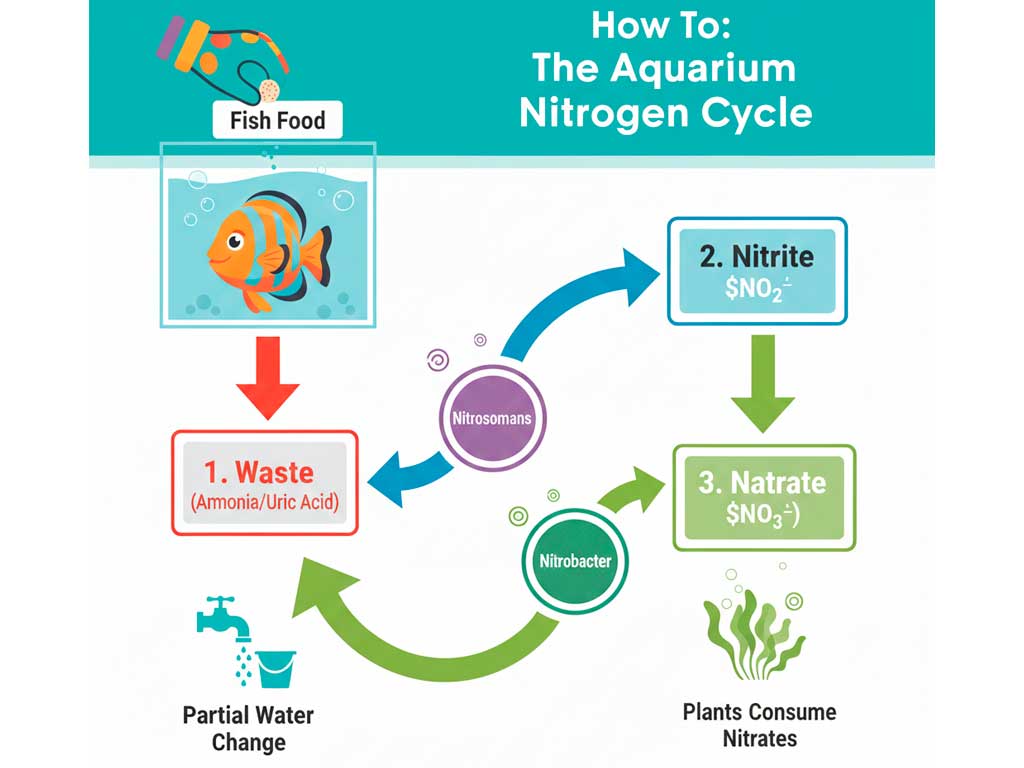
The most vital concept for any hobbyist is the nitrogen cycle. This is the process where beneficial bacteria transform toxic waste into less harmful substances.
- Ammonia (NH3): Released through fish waste and uneaten food. It is highly toxic and can cause gill damage or death even at low levels.
- Nitrite (NO2): Bacteria (Nitrosomonas) convert ammonia into nitrite. While an improvement, nitrite is still extremely dangerous as it prevents fish from carrying oxygen in their blood.
- Nitrate (NO3): A second group of bacteria (Nitrospira) converts nitrite into nitrate. This is far less toxic and is removed through regular water changes or consumed by live plants.
Pro Tip: In a mature “cycled” aquarium, your ammonia and nitrite levels should always read 0 ppm. If you see these numbers rising, your biological filter is struggling.
Key Parameters Every Owner Should Monitor
To keep your ecosystem in balance, you need to be familiar with these four pillars of water chemistry:
1. pH Levels (Acidity vs. Alkalinity)
The pH scale measures how acidic or basic your water is. Most tropical fish thrive between 6.5 and 7.5, but consistency is more important than hitting a specific decimal point. Sudden swings in pH cause “osmotic shock,” which weakens a fish’s immune system instantly.
2. Water Hardness (GH and KH)
- General Hardness (GH): Measures dissolved calcium and magnesium. It’s essential for fish metabolic functions and bone development.
- Carbonate Hardness (KH): Also known as “alkalinity,” KH acts as a buffer for your pH. Think of it as a sponge that absorbs acids; if your KH is too low, your pH can crash unexpectedly.
3. Temperature Stability
While not a “chemical,” temperature dictates the speed of chemical reactions. Most tropical species require a steady range between 24°C and 27°C (75°F – 80°F). Use a reliable heater and always double-check with an independent thermometer.
How to Keep Your Water in Peak Condition
Managing water quality doesn’t require a lab coat, just a consistent routine.
- Test Weekly: Use a liquid test kit rather than strips for better accuracy. Check your levels before your weekly maintenance.
- The 20% Rule: Replacing roughly 20% of your water weekly is the most effective way to export nitrates and replenish essential minerals.
- Condition Your Water: Never add tap water directly to your tank. Always use a water conditioner to neutralize chlorine and chloramines, which are lethal to beneficial bacteria.
- Avoid Overfeeding: Excess food is the primary cause of ammonia spikes. Only feed what your fish can consume in two minutes.
Did You Know?
Live plants act as “natural filters.” They don’t just produce oxygen; they actively suck up nitrates and ammonium as fertilizer, helping to stabilize your water chemistry between maintenance sessions.
Expert Insight: If you notice your fish gasping at the surface or darting erratically, perform a 30% water change immediately. When in doubt, “dilution is the solution to pollution.”
Medical Disclaimer: While water chemistry is the root of most fish ailments, if your pets show signs of advanced disease (such as ich, velvet, or dropsy), consult an expert or a certified specialist for specific medicinal treatments.
The Aquarium Maintenance Checklist
Focus: Stability, Algae Control, and Nitrogen Cycle Preservation.
This plan accounts for a standard community tank (30-55 gallons – 100-200 litres) with a mix of fish and live plants, as this is the most common setup that requires balanced chemistry management.
Daily: The “Eye Test” (2 Minutes)
- Observe Behavior: Are fish active? Any gasping at the surface or clamped fins?
- Check Temperature: Ensure your heater hasn’t stuck “on” or “off.”
- Equipment Check: Is the filter outflow strong? Is the air pump humming?
- Remove Excess Food: If you see flakes hitting the bottom, you fed too much. Scoop them out.
Weekly: The “Reset” (30-45 Minutes)
- Water Analysis: Test for pH, Ammonia (NH3), Nitrites (NO2), and Nitrates (NO3).
- Goal: 0 Ammonia, 0 Nitrite, <20ppm Nitrate.
- 20-30% Water Change: Use a gravel vacuum to “siphon” waste from the sand/gravel.
- Water Conditioning: Add dechlorinator to your new water before it hits the tank.
- Glass Cleaning: Wipe down the inside glass with an algae magnet or sponge.
- Plant Care: Trim dead leaves so they don’t rot and cause ammonia spikes.
Monthly: The “Deep Systems” Check (1 Hour)
- Filter Maintenance: Rinse your sponges or ceramic rings in a bucket of old tank water.
- CRITICAL: Never use tap water; the chlorine will kill your beneficial bacteria instantly.
- Impeller Cleaning: Take apart the filter motor and wipe the magnetic impeller to prevent motor burnout.
- Check Expiration Dates: Test kit reagents and fish food lose potency after 6 months of being open.
- Top-off Evaporation: Use treated water to keep the water line at the correct level.
Chemical “Cheat Sheet” for your Variables:
| Parameter | Ideal Range | If it’s too high… |
| Ammonia | 0 ppm | Perform 50% water change immediately. |
| Nitrite | 0 ppm | Add aquarium salt (dose carefully) to prevent brown blood disease. |
| Nitrate | 5-20 ppm | Add more live plants or increase water change frequency. |
| pH | 6.8 – 7.6 | Do not use “pH Up/Down” chemicals. Use driftwood (to lower) or crushed coral (to raise) for a slow, safe change. |
Pro-Tips for “Expert Mode”:
- The “Snooze” Rule: If you miss a weekly water change, do not double the amount the next week. Two small changes are always safer than one massive 80% change, which can shock the fish.
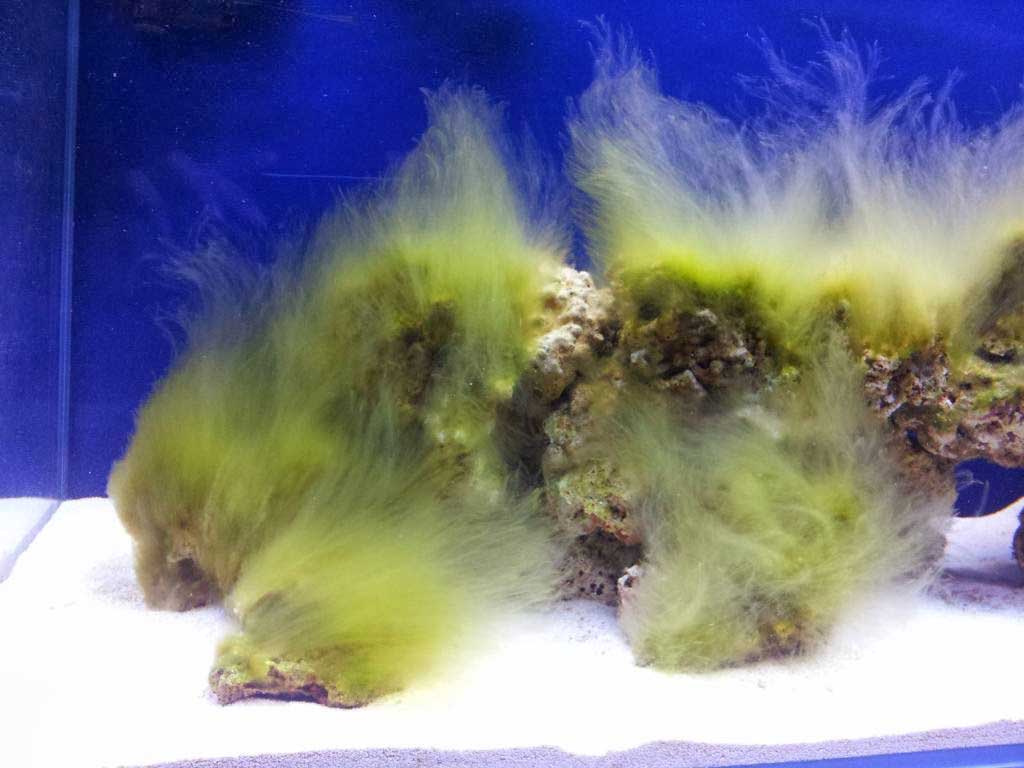
- Light Control: Keep your lights on a timer for 6-8 hours. Any more and you are essentially farming algae.
- Quarantine: New fish should live in a separate small tank for 2 weeks. One sick fish can ruin a perfectly balanced 55-gallon ecosystem.