
In the vast royalty of African cichlids, few fish possess the calm, majesty, and imposing presence of the Frontosa Cichlid. This giant of Lake Tanganyika’s depths is not a cichlid of flashy colors or frantic behavior; it is a serene monarch, a slow-moving predator that governs its domain with unshakeable confidence. With its characteristic vertical stripes, incredible longevity, and, above all, the spectacular nuchal hump that males develop, the Frontosa is a true “trophy fish” for the dedicated aquarist.
Keeping this king, however, is not a task for beginners. It requires a significant commitment in space, equipment, and patience. In this definitive guide, we will dive into the deep waters of Tanganyika to explore every facet of this incredible fish. From the differences between the frontosa and gibberosa species, to its complex social needs, its fascinating reproduction, and an expert tip to reveal a secret blue color that most enthusiasts never get to see.
The Giant of the Depths: Habitat in Lake Tanganyika
The Frontosa inhabits the rocky and sandy areas of Lake Tanganyika, but unlike many other cichlids that live near the surface, it is a true abyssal dweller. It is found at depths ranging from 30 to 80 meters (100 to 260 feet), a dim world where sunlight barely penetrates. In this low-light environment, they form enormous colonies of 30, 50, or even 100 individuals, slowly patrolling the sandy bottoms in search of their primary prey: other smaller fish.
Majesty and Power: Frontosa Morphology
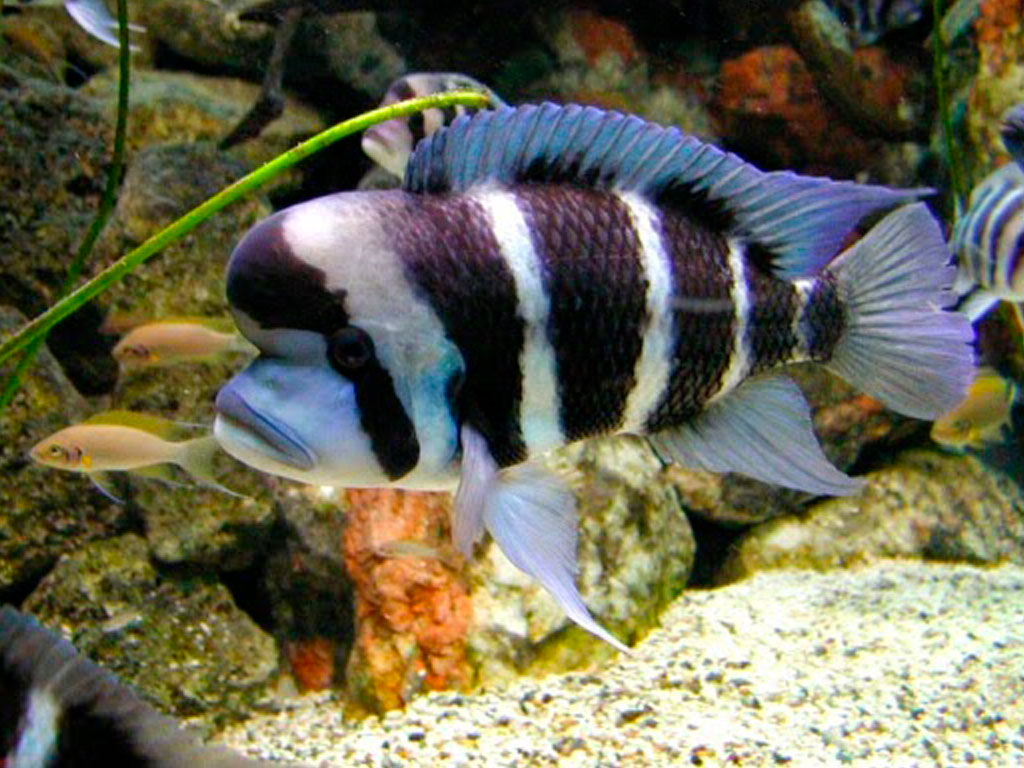
The Frontosa is unmistakable. Its body is robust and tall, white or pale blue, crossed by 5 to 7 thick vertical black or dark blue stripes. The number of stripes and the intensity of the blue color vary according to the geographical variant from which they originate (Burundi, Mpimbwe, Kigoma, etc.).
- Size: This is a large fish. Males can reach 35 cm (14 inches) in length, while females are somewhat smaller.
- The Nuchal Hump: The most iconic feature is the pronounced hump or gibbosity that adult males develop on their heads. This fatty protrusion is a sign of maturity and dominance, and can become truly massive.
- Frontosa vs. Gibberosa: It is important to know that two very similar species are currently recognized: Cyphotilapia frontosa and Cyphotilapia gibberosa. They differ subtly in head shape, scale count, and geographical distribution in the lake, but their aquarium care is practically identical.
The Calm Predator: Behavior and Social Structure
Despite being an effective predator, the Frontosa is not one of the most aggressive cichlids. Its temperament is rather calm and slow-paced. They are not tireless fighters like the Mbunas of Lake Malawi. However, they are still cichlids with a territorial character, especially among males competing for hierarchy to reproduce.
In nature, their social structure of large colonies is key. In the aquarium, replicating this is fundamental. A large group works much better than a pair or a trio, as aggression is dispersed, and they feel more secure.
Building an Abyssal Palace: The Frontosa Aquarium
To see them thrive, you must recreate the stability of their deep-water African habitat. This starts with the most critical, non-negotiable factor: choosing the correct frontosa tank size.
Why Frontosa Tank Size is Non-Negotiable
Unlike many active cichlids that dart around, Frontosas are “stationary hunters.” They are slow but steady growers, eventually reaching impressive sizes of up to 12-14 inches (30-35cm). Because they are deep-water fish, they require high water stability and plenty of horizontal swimming room.
Minimum Volume: Forget about small or “standard” setups. For a healthy group, a minimum aquarium of 500-600 liters (130-160 gallons) is the baseline.
The “Footprint” Rule: Length and width are more important than height. A 6-foot tank is generally considered the gold standard to allow for natural swimming patterns and territory definition.
Water Stability: Large volumes of water are easier to keep chemically stable—a vital requirement for these sensitive Tanganyikan natives.
Expert Tip: The “Deep Water” Aquarium to Reveal Its Secret Blue Color
Frontosas seen in stores, under white lights, appear black and white. But in their habitat, 50 meters deep, the light is very different. To see their true color, do the following:
- Forget white light: Do not use typical white LED tubes.
- Install actinic lighting: Use an actinic blue light tube, the same type used in marine aquariums. This blue light simulates the light spectrum that penetrates the depths of the lake.
- Observe the Magic: In an aquarium with actinic light, Frontosa varieties with genetic potential (like those from Mpimbwe or Burundi) will undergo a spectacular transformation. The white of their body and fins will be tinged with electric, iridescent blue tones that are simply astonishing and completely lost under white light.
A Carnivore’s Diet: Feeding
In the lake, their diet is based on fish such as Xenotilapia and Cyprichromis. In the aquarium, it is not necessary to feed them live fish. Fortunately, they adapt perfectly to a varied diet:
- Dry Food: High-quality granules and pellets for carnivorous cichlids should be the base of their diet.
- Frozen Food: They readily accept krill, mysis, pieces of white fish, mussels, and shrimp.
The Best Frontosa Tank Mates: A Quick Compatibility Guide
Choosing neighbors for the “King of Lake Tanganyika” is about balancing size and temperament. You need fish that are large enough to avoid being prey but calm enough not to stress your Frontosas.
Top-Tier Companions
These species are the “gold standard” for a Frontosa community because they share identical water chemistry (high pH/Hardness) and deep-water origins:
- Altolamprologus calvus: Famous for their unique flat bodies; they are peaceful and move at a similar slow pace.
- Synodontis multipunctatus: Also known as Cuckoo Catfish, these are active, armored, and great at cleaning up leftover food.
- Cyprichromis leptosoma: These open-water swimmers stay near the top, providing “dither” movement that makes Frontosas feel more secure.
- Large Plecos: Their tough scales and nocturnal habits make them excellent “janitors” that Frontosas generally ignore.
Selection Criteria: The “Golden Rules”
Before adding any fish to your tank, ensure they meet these three requirements:
- Size Matters: The tank mate must be at least 5–6 inches long. Frontosas are opportunistic predators; if it fits in their mouth, it’s dinner.
- Temperament Check: Avoid hyper-aggressive species (like Malawi Mbunas). Their frantic energy will cause your Frontosas to hide constantly.
- Water Parameters: Only choose fish that thrive in alkaline water (pH 8.0–9.0).
Species to Avoid
To keep your “Abyssal Palace” peaceful, steer clear of these common mistakes:
- Small Community Fish: Neon tetras, guppies, and danios will be hunted overnight.
- African Mbunas: These are too territorial and fast, often nipping at the Frontosa’s majestic fins.
- Goldfish: They require cold water and have a completely different waste profile.
Pro Tip for Success: > When introducing new frontosa tank mates, try adding them at night or rearranging the rockwork. This disrupts established territories and gives the newcomers a fair chance to find a hiding spot.
A Decades-Long Legacy: Longevity and Reproduction
The Frontosa is a long-term investment. They are extremely long-lived, potentially exceeding 25 years of life with proper care.
Their reproduction is a fascinating event. They are maternal mouthbrooders. After courtship, the female lays the eggs, the male fertilizes them, and the female quickly collects them in her mouth. She will incubate them for 3 to 4 weeks, a period during which she will not eat. The clutches are not very large (10 to 50 eggs), but the eggs themselves are huge. Upon release, the fry are already miniature replicas of their parents, fully formed and ready to eat.
The Frontosa Cichlid is not a fish for the impulsive aquarist. It is a project, a long-term commitment that rewards with the serene beauty of a deep-water ecosystem. Its majesty, complex social behavior, and the possibility of revealing its hidden blue colors make it one of the most rewarding experiences in large cichlid aquaristics. If you have the space and dedication to build its abyssal palace, the King of Tanganyika will honor you with its presence for decades.
FAQs
What is the real difference between Cyphotilapia frontosa and gibberosa?
They are two very similar species. The differences are subtle and appreciated by experts: gibberosa tends to have a higher, more vertical hump and a different geographical distribution in the south of the lake, while frontosa has a more rounded hump and inhabits the north. For practical purposes for the aquarist, their care is identical.
Does my Frontosa really need a 600-liter aquarium?
Yes. They are fish that reach 35 cm (14 inches), live in groups, and are long-lived. A smaller tank will limit their growth, cause stress, and increase aggression. It is a non-negotiable requirement for their long-term well-being.
Why doesn’t my Frontosa have a large hump on its head?
The nuchal hump is a secondary sexual characteristic of dominant, mature males. It takes years to develop fully. If your fish is young, female, or a non-dominant male in a group, its hump will be small or nonexistent.
Is it a very aggressive fish for a cichlid community tank?
Compared to other cichlids like Mbunas, it is relatively peaceful. Its aggression is contained and focuses on territorial defense and hierarchy. The problem is not so much its aggressiveness, but its predatory nature towards smaller fish.
How can I get my Frontosa to show its blue colors?
The key is lighting. Replace your standard white light with actinic or blue light (common in marine aquariums). This will simulate deep-water light and reveal blue tones in varieties that genetically possess them, such as “Mpimbwe Blue” or some Burundi variants.